


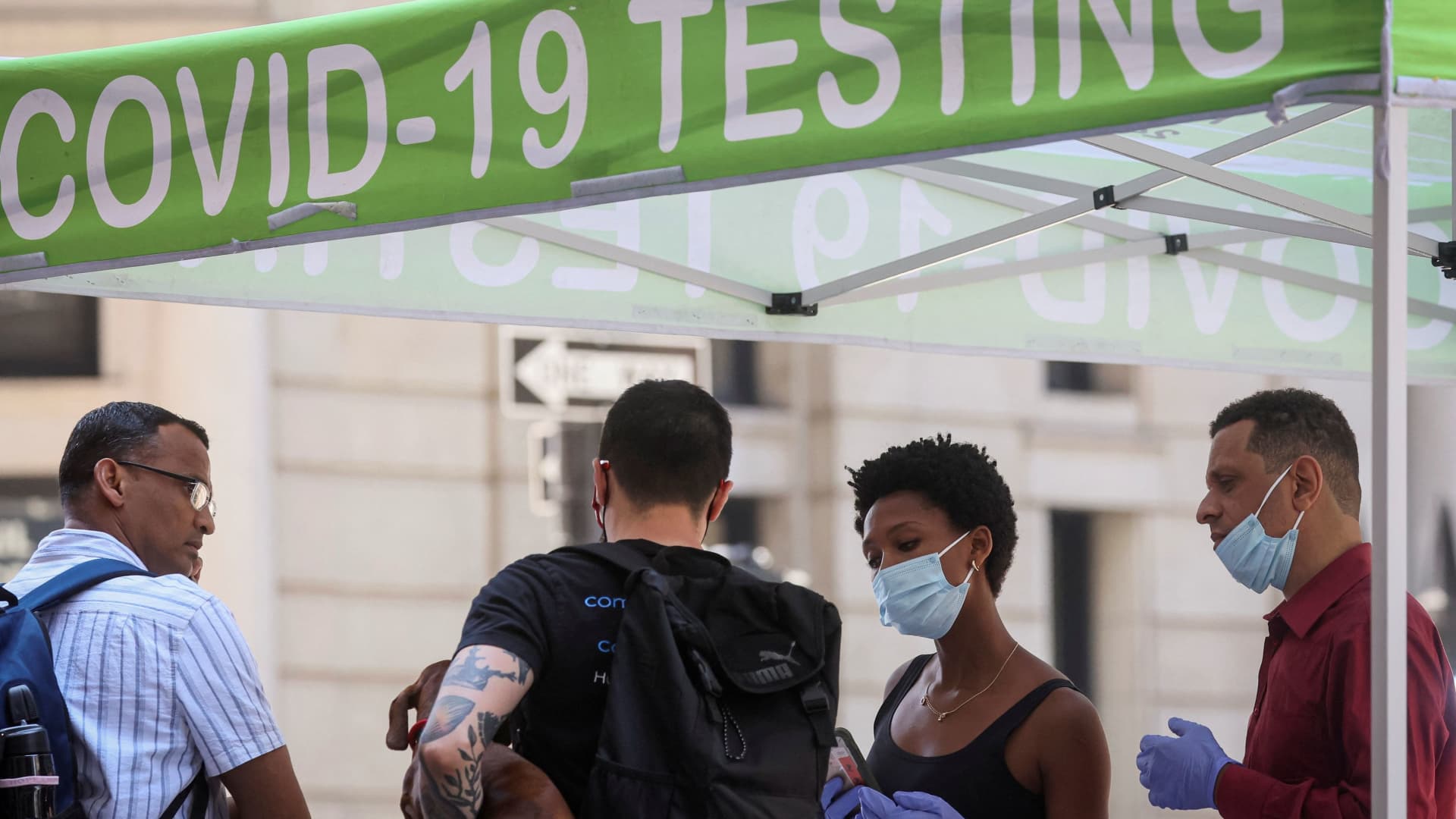
People wait to take coronavirus disease (COVID-19) tests at a pop-up testing site in New York City, July 11, 2022.
Brendan McDermid | Reuters
The most immune evasive omicron subvariants yet are now causing more than 70% of new infections in the U.S., as millions of Americans prepare to travel and gather with family for the holidays later this month.
The BQ.1 and BQ.1.1 subvariants taken together are now responsible for 68% of new cases, according to data published by the Centers for Disease Control and Prevention on Friday. The XBB subvariant is causing 4.7% of new infections.
Scientists, in several independent studies, have described the BQ and XBB subvariants as more adept at evading immunity from vaccination and infection than prior versions of the virus.
They pose a significant threat to people with compromised immune systems because key antibody treatments are resistant to them. The Food and Drug Administration last week pulled bebtelovimab, a monoclonal antibody used to prevent people who catch Covid from developing severe illness.
Bebtelovimab was used by people who cannot take other FDA-authorized treatments, such as the antiviral Paxlovid. Many people with weak immune systems, such as organ transplant patients, cannot take Paxlovid with their other medications.
The BQ and XBB subvariants are also resistant to Evusheld, an antibody cocktail that many people with compromised immune systems rely on for protection because they do not mount an adequate response to the vaccines. The FDA still authorizes Evusheld for use.
The omicron boosters also trigger a weaker immune response against the BQ and XBB subvariants than they do to the previously dominant version of the virus, according to a recent study. The shots were designed against the BA.5 subvariant, which is now causing just 11% of infections in the U.S.
Though the boosters are likely less effective against the BQ and XBB subvariants than they are against BA.5, they do still trigger an immune response. Pfizer found that the new boosters do a better job against BQ.1.1 and XBB than the original shots.
White House chief medical advisor Dr. Anthony Fauci, in a press conference last month, said the boosters will still provide protection against the more immune evasive subvariants, though not at an optimal level. Fauci said protection declines some with BQ.1.1, but drops multifold against XBB.
The shots are expected to provide better protection against hospitalization than infection and mild illness, experts say.
Covid infections and hospitalizations are rising after the Thanksgiving holiday. Cases increased nearly 50% to about 459,000 for the week ending Dec. 7, compared to 307,000 the week prior, according to CDC data. This is an undercount because the official data does not include the results of people who test at home.
Hospitalizations of people with Covid have increased about 14% week over week to more than 4,800 admissions per day on average, according to CDC data. More than 50% of those hospitalized are ages 70 and older.
CDC Director Dr. Rochelle Walensky encouraged the public to mask up this winter to help prevent the spread of respiratory illnesses, particularly people who are living in counties with high Covid levels.
The CDC is calling on everyone who is eligible to get their Covid booster and flu shot to help reduce the burden of disease this winter.


