


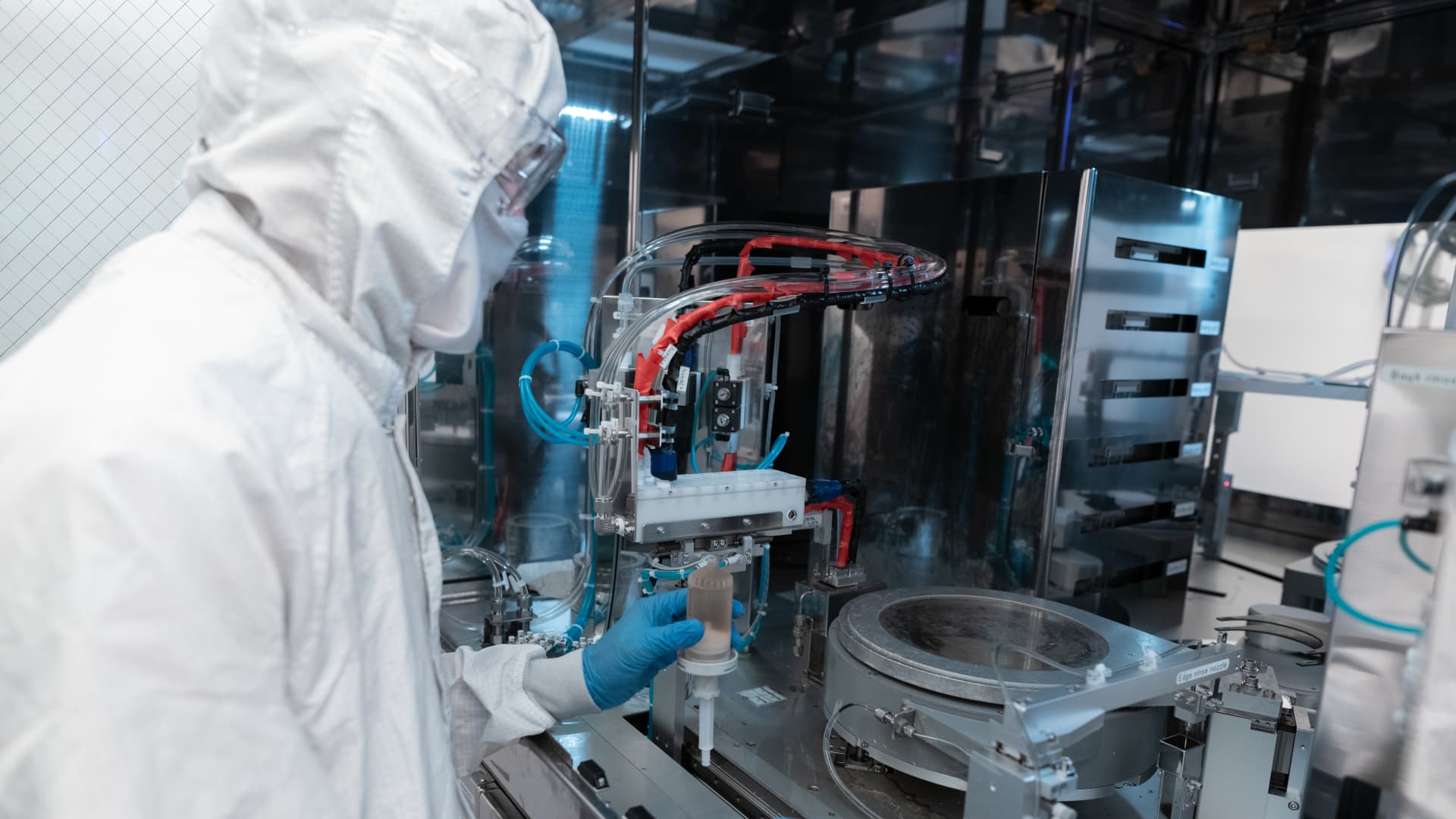
Employees working in Precision’s manufacturing facility
Courtesy: Precision Neuroscience
Neurotech startup Precision Neuroscience announced Thursday it has acquired a factory in Dallas, where it will build the key component of its brain implant, the Layer 7 Cortical Interface. The facility will help the company speed up development and move closer to the regulatory approval it is hoping to clinch in 2024.
The company has started testing its brain implant on human patients and believes it could ultimately help people with paralysis operate digital devices with their brain signals. Precision said the manufacturing plant is the only facility capable of producing its “sophisticated” electrode array.
“It allows us to iterate really quickly, improve performance, longevity, different form factors of the device — all the things that we’ve always wanted to do, we can now do in much quicker succession,” co-founder and CEO Michael Mager told CNBC in an interview.
Precision’s electrode array is thinner than a human hair and could easily be mistaken for a piece of Scotch tape. The system’s flexible design allows it to rest on the brain’s surface and generate a real-time, high resolution rendering of neural activity without damaging any tissue.
Stephanie Rider of Precision Neuroscience inspects the company’s microelectrode array
Source: Precision Neuroscience
As a member of the fast-growing brain-computer interface (BCI) industry, Precision is developing its technology alongside other companies like Synchron, Paradromics, Blackrock Neurotech and Elon Musk’s Neuralink. Precision’s co-founder and chief science officer, Dr. Benjamin Rapoport, also helped co-found Neuralink before departing the company in 2018.
Neuralink is perhaps the best-known company in the BCI space thanks to the high profile of Musk, who is the CEO of Tesla and SpaceX. The company is taking a more invasive approach with its implant than Precision. Neuralink also manufactures its technology in-house.
Mager said it can be difficult to make rapid design changes, protect trade secrets and keep supply levels up when working with third parties during the manufacturing process. He added that it’s much easier to ensure that Precision’s arrays are safe and of high quality when the company is directly involved with production.
“We manufacture systems that go on human brains. The responsibility is really tremendous,” Mager said.
At the request of the seller, a Japanese multinational corporation, Precision declined to share how much the manufacturing facility cost. Mager said the company was able to retain the 11 “key personnel” who were working there, and there’s a possibility that number will grow with time. Keeping the employees on board was a big victory for Precision, as it meant the company did not have to teach new workers how to handle the complex technology.
Employees working in Precision’s manufacturing facility
Courtesy: Precision Neuroscience
Precision has been up and running at the facility since May, and it has already made a material difference in the company’s supply levels. Mager said previously that Precision worked with a facility that took over a year to manufacture six arrays, and now, the company can manufacture more than 100 arrays in a single week.
The arrays coming from the new facility will help Precision keep up with the intense pace of regulatory testing, and it will also aid the company as it gears up for additional human trials at the University of Pennsylvania and at the Mount Sinai Health System in New York City.
“I think, ultimately, the value that we have the potential to create is a lot greater as a result of being in complete control and owning 100% of the facility that is helping to drive all this innovation,” Mager said. “But it is a longer, more capital-intensive game.”
Precision has been working closely with regulators, but the company still needs to go through several rounds of rigorous safety and efficacy testing before it will receive approval from the Food and Drug Administration to commercialize its technology.
But the FDA recently gave Precision a nod, as the company announced Thursday it has received a Breakthrough Device designation from the agency. The designation is awarded to medical devices that have the potential to provide improved treatment for debilitating or life-threatening conditions, and the FDA has granted 109 of them in fiscal 2023 so far, according to its website.
Mager said the designation will open a more frequent line of communication between Precision and the agency that will help expedite the company’s path toward commercialization. He said that with the manufacturing facility, the Breakthrough Device designation and in-patient trials in the works, Precision has the momentum it needs to move forward.
“It’s never been more exciting,” he said.


