


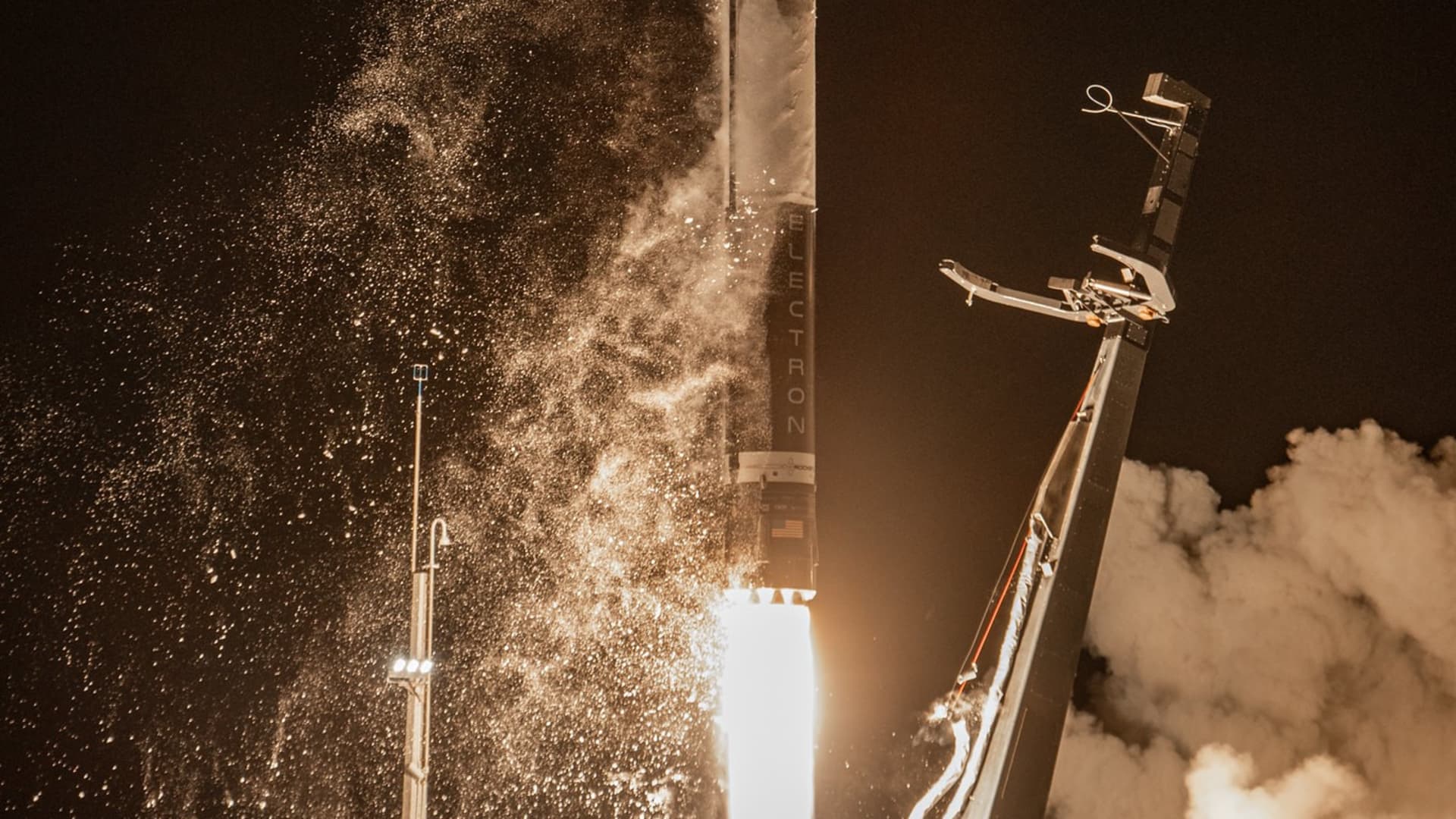
The company’s Electron rocket carrying the CAPSTONE mission lifts off from New Zealand on June 28, 2022.
Rocket Lab
Rocket Lab launched a small spacecraft bound for the moon from its New Zealand facility early Tuesday, a mission that represents firsts for both the company and the National Aeronautics and Space Administration.
The company’s Electron rocket carried a special version of its Photon satellite platform, which is carrying a 55-pound, microwave oven-sized spacecraft called CAPSTONE.
“Perfect Electron launch!” Rocket Lab CEO Peter Beck tweeted Tuesday.
CAPSTONE, an acronym for “Cislunar Autonomous Positioning System Technology Operations and Navigation Experiment,” is a low-cost mission that represents the first launch under NASA’s lunar Artemis program.
With a price tag just shy of $30 million, NASA hopes the mission will verify that a specific type of moon orbit is suitable for the lunar Gateway space station that the agency aims to launch later this decade.
Gateway’s success does not depend on this data, NASA’s Christopher Baker, executive of the small spacecraft technology program, explained to CNBC before the launch. But, he added, CAPSTONE allows the agency to ground its orbital calculations “in actual data” and give “operational experience in the near-rectilinear Halo orbit.”
Currently in orbit around the Earth, Photon will next fire its engine multiple times over the coming days, before sending the CAPSTONE spacecraft on a trajectory that will take about four months to reach the moon. Once there, CAPSTONE will stay in orbit around the moon for at least six months to collect data.
The CAPSTONE spacecraft mounted on top of the company’s lunar Photon spacecraft.
Rocket Lab
CAPSTONE also represents the first Rocket Lab mission going into “deep space” – venturing beyond the company’s typical target of low Earth orbit.
NASA turned to a small cohort of companies to make CAPSTONE happen. In addition to Rocket Lab’s Electron rocket and Photon spacecraft, Colorado-based Advanced Space developed and will operate CAPSTONE, while two California companies built the small spacecraft and provided its propulsion system – Terran Orbital and Stellar Exploration, respectively.
“Every major component here is actually coming from a company that has within the last 10 years received a small business award from the government to develop the technology that is being used for this mission,” NASA’s Baker said.
“We’re very interested in how we can support and leverage U.S. commercial capabilities to advance what is capable – and one of the things we’ve really been pushing for over the years has been how we extend the reach of small spacecraft beyond low Earth orbit to challenging new destinations,” Baker added.

