A SpaceX Falcon 9 rocket carrying the Nova-C lander for the IM-1 mission launches from pad 39A at the Kennedy Space Center at 1:05 a.m. EDT on February 15, 2024 in Cape Canaveral, Florida.
Paul Hennessy | Anadolu | Getty Images
Texas-based Intuitive Machines’ inaugural moon mission began early Thursday morning, heading toward what could be the first U.S. lunar landing in more than 50 years.
Intuitive Machines’ Nova-C lander launched from Florida on SpaceX’s Falcon 9 rocket, beginning the IM-1 mission.
“It is a profoundly humbling moment for all of us at Intuitive Machines. The opportunity to return the United States to the moon for the first time since 1972 is a feat of engineering that demands a hunger to explore,” Intuitive Machines vice president of space systems Trent Martin said during a press conference.
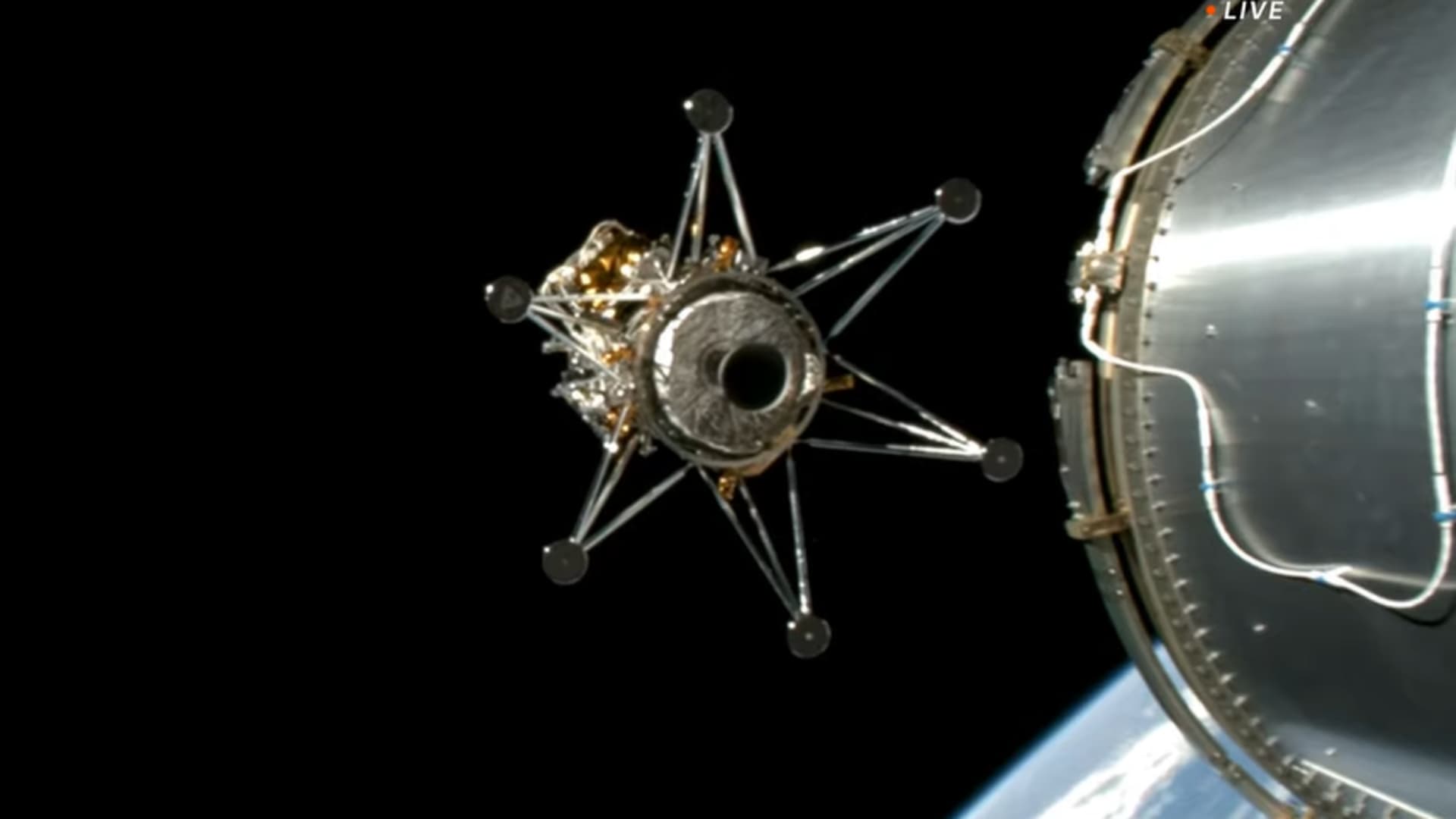
Intuitive Machines’ Nova-C lander “Odysseus” deploys from the upper stage of SpaceX’s Falcon 9 rocket to begin the IM-1 mission.
NASA TV
The IM-1 lander, named “Odysseus” after the mythological Greek hero, is carrying 12 government and commercial payloads — six of which are for NASA under an $118 million contract.
Sign up here to receive weekly editions of CNBC’s Investing in Space newsletter.
NASA leadership emphasized before the launch that “IM-1 is an Intuitive Machines’ mission, it’s not a NASA mission.” But it marks the second mission under NASA’s Commercial Lunar Payload Services (CLPS) initiative, which aims to deliver science projects and cargo to the moon with increasing regularity in support of the agency’s Artemis crew program.
The agency views CLPS missions as “a learning experience,” NASA’s deputy associate administrator for exploration in the science mission directorate, Joel Kearns, told press before the launch.
“Success of every landing is never assured,” Kearns said. “NASA is using CLPS to get our science investigations and technologies tests done on the moon surface and to develop a commercial community of robotic landing service providers for Artemis.”
Intuitive Machines outlined 16 milestones it hopes to achieve with IM-1, with landing successfully representing the final step. So far, the company confirmed IM-1 has achieved two of those milestones — launch and separation from the rocket.
The IM-1 lander is expected to spend about eight days traveling to the moon before descending to the surface on Feb. 22. The mission is targeting the “Malapert A” crater, about 300 kilometers from the moon’s south pole. After landing, Intuitive Machines aims to operate Odysseus on the surface for up to seven days.
Intuitive Machines’ stock has doubled since the beginning of the year, but at $4.98 a share at Wednesday’s close, it’s about half of the price it was when the company’s stock debuted in February 2023 on the Nasdaq after a SPAC merger.
Intuitive Machines’ Nova-C lunar lander on display at NASA’s Marshall Space Flight Center.
NASA
Last month, Japan became the fifth country to land on the moon, following Russia — then the Soviet Union — the U.S., China and India.
Governments and private companies alike have made more than 50 attempts to land on the moon with mixed success since the first attempts in the early 1960s, and the track record has remained shaky even in the modern era.
Last year, Japanese company ispace made its first attempt to land on the moon, but the spacecraft crashed in the final moments. Last month, U.S. company Astrobotic got its first moon mission off the ground but encountered problems shortly after launch. The flight was cut short and failed to make a lunar landing attempt.
Even though Astrobotic’s recent attempt didn’t succeed, Kearns said that NASA was “really happy with how open and transparent” the company was about the mission and its learnings from it.
“[Astrobotic] did a virtual meeting with all the other CLPS companies, to brief the other CLPS companies about what they found,” Kearns said.
More attempts are on the way. NASA expects U.S. companies to launch additional missions this year, while China plans to launch another lunar lander in May.