


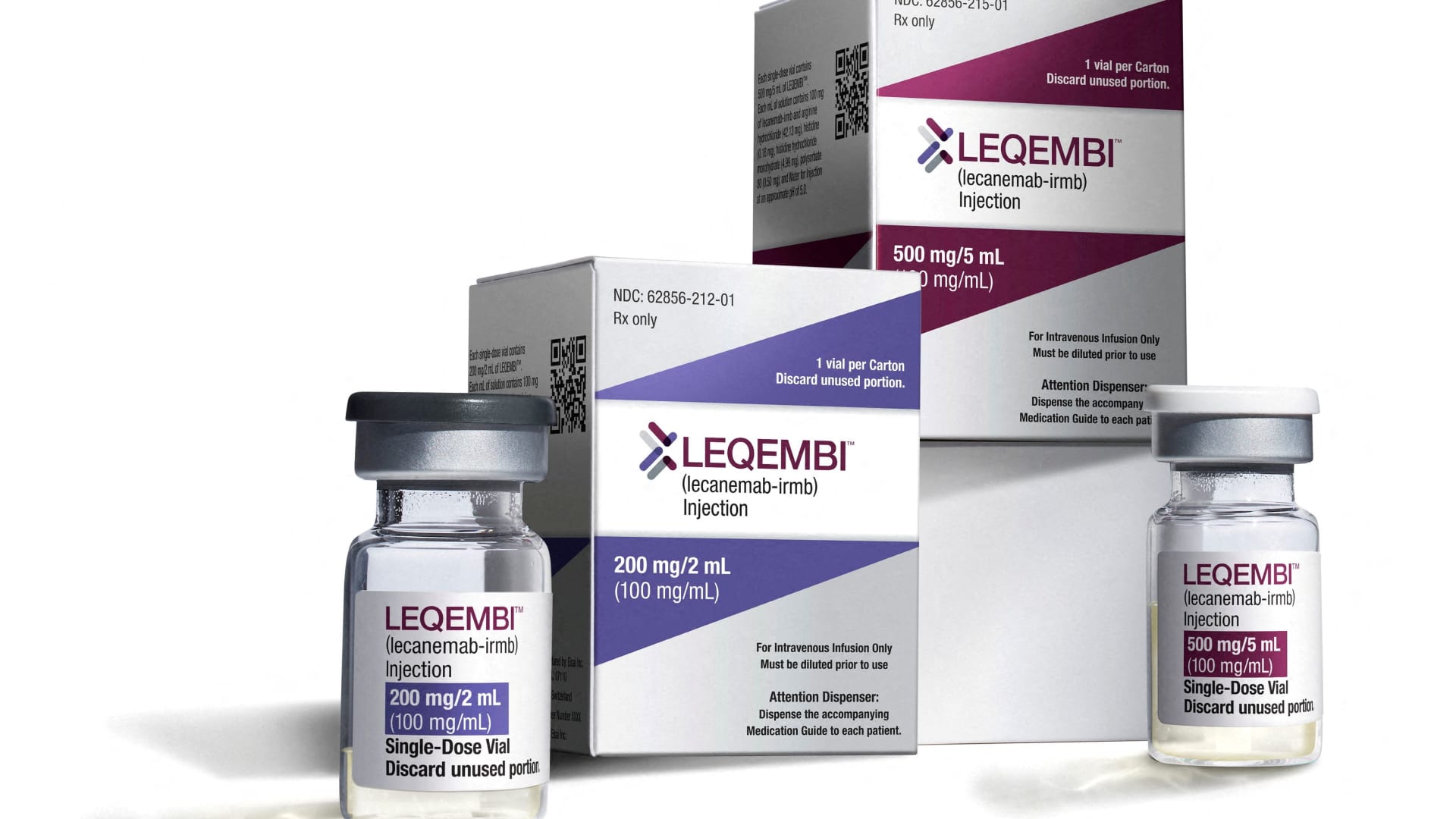
The Alzheimer’s drug Leqembi is seen in this undated handout image obtained by Reuters on January 20, 2023.
Eisai | via Reuters
Medicare has agreed to pay for the Alzheimer’s treatment Leqembi, a major turning point for patients who are diagnosed with the early stages of the disease.
Leqembi is the only drug on the market right now that has demonstrated the ability to slow the progression of early stages of Alzheimer’s disease in a clinical trial. The monoclonal antibody, administered twice monthly through intravenous means, slowed cognitive decline by 27% over 18 months in the trial.
Leqembi is made by Japanese drugmaker Eisai and its partner Biogen, which is based in Cambridge, Massachusetts.
Medicare’s decision to cover Leqembi, which came moments after the Food and Drug Administration fully approved the drug Thursday, promises to make the treatment more accessible to patients.
Medicare coverage is crucial for most patients to have any hope of being able to afford Leqembi. Eisai has priced Leqembi at $26,500 per year before insurance coverage, which is extraordinarily expensive for Medicare patients, who have a median income of about $30,000.
Medicare is picking up the majority of the bill, though many patients will still face several thousand dollars in out-of-pocket costs.
Patients with traditional Medicare will pay 20% of the bill for Leqembi, according to the federal Centers for Medicare and Medicaid Services. That means these patients could see an annual bill of more than $5,000, according to an estimate from KFF, a nonprofit group that researches health-care issues.
People with Medicare Advantage plans also typically pay 20% for drugs such as Leqembi, up to their out-of-pocket maximum, which was about $5,000 on average for in-network services, according to KFF.
Patients with supplemental insurance such as Medigap or Medicaid might pay less, according to KFF.
People of modest means might not be able to afford the out-of-pocket costs for Leqembi even with Medicare coverage, said Tricia Neuman, an expert on Medicare at KFF.
This is particularly concerning because Black and Hispanic people are at higher risk of Alzheimer’s disease but are also more likely to have lower incomes, Neuman said.
If demand for Leqembi is high, there are also concerns that patients might face long wait times to see specialists and receive infusions.
What are the coverage conditions?
Medicare has imposed certain conditions that must be fulfilled for patients to become eligible to have Leqembi covered.
Leqembi coverage requirements
- You must be enrolled in Medicare.
- You must be diagnosed with mild cognitive impairment or mild Alzheimer’s disease with evidence of amyloid plaque on the brain.
- You must have a doctor who is participating in a registry that collects information on the tests you’ve taken as part of your diagnosis, notes whether you are on blood thinners and documents whether you have had side effects from Leqembi.
To get diagnosed with Alzheimer’s or a mild cognitive impairment, patients must undergo a cognitive evaluation and have a PET scan or spinal tap to detect the amyloid protein associated with the disease. PET scans are the most common method to detect amyloid because they are less invasive.
Medicare currently covers a single PET scan per lifetime to detect amyloid. CMS is reconsidering this policy and plans to issue a proposed rule soon, an agency spokesperson said.
The requirement that doctors enter information on the patient into a registry system is controversial. The Alzheimer’s Association and some members of Congress are worried the data-collection requirement creates unnecessary red tape for patients to get treated.
The federal Centers for Medicare and Medicaid Services has set up a nationwide portal that is supposed to make it easy for doctors to enter the required information about their patients. CMS has released a video that shows doctors how to navigate the system:
Doctors can access the free-to-use registry at this website.
Dr. David Knopman, a neurologist who specializes in Alzheimer’s disease at the Mayo Clinic in Minnesota, said the registry is minimalist and unlikely to be burdensome to patients and physicians.
What are the benefits and risks?
Patients diagnosed with mild cognitive impairment or mild Alzheimer’s disease need to talk to their doctor about whether the benefits of Leqembi outweigh the risks, according to CMS.
Although Leqembi modestly slowed cognitive decline in the clinical trial, the treatment also carries serious risks of brain swelling and bleeding. In the trial, 13% of patients who received Leqembi had swelling and 14% had bleeding.
The swelling and bleeding were typically mild, without obvious symptoms, but these episodes can be fatal, according to the Food and Drug Administration’s independent review of the clinical trial data. When symptoms do present, they include headache, confusion, dizziness, vision changes and nausea.
People with two copies of a gene mutation called APOE4 are at higher risk of swelling and bleeding and patients should be tested to confirm whether they have the mutation before taking Leqembi, according to the FDA. Medicare covers testing for the APOE4 mutation, a CMS spokesperson said.
And patients on anticoagulants also appear to have a higher risk of brain bleeding, according to the FDA.
Three patients who received Leqembi in the trial died, although the FDA was unable to conclude whether these deaths were related to the treatment.
Knopman said appropriately diagnosed and informed patients should be able to decide for themselves whether they want to take Leqembi after weighing the benefits of treatment against the risks of potential serious side effects.


