


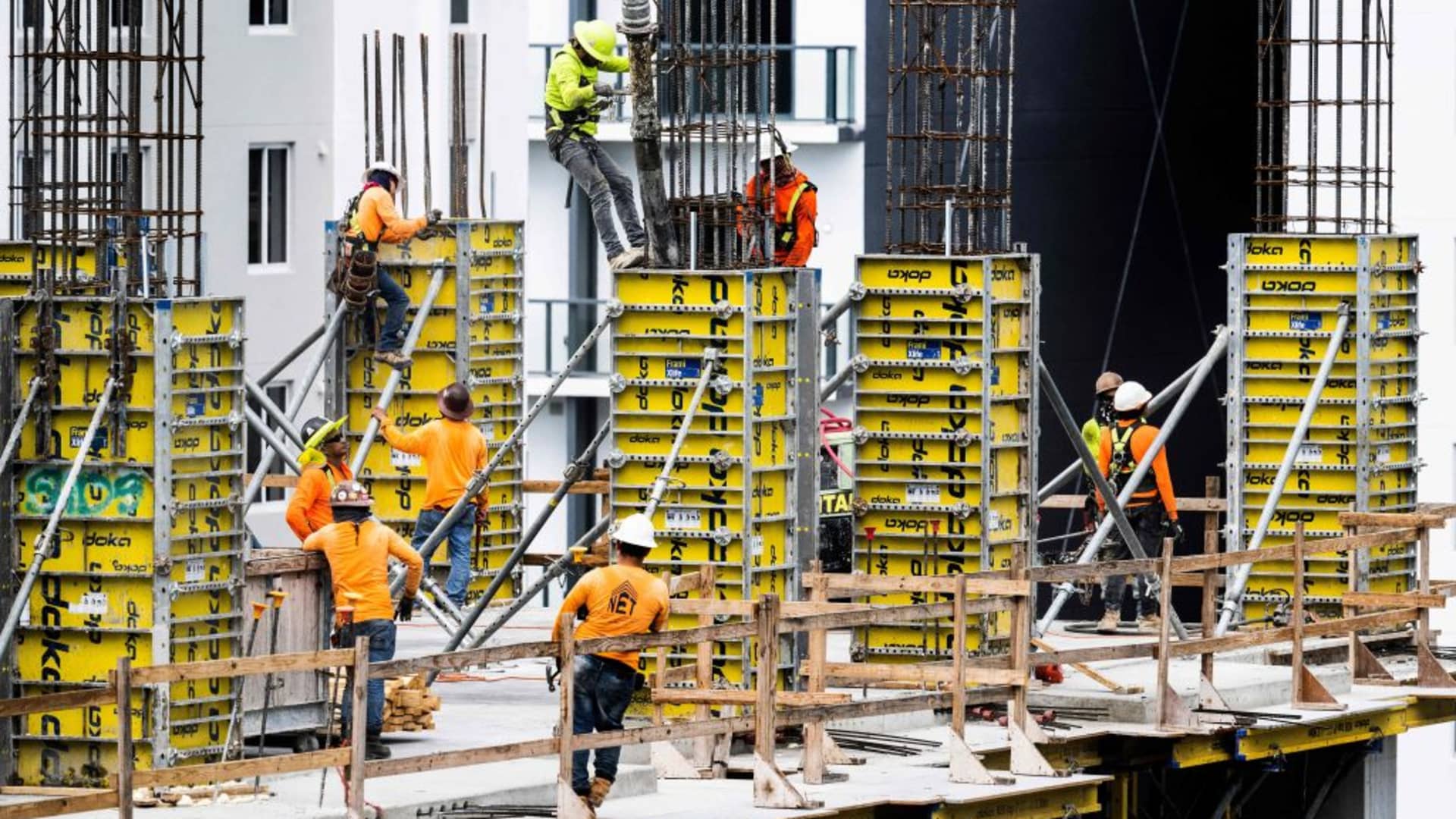
Construction workers erect a building in downtown Miami, Florida, on June 14, 2023.
Jim Watson | AFP | Getty Images
At Ample’s manufacturing facilities in the Bay Area, employees work on the floor alongside robots, making battery packs and other parts for its EV battery swapping technology.
The job is clean, high-tech and skilled – all key recruitment points as the company looks to add to its ranks in the year to come. It hopes to double its 100-person manufacturing workforce by the end of the year.
Finding people who have the training to do those jobs may prove challenging.
Ample is working with brands from Daimler to Stellantis to Uber to swap out depleted EV batteries with fully charged ones and get electric cars back on the road quickly. It expects business will get a boost as the U.S. works toward its renewable energy goals.
Ample is facing a problem that has plagued many manufacturers for years: a skilled worker shortage. The company is seeking experienced workers to handle high-voltage machinery and complex robotics. It is also filling less-skilled positions.
“I think the important thing to … wrap our head around is that as the machines are getting more sophisticated, the manufacturing is getting more automated,” Ample CEO Khaled Hassounah told CNBC. “That means we’re expecting a lot more of the people who are managing the process, the people who are actually doing the manufacturing, and that naturally means that job becomes a lot more sophisticated.”
The company is taking matters into its own hands. Ample is running apprenticeship partnerships with the City College of San Francisco, Laney College and the College of San Mateo, launched as a result of the Inflation Reduction Act.
Those training programs make the company confident it can meet its growth goals. He said some of the positions Ample is recruiting for do not require a college degree.
“We’re realizing that we can lean on community colleges to give that. You don’t have to go to college for two years just to get started. But there are classes you will take that will fundamentally increase your ability to the job really, really well, or do it safely even, or be able to be more effective,” Hassounah said.
As it ramps up hiring, Ample is bucking a slowdown in manufacturing jobs in the U.S. and around the globe. The sector added only 12,000 net jobs in 2023 for varying reasons, including automotive worker strikes last fall, according to the Bureau of Labor Statistics.
The U.S. added 23,000 jobs in manufacturing in January, but there were 601,000 open positions in the industry in December, a three-month high, according to Bureau of Labor Statistics data. This year is projected to be challenging for the sector, as the economic outlook is uncertain and companies struggle to staff adequately in a tighter job market, according to an industry outlook from consulting firm Deloitte.
Companies relying on blue collar workers in the trades face challenges in finding the right job candidates as Baby Boomers retire and younger people choose between college and the workforce. The Manufacturing Institute, an industry advocate, projected in 2021 that some 4 million jobs will need to be filled in the industry by 2030, and more than 2 million jobs could go unfilled in the sector by that time if workers don’t pursue modern manufacturing careers.
“The biggest misperception about manufacturing is what modern manufacturing really looks like, people just don’t know,” Carolyn Lee, president of the Manufacturing Institute, said. “They think that it’s antiquated or that you come in and you do one job. They don’t know that modern manufacturing today is all about technology.”
The group is broadening its recruitment efforts among workers of all demographics, backgrounds and ages, even starting to tell kids in middle schools about the opportunities in the industry.
Construction industry also faces shortage
More manufacturing jobs are likely on the way in the coming years, as funding hits from the CHIPS Act, the Inflation Reduction Act and the bipartisan infrastructure deal. But the growth will go beyond that.
Construction hiring has also picked up, as the sector added an average of 16,000 jobs per month in 2023. Manufacturing-related construction jobs have also grown over the last year. Industry watchers expect more to come.
“It’s hundreds of billions of dollars over the next four or five years,” Ben Brubeck, vice president of regulatory, labor and state affairs at trade group Associated Builders and Contractors, said of the federal funds tied to construction and manufacturing projects. “And that’s going to have a big impact on skilled labor and the shortage we’re facing right now.”
The construction industry will need to bring on an estimated 501,000 additional workers on top of the normal pace of hiring in 2024 to meet the demand for labor, according to a proprietary model developed by the trade group.
Smaller employers are likely feeling the trades hiring crunch in a more meaningful way. The National Federation of Independent Business reported quality of labor ranked among the top three concerns for small business owners in December, just behind inflation.
Thirty-three percent of all small business owners surveyed had openings for skilled labor, and the group mentioned hiring challenges were most acute in the construction and transportation sectors.
To ease the hiring issues, companies in part aim to bring on younger workers and train them to work in manufacturing and construction. It’s something even high schools are doing in unique ways.
At South San Francisco High School, a course that was designed as a traditional woodshop elective has been transformed into a two-year trades course for the construction industry.
“Really going from building a birdhouse to learning how to form walls, roofs on buildings, so it was really out of just understanding, what is it that students will need to be competitive in the work environment?” Jason Brockmeyer, director of innovation, community outreach and special projects at South San Francisco High School District, said. “And what can we do to help support them get there, we really focus on trying to ensure not just that students are prepared for college, but also career.”


