


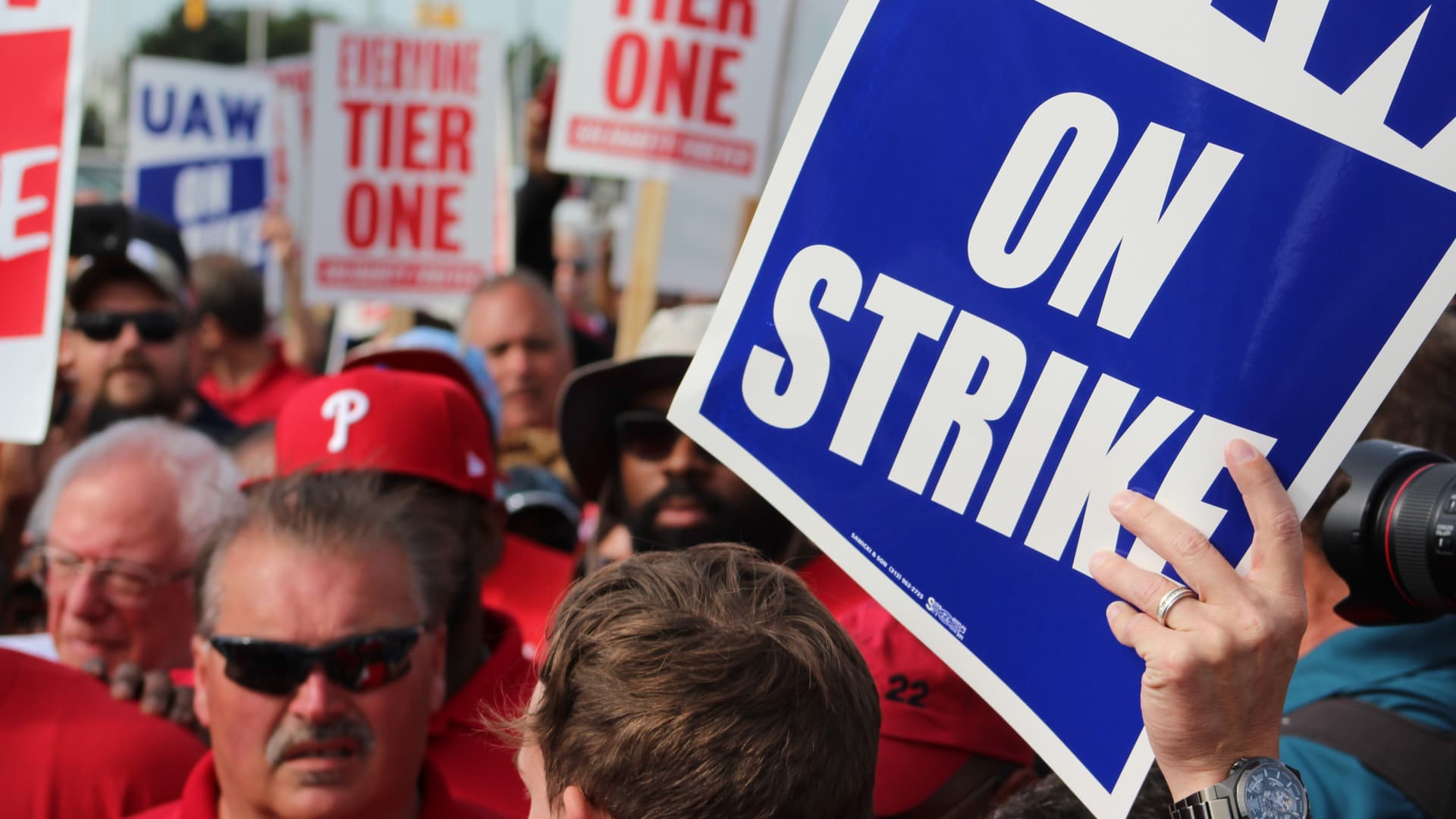
United Auto Workers members on strike picket outside General Motors’ Detroit-Hamtramck Assembly plant in Detroit with Sen. Bernie Sanders, of Vermont, far left, Sept. 25, 2019.
Michael Wayland | CNBC
DETROIT – If the United Auto Workers union decides to strike against Detroit’s Big Three automakers when current labor contracts expire next month, the economic effect would quickly tally into the billions, according to a report released Thursday.
A work stoppage by nearly 150,000 UAW workers at General Motors, Ford Motor and Stellantis would result in an economic loss of more than $5 billion after 10 days, according to Anderson Economic Group, a Michigan-based consulting firm that closely tracks such events.
AEG estimates the total economic loss by calculating potential losses to UAW workers, the manufacturers and to the auto industry more broadly if the sides cannot reach tentative agreements before the current contracts expire at 11:59 p.m. ET on Sept. 14.
“Consumer and dealer losses are typically somewhat insulated in the event of a very short strike,” said Tyler Theile, vice president at AEG. “However, with current inventories hovering around only 55 days, the industry looks different than it did during the last UAW strike.”
During the last round of bargaining in 2019, a breakdown in negotiations between the Detroit automakers and the UAW led to a national 40-day strike against GM. The automaker said the strike cost it about $3.6 billion that year in earnings.
In past negotiating periods, the UAW has selected a lead company of the Big Three and targeted initial collective bargaining efforts, including the threat of striking, there. But the new union leadership, already more aggressive than in recent history, hasn’t promised to limit such efforts to one automaker, leaving all three more vulnerable.
“This is a different year than 2019,” AEG CEO Patrick Anderson said Thursday during a webinar with the Automotive Press Association. “It’s a different environment now.”
UAW President Shawn Fain during a Facebook Live event Tuesday reaffirmed that the expirations of the contracts are deadlines, not suggestions. He said the union has no plans to extend the current contracts to allow for bargaining to continue without a strike, which was previously common practice.
Effects for the companies would vary based on their U.S. operations and employees.
GM losses would be $380 million through a 10-day strike, according to AEG. That compares to estimates of $325 million for Ford and $285 million impact on Stellantis.
AEG’s estimates do not include UAW strike pay or assessments for strike pay, unemployment benefits or unemployment taxes, income taxes on wages and other potential effects such as settlement bonuses.
The report from AEG comes a day after RBC Capital suggested the potential effect of a strike on the automakers may be “overblown.” In an investor note, analyst Tom Narayan argues GM’s “sharp snapback” after the 2019 work stoppage “suggests a similar event could be manageable.”
However, the strike four years ago was only against one automaker, not all three. A simultaneous strike would likely cause ripple effects more quickly, especially for embattled suppliers that are still attempting to recover from lower production caused by supply chain issues.


