


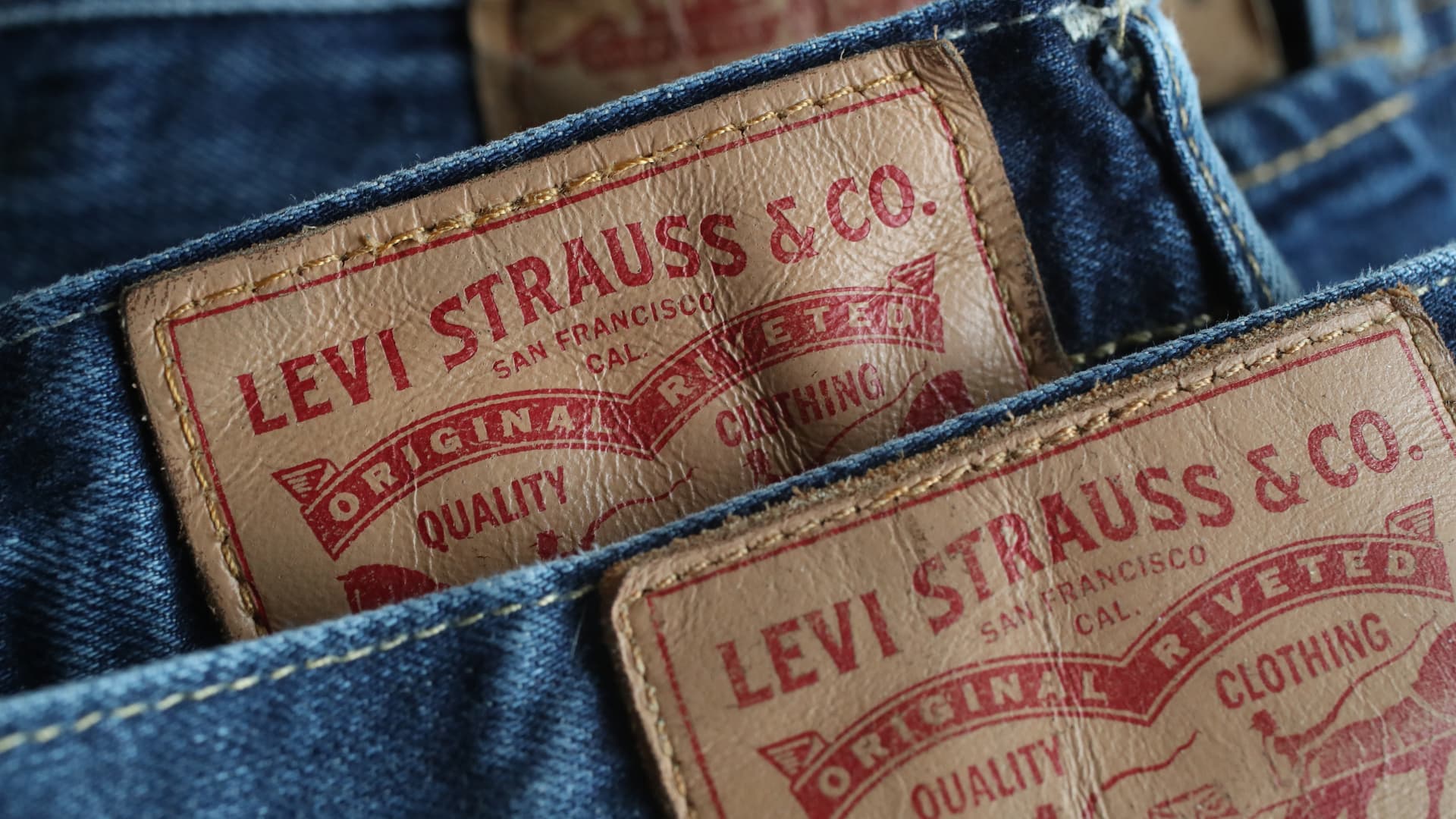
Levi’s 501 blue jeans on display.
Sean Gallup | Getty Images
Levi Strauss on Thursday cut its full-year sales forecast, as it missed Wall Street’s quarterly revenue expectations and was dragged down by weaker shopping trends at department stores and big-box retailers across the U.S.
Shares fell more than 3% in extended trading.
The company’s more cautious outlook comes just three months after it already slashed its full-year profit outlook. It said it now expects net revenues to be flat to up 1% year-over-year compared with a prior range of between 1.5% to 2.5% growth. It said it anticipates adjusted earnings per share to be on the low-end of the previously shared range of $1.10 to $1.20.
In an interview with CNBC, CEO Chip Bergh said shoppers – pinched by inflation, rising mortgage rates and gas prices – have bought fewer items from retailers that carry Levi’s apparel.
“All the things that are impacting that middle-income consumer are impacting our wholesale business,” he said.
Here’s how the denim retailer did in its fiscal third quarter compared with what Wall Street was anticipating, based on a survey of analysts by LSEG, formerly known as Refinitiv:
- Earnings per share: 28 cents, adjusted, vs. 27 cents expected
- Revenue: $1.51 billion vs. $1.54 billion expected
Net income for the three-month period that ended Aug. 27 was $10 million, or 2 cents per share, compared with $173 million, or 43 cents per share a year earlier. On an adjusted basis, earnings per share were 28 cents.
Sales were roughly in line from the $1.52 billion in revenue that the company reported in the year-ago period.
Consumers under pressure
Like other retailers, Levi — which also makes Dockers and Beyond Yoga — has coped with a tougher sales backdrop in the U.S. Levi sells its items directly on its website and in its own stores across the globe, but also sells many items through chains retailers like Macy’s, Kohl’s and Target. Those retailers, which buy wholesale items from Levi to carry on their stores and websites, have seen weaker discretionary sales.
Bergh said its value-based denim lines, Signature by Levi Strauss and Denizen, have especially been softer. In the third quarter, he said sales of those brands, which are carried by Walmart and Target, were down double digits, he said.
“Clearly, that’s an indication that that value consumer is under pressure,” he said.
For Levi, direct sales and international sales have been the stronger parts of its business. Like Nike, Levi has tried to control its own destiny by driving more of its overall sales through its own stores and website.
In the fiscal third quarter, net revenues from Levi’s direct-to-consumer business increased 14% compared with the year-ago period. E-commerce revenuer shot up by 19% year over year, as the company posted double-digit growth across all of its brands.
Direct-to-consumer drove 40% of total net revenues in the fiscal third quarter. It has pledged to get that up to 55% by fiscal 2027.
Net revenue from wholesale dropped 8% year-over-year, as sales gains in Asia and Latin American weren’t enough to offset declines in North America and Europe.
Warm weather and price cuts
Bergh said unseasonably warm weather in the U.S. and Europe likely played a role in worse wholesale trends, too.
Most of the Levi apparel that Walmart, J.C.Penney, Macy’s and others carry are jeans, he said.
“It’s hard to sell blue jeans when it’s 110 degrees outside,” he said.
At its own stores, he said, Levi can has a wider range of clothing, such as tank tops, skirts and shorts it can swap out based on customer trends — and the temperature. Plus, he said, it draws shoppers who have higher incomes and are willing to pay more for fashion-forward premium denim.
It’s hard to sell blue jeans with 110 degrees outside.
Chip Bergh
Levi Strauss CEO
“We know that $100,000 and up consumer is a little bit less impacted by what’s happening from a macro [economic] standpoint,” he said. “We’re all being affected, to be clear, but they’ve got a little bit more income to spend and the people that are coming into our stores they want to buy Levi’s.”
Levi made an unusual move in recent months: Cutting prices of about half a dozen more price-sensitive items sold by other retailers to try to jumpstart sales. Bergh said in July that Levi would lower the price of select pairs of jeans from $79.50 to $69.50. That price is still higher than its pre-pandemic price of $59.50, Bergh said.
Retailers had control over when to cut those prices, but some took effect in early August — the final month of the third quarter, Bergh said.
“As retailers have reflected price reductions to the consumer on those particular fits, the trends have improved,” he said.
He said the company is “cautiously optimistic” that as new styles debut and the holiday season approaches, customers may be more willing to open their wallets.
One factor that could help Levi this holiday season? Cleaner inventories across the retail industry, Bergh said. In the year-ago period, many retailers’ biggest holiday wish was to clear through a glut of unsold merchandise. That led to lots of deep discounts and less profitable sales.
Bergh said he expects a “slightly less promotional environment than a year ago.”
“We’re not gonna lead aggressive promotions, but we will be competitive,” he said.
Shares of Levi have fallen about 14% so far this year, underperforming the 11% gains of the S&P 500. The company’s stock closed on Thursday at $13.21, down nearly 2%.


