


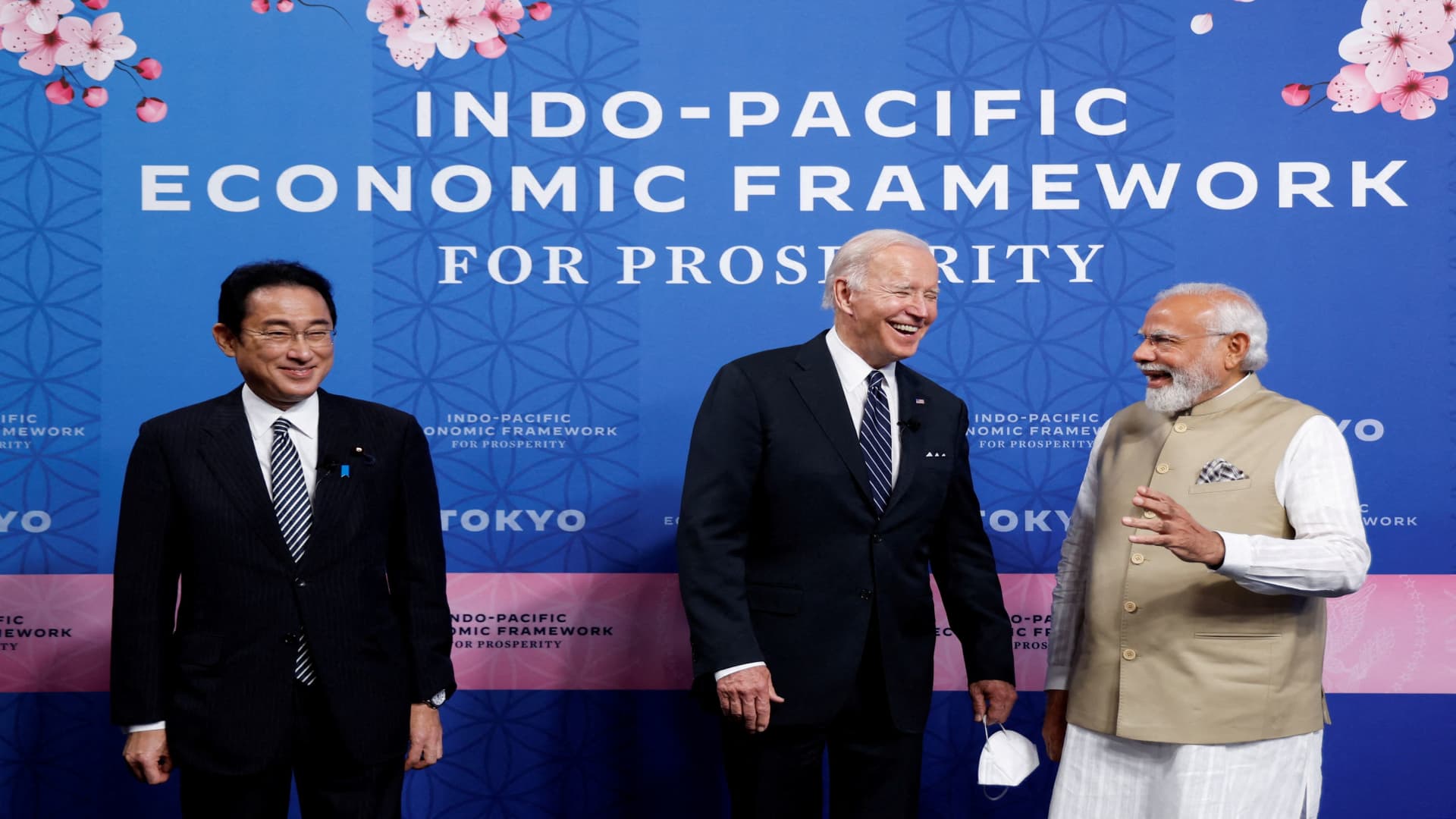
U.S. President Joe Biden, India’s Prime Minister Narendra Modi and Japan’s Prime Minister Fumio Kishida attend the Indo-Pacific Economic Framework for Prosperity (IPEF) launch event at Izumi Garden Gallery in Tokyo, Japan, May 23, 2022.
Jonathan Ernst | Reuters
Amid the fanfare of U.S. President Joe Biden’s new Indo-Pacific strategy, China flew under the radar and hosted a high-level discussion on RCEP, the world’s largest trade pact.
It came days after the Biden administration launched the Indo-Pacific Economic Framework, or IPEF — a partnership which involves 13 countries, excluding China, as the U.S. seeks to expand its political and economic leadership in the Indo-Pacific region.
The Regional Comprehensive Economic Partnership (RCEP) meeting in the southern island of Hainan underscored analysts’ expectations that instead of reacting to or countering IPEF, China will likely forge ahead with agreed-upon trade pacts and capitalize on ready-to-go tariffs and market accesses.
“China will not take immediate or very targeted measures to respond to the IPEF,” said Li Xirui, a trade scholar at the S. Rajaratnam School of International Studies at Singapore’s Nanyang Technological University.
At the second RCEP Media & Think Tank Forum, held in the Hainan capital of Haikou the weekend after IPEF was announced, non-government trade experts across the region gathered to discuss more ways to expand trade within the bloc.
China is likely to continue promoting the adoption of RCEP as this grants member states huge market access, which IPEF lacks.
Li Xirui
S. Rajaratnam School of International Studies, NTU
RCEP includes China and the 10-member ASEAN bloc, together with Australia, Japan, South Korea and New Zealand.
Led by the Hainan government, the meeting also marked another provincial effort to meet Beijing’s wider strategy of implementing RCEP since its launch at the start of this year.
“Consistent with its support of multilateralism and globalization, China is likely to continue promoting the adoption of RCEP as this grants member states huge market access, which IPEF lacks,” Li told CNBC.
She said China would likely respond to the U.S. on any of its future Asia-Pacific economic forays by expanding its economic dominance in the region and growing its trade under the RCEP.
Beijing would also focus on its applications to join other large-scale trade deals including the second-largest global trade pact, the Comprehensive and Progressive Agreement for Trans-Pacific Partnership (CPTPP) and the Digital Economy Partnership Agreement (DEPA), Li added.
China’s strategy will be in line with how it, and other states and political observers, views the IPEF — a non-trade deal and Biden’s geopolitical rather than economic tilt back into Asia Pacific, Li added.
In late May, following the IPEF’s launch, former Malaysian Prime Minister Mahathir Mohamad criticized the Indo-Pacific deal, and said it was a political move by the U.S. to isolate China.
Malaysia is one of 13 nations that joined the IPEF which did not include China.
RCEP is the only mega regional trade agreement to which China is a party, and China would likely highlight it.
Heng Wang
Herbert Smith Freehills CIBEL Centre
Trade specialist Heng Wang, who is at the Herbert Smith Freehills China International Business and Economic Law (CIBEL) Centre at the University of New South Wales, also took the view that China will continue to use market accesses it has under RCEP as they will allow it to deepen its presence in the region.
“RCEP is the only mega regional trade agreement to which China is a party, and China would likely highlight it,” Wang said.
The threat of a competing trade deal by the U.S. however remains a reality, said Henry Gao, associate professor of law at Singapore Management University.
“In case anyone doubts the U.S. vision of the IPEF as the RCEP-killer, the White House stated explicitly in the [IPEF] announcement, that: ‘Together, we represent 40% of world GDP,'” Gao said.
“Why [use] this statement when the IPEF isn’t supposed to be about market access?”
Gao pointed out the symmetry of comments made by RCEP members, especially China, who have been advertising the fact that the RCEP accounts for 30% of world GDP.”
China’s grand plans for RCEP
Meanwhile, China has already gained headways with implementing the RCEP since its launch in January, according to Li.
It laid out a blueprint for Chinese businesses on how to expand trade and find opportunities through RCEP.
Beijing laid out guidelines in six areas including trade and manufacturing, and promoted the use of the Chinese yuan for trading settlement of trading transactions. Authorities also asked businesses to pursue the use of its heavily publicized free-trade port in Hainan which was implementing an independent customs system.
Li, who has been watching China’s RCEP implementation, pointed out at least 10 provinces including Fujian and Zhejiang had laid out extensive plans to use the RCEP.
Yunnan, for example, wants to increase exports of agricultural products, while Guangxi is looking to upgrade jointly operated industrial parts in Malaysia.
The Guangxi and Fujian governments also want to build more industrial facilities in Vietnam, Malaysia and Indonesia.
Many provinces have pledged to provide a range of RCEP-related support services in the protection of intellectual property rights and trade dispute resolution mechanisms, Li said.
As for signing more trade deals to potentially counter the IPEF, China will not likely ink other bilateral or trilateral pacts in the region such as concluding the outstanding China-Japan-Korea free trade pact, Li said, citing China’s preference for “gradualism” or a slow-reform approach to trade deals.

