


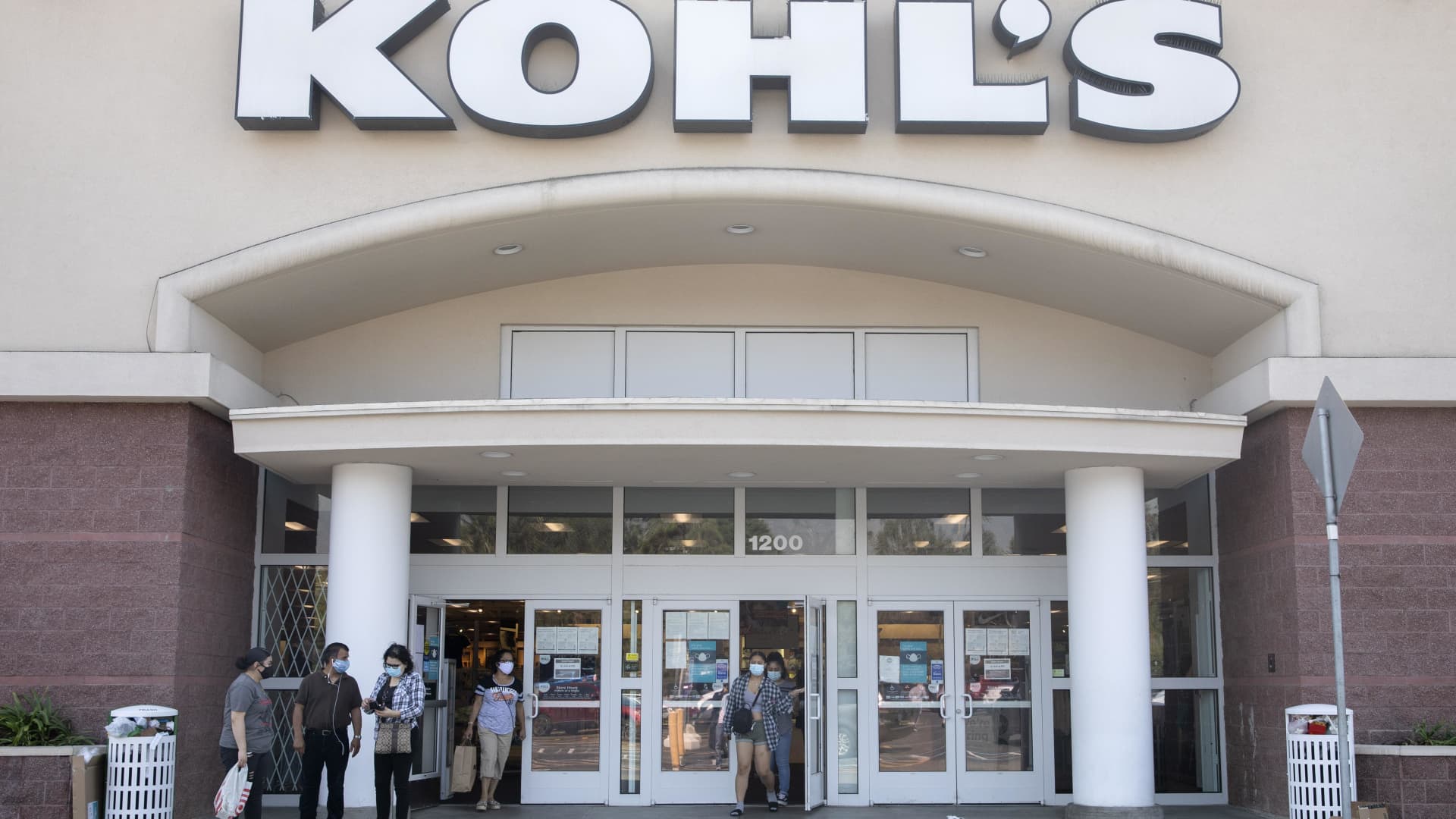
People shop at Kohl’s department store amid the coronavirus outbreak on September 5, 2020 in San Francisco, California.
Liu Guanguan | China News Service | Getty Images
Kohl’s on Wednesday posted a big, surprising loss and a sales decline of about 7% in the holiday quarter.
Its latest results come as the retailer copes with years of lagging sales, which have drawn attention from activist investors and contributed to a recent leadership shakeup.
Kohl’s also sees more lackluster sales ahead. It shared a weak outlook for the year. It said it anticipates net sales to range between a decline of 2% and a decline of 4%, including the impact of the 53rd week of the year that is worth about 1% year over year. It said it expects diluted earnings per share to range from $2.10 to $2.70, excluding nonrecurring charges.
Here’s how Kohl’s did for the quarter that ended Jan. 28 compared with what Wall Street was anticipating, based on a survey of analysts by Refinitiv:
- Loss per share: $2.49 vs. expected earnings of 98 cents a share
- Revenue: $5.78 billion vs. $5.99 billion
In the fourth quarter, the company’s net income swung dramatically to a loss of $273 million, or a loss of $2.49 per share, from net income of $299 million, or $2.20 a share.
Its same-store sales dropped 6.6% in the quarter.
A disappointing holiday
Tom Kingsbury, Kohl’s newly named CEO, attributed the retailer’s disappointing holiday results to inflation. On a call with investors, he called out Kohl’s expansion of Sephora locations in its stores as one of its successes. It plans to open the beauty shops in all of its more than 1,000 stores.
But he acknowledged Kohl’s has “lost some ground in other key categories,” he said. “Candidly, I know we can do better.”
Store sales patterns improved as the fourth quarter went on, as more Sephora shops opened in stores and Kohl’s offered more items on clearance after the holidays.
Digital sales declined 12% year over year and made up 37% of total sales.
Kingsbury asked for patience, as the retailer tries to turns its sales around while catering to middle-income consumers who have become more cautious with spending.
“The full impact of our efforts will take some time. It won’t happen overnight,” he said. “And we must acknowledge that we are implementing these changes in a challenging macroeconomic backdrop.”
Kingsbury has begun putting together his new leadership team. Earlier this week, Kohl’s announced the hire of Dave Alves, a 30-year retail veteran, as its new chief operating officer. He will step into the role in April. Last month, it named Nick Jones chief merchandising and digital officer. Jones, who will start this month, has worked with well-known U.K. retail names, including department store Marks & Spencer and fashion brand George.
He said Kohl’s wants to expand its women’s dress business, increase sales for home decor and “become a destination for gifting.”
Sales of Kohl’s private brands, which tend to be lower priced, were roughly flat in the quarter year over year, Chief Financial Officer Jill Timm said on the investor call. Sales of national brands declined by a high single-digit percentage due to weaker sales of active clothing, home goods and denim.
Accessories was its strongest business, growing by a mid single-digit percentage versus last year. Men’s and women’s apparel outperformed the company average. The home, footwear and children’s departments underperformed the company average.
Missing out on pandemic gains
Kohl’s is not the only retailer that has felt a pullback as consumers spend more on food, housing and other necessities. Walmart, Target and Macy’s have also cited inflationary pressures. Yet Kohl’s has missed out on the significant sales gains of the early years of the Covid pandemic, a time when consumers had extra dollars from stimulus checks and were largely spending on goods instead of services.
Overall retail spending has grown by 28.4% compared with 2019, according to an analysis by research firm GlobalData. During that same three-year period, spending at Kohl’s fell by 15.4% and profit at the company plummeted by 203%.
As Kohl’s performance lagged, it became a target for activist investors. It’s recently had leadership changes, too.
Then-CEO Michelle Gass announced in November that she was leaving to become president and CEO-in-training at Levi Strauss & Co. Her departure came after Ancora Holdings and Macellum Advisors questioned Kohl’s turnaround strategy, pushed for improvement to its sales trends and called for new leadership.
Pressure from those investors gained momentum after Kohl’s ended talks over the summer to sell to the Franchise Group, owner of The Vitamin Shoppe.
Kohl’s announced last month that Kingsbury, who served as interim CEO, would step into the position permanently. He is the former CEO of Burlington Stores. It said at the time that it had reached a cooperative agreement with Macellum Advisors, as it named Kingsbury to the role.
The retailer had declined to provide a holiday-quarter outlook and pulled its full-year guidance in November, saying inflation had hurt consumer spending and made future sales patterns hard to predict.
Along with other retailers, Kohl’s has also struggled with a glut of unsold inventory as shoppers bought less of categories like home goods and activewear that had been popular during the pandemic. That’s forced companies to turn to more markdowns.
Kohl’s inventory remains elevated, up 4% year over year as of the end of the fourth quarter, the company said.
As of Tuesday’s close, Kohl’s stock is up about 11% this year, outperforming the approximately 3% gain of the S&P 500. Its shares closed at $28.04, bringing the company’s market value to nearly $3.1 billion.


