


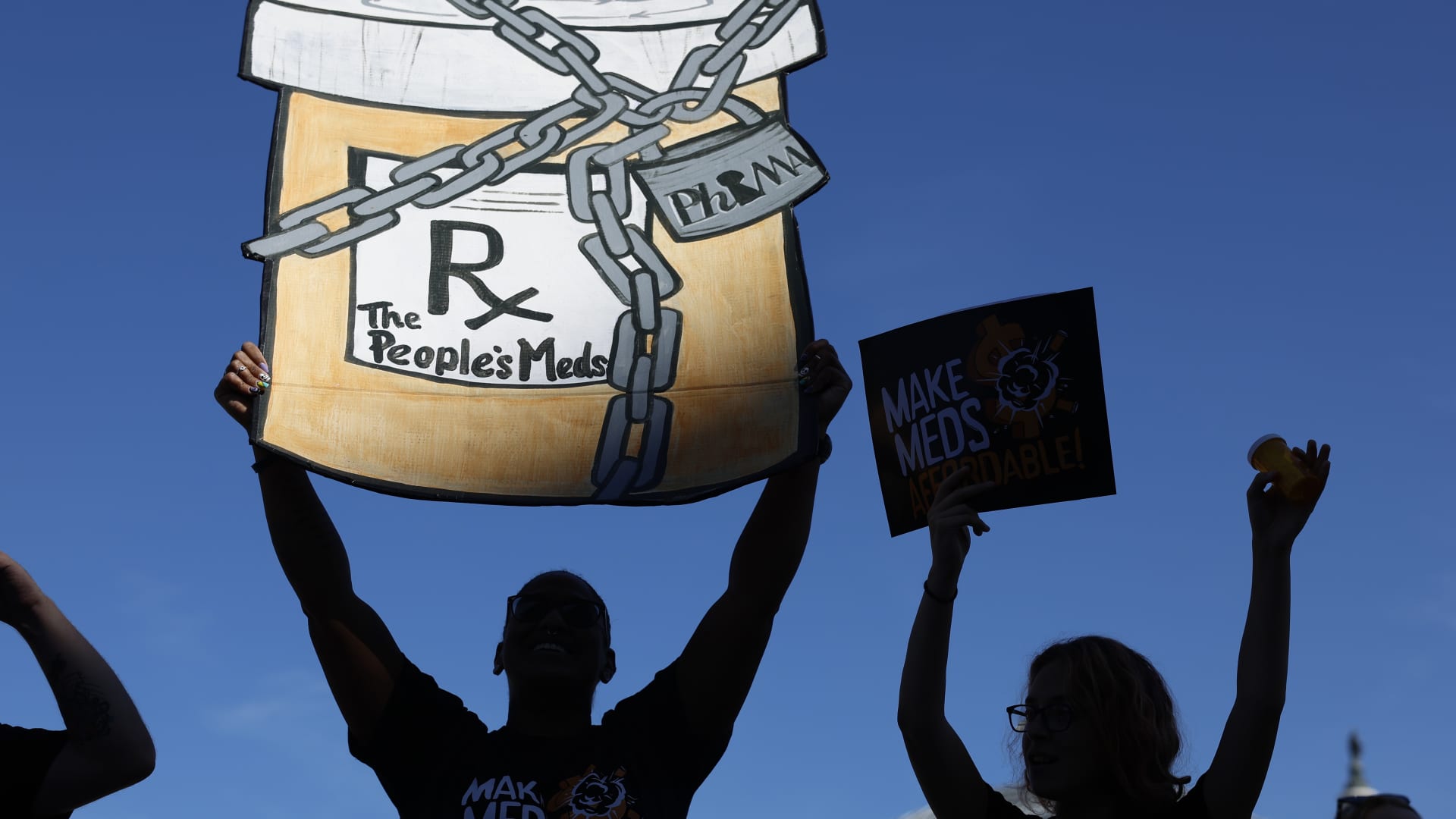
Activists protest the price of prescription drug costs in front of the U.S. Department of Health and Human Services building in Washington, D.C., on Oct. 6, 2022.
Anna Moneymaker | Getty Images
A federal judge on Friday rejected AstraZeneca‘s legal challenge to Medicare’s new power to negotiate the prices of certain costly prescription drugs with manufacturers.
The decision is another win for the Biden administration in a bitter legal fight with the pharmaceutical industry over the constitutionality of those price talks. The negotiations are a key policy under the Inflation Reduction Act that aims to make medicines more affordable for seniors and could take a bite out of the pharmaceutical industry’s profits.
The legal wrangling over the policy is far from over. Manufacturers have said they intend to escalate the issue to the Supreme Court.
The judge’s decision came one day before a crucial deadline in the process.
Manufacturers of the first 10 drugs selected for negotiations have until Saturday to respond to Medicare’s initial price offer for their treatments. Those drugs include AstraZeneca’s Farxiga, which is used to treat Type 2 diabetes, chronic kidney disease and heart failure.
Final negotiated prices for the first round of drugs will go into effect in 2026.
In a 47-page opinion, U.S. District Judge Colm Connolly of the District of Delaware said AstraZeneca has not identified a property protected by the constitution that will be jeopardized by the price talks.
He wrote that AstraZeneca’s participation in the Medicare market is voluntary, so the company’s “desire” or even “expectation” to sell its drugs to the government “at the higher prices it once enjoyed does not create a protected property interest.”
The opportunity to sell drugs to more than 49 million Medicare and Medicaid beneficiaries is a “powerful incentive” for manufacturers to participate in the price talks with the government, Connolly wrote. But he said that incentive is not “a gun to the head” like AstraZeneca contends in its suit.
“It is a potential economic opportunity that AstraZeneca is free to accept or reject,” Connolly wrote.
In a statement, AstraZeneca said it is “disappointed with the court’s decision and the potential negative impact it will have on patients’ access to future life-saving medicines.” The company said it is evaluating its path forward.
AstraZeneca’s lawsuit claimed that the talks would force it to sell medicines at huge discounts, below market rates. The company asserted that this violates due process under the Fifth Amendment, which requires the government to pay reasonable compensation for private property taken for public use.
The judge’s decision is another blow to the pharmaceutical industry, which has filed a flurry of lawsuits claiming that the negotiations are unconstitutional.
The ruling comes a month after a federal judge in Texas tossed a separate lawsuit challenging the price talks.
A federal judge in Ohio also issued a ruling in September denying a preliminary injunction sought by the Chamber of Commerce, one of the largest lobbying groups in the country, which aimed to block the price talks before Oct. 1.
But many of the other cases are still pending. On March 7, Bristol Myers Squibb, Novo Nordisk, Novartis and Johnson & Johnson will present their oral arguments to a federal judge in New Jersey in the same hearing.
Don’t miss these stories from CNBC PRO:


