




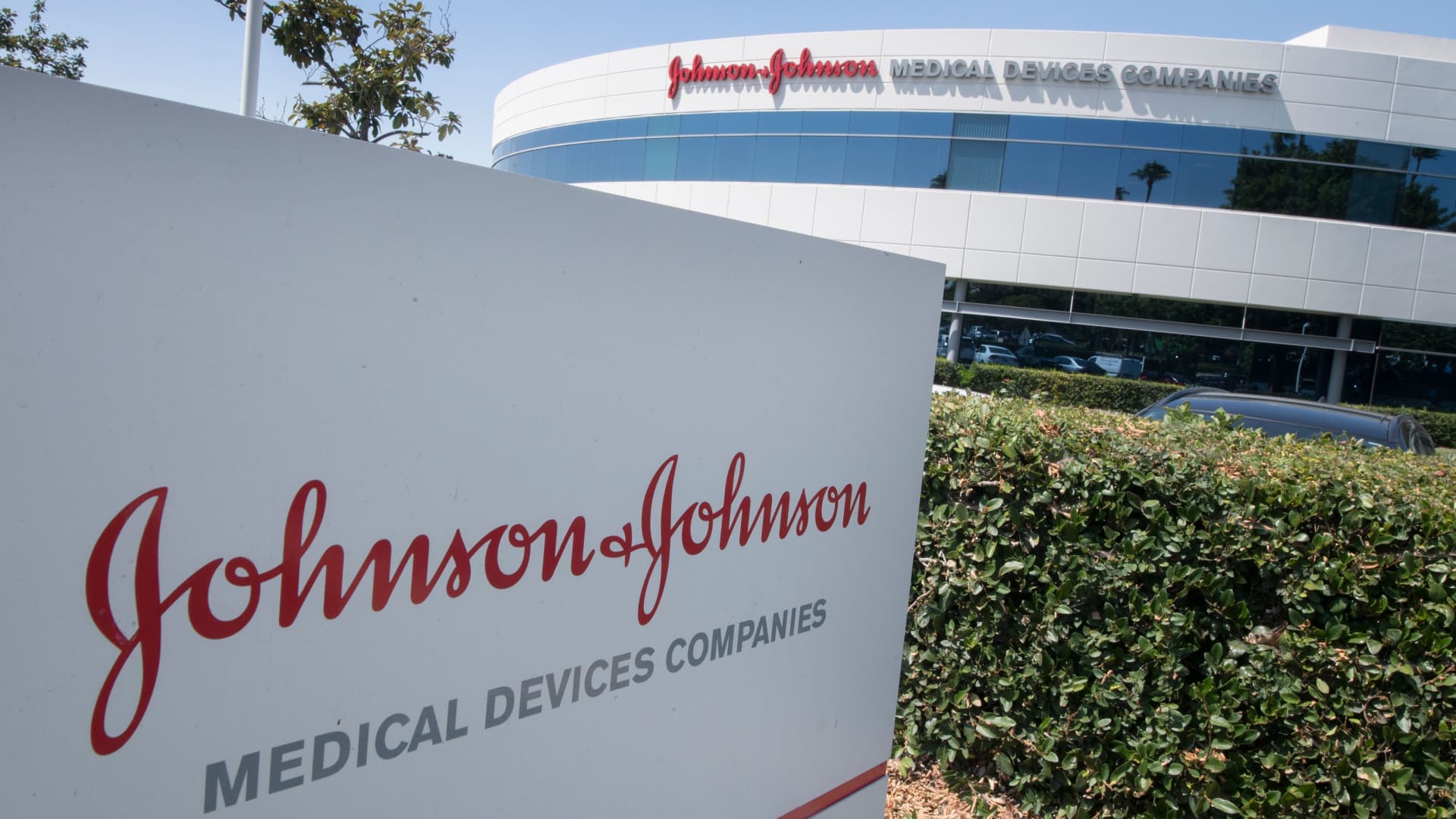
An entry sign to the Johnson & Johnson campus shows their logo in Irvine, California on August 28, 2019.
Mark Ralston | AFP | Getty Images
Johnson & Johnson on Tuesday reported first-quarter adjusted earnings that topped Wall Street’s expectations as sales in its medical devices business surged.
Meanwhile, the company’s total revenue for the period was largely in line with estimates.
J&J’s medtech division provides devices for surgeries, orthopedics and vision. The company is benefiting from a rebound in demand for nonurgent surgeries among older adults, who deferred those procedures during the Covid pandemic. That increased demand has been observed by health insurers like Humana, UnitedHealth Group and Elevance Health.
Here’s what J&J reported for the first quarter compared with what Wall Street was expecting, based on a survey of analysts by LSEG:
- Earnings per share: $2.71 adjusted vs. $2.64 expected
- Revenue: $21.38 billion vs. $21.4 billion expected
J&J’s financial results are considered a bellwether for the broader health sector.
The company reported $21.38 billion in total sales for the first three months of 2024, up more than 2% from the same quarter in 2023.
The pharmaceutical giant booked net income of $5.35 billion, or $2.20 per share during the quarter. That compares with a net loss of $491 million, or 19 cents per share, for the year-earlier period. At the time, J&J recorded costs tied to its talc baby powder liabilities and the spinoff of its consumer health unit Kenvue.
Excluding certain items for the first quarter of 2024, adjusted earnings per share were $2.71.
J&J also narrowed its full-year guidance for the year. The company now expects sales of $88 billion to $88.4 billion. That compares to a previous forecast of $87.8 billion to $88.6 billion.
J&J expects adjusted earnings of $10.57 to $10.72 per share. That compares to a previous guidance of $10.55 to $10.75 per share.
Separately on Tuesday, J&J said it will increase its quarterly dividend to $1.24 per share, up 4.2% from $1.19 per share. That marks the company’s 62nd year of consecutive dividend increases, it said. The dividend is payable on June 4.
Medical device unit
The results come weeks after J&J’s whopping $13.1 billion acquisition of heart device firm Shockwave Medical — part of its push into the cardiovascular space. Both companies have said the deal will make J&J a leader in four quickly growing cardiovascular technology categories.
J&J has scooped up two other heart device companies over the last two years, spending $16.6 billion to buy Abiomed and $400 million to acquire private company Laminar.
Those deals also aim to strengthen J&J’s medical devices business following the company’s separation from its consumer health unit Kenvue last year.
J&J’s medical devices business generated sales of $7.82 billion during the first quarter, up more than 4% year over year. Wall Street was expecting revenue of $7.87 billion, according to estimates compiled by StreetAccount.
J&J said its acquisition of Abiomed fueled the year-over-year rise. The growth also came from electrophysiological products, which evaluate the heart’s electrical system and help doctors understand the cause of abnormal heart rhythms, according to J&J.
Wound closure products and devices for orthopedic trauma, or serious injuries of the skeletal or muscular system, contributed, along with contact lenses.
Other segments
Meanwhile, J&J reported $13.56 billion in pharmaceutical sales, marking around 1% year-over-year growth. Excluding sales of its unpopular Covid vaccine, revenue in the pharmaceutical division grew almost 7%.
It was the fourth quarter without any U.S. sales from J&J’s Covid vaccine, which brought in $25 million in international revenue.
Analysts were expecting sales of $13.5 billion for the business segment, according to StreetAccount. The business, also known as “Innovative Medicine,” is focused on developing drugs across different disease areas.
The company said the growth was driven by sales of Darzalex, a biologic for the treatment of multiple myeloma, and Erleada, a prostate cancer treatment. J&J’s Carvykti, a cell therapy approved for a certain blood cancer, and other oncology treatments also contributed to the rise.
But first-quarter sales of the company’s blockbuster drug Stelara, which is used to treat several chronic and potentially disabling conditions such as Crohn’s disease, were relatively flat from the same period a year ago.
Stelara brought in $2.45 billion in sales for the quarter. Wall Street was expecting revenue of $2.61 billion.
J&J began to lose patent protections on Stelara late last year, which opened up the door for cheaper biosimilar competitors to enter the market. But the company has signed settlement agreements with Amgen and other drugmakers to delay the launch of some Stelara copycats to 2025.
Talc liabilities
J&J’s first-quarter results come amid investor anxiety over the tens of thousands of lawsuits claiming that the company’s talc-based products were contaminated with the carcinogen asbestos and caused ovarian cancer and several deaths.
Those products, which include J&J’s namesake baby powder, now fall under Kenvue. But J&J will assume all talc-related liabilities that arise in the U.S. and Canada.
In January, J&J said it has reached a tentative settlement to resolve an investigation by more than 40 states into claims the company misled patients about the safety of its talc-based products. The company will pay $700 million to settle the probe, its CFO Joseph Wolk told The Wall Street Journal at the time.
Last year, J&J set aside about $400 million to resolve U.S. state consumer protection claims.
Notably, the settlement does not resolve the lawsuits, some of which are slated to go to trial this year.
J&J will hold an earnings call with investors at 8:30 a.m. ET on Tuesday.


