


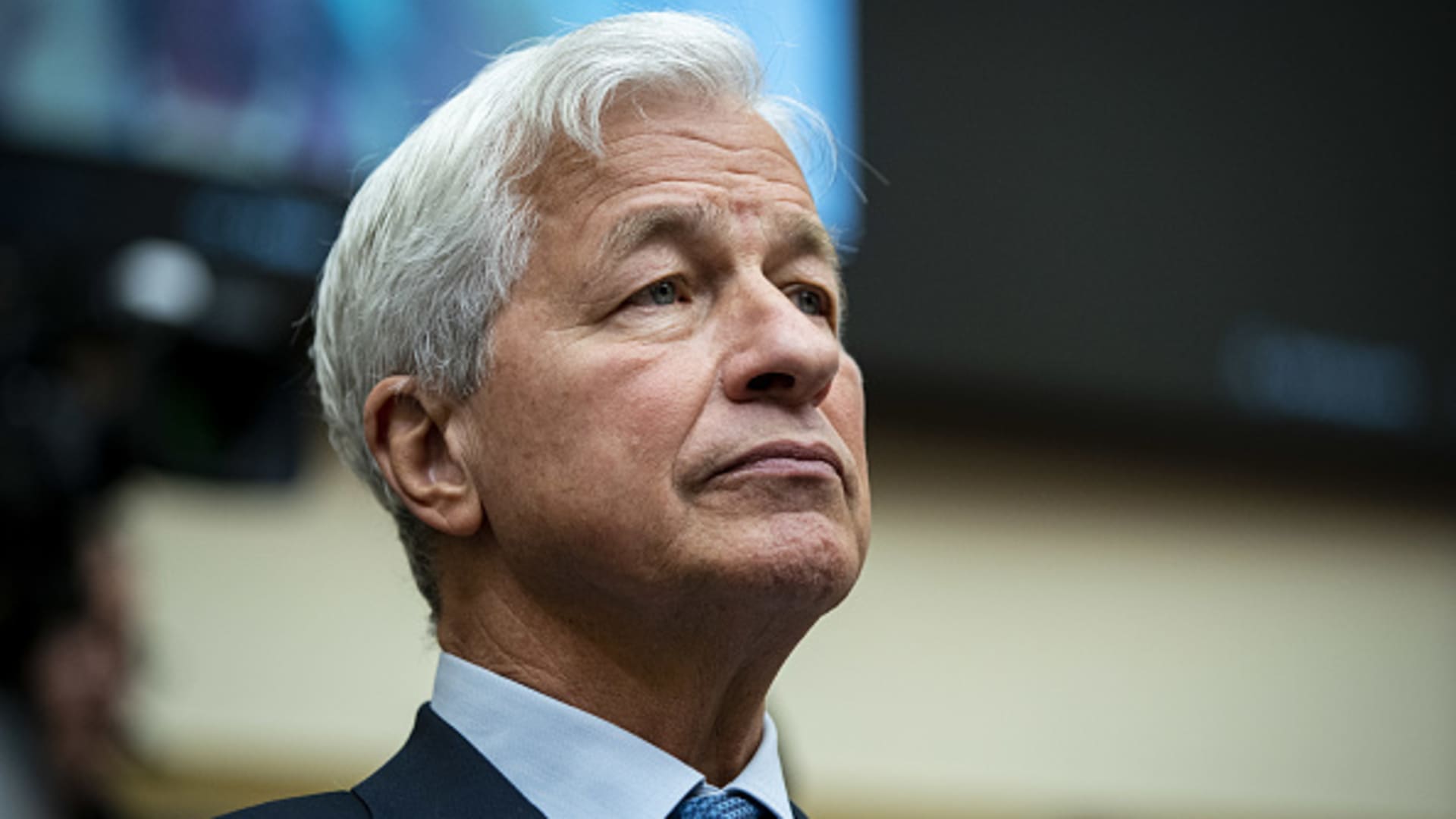
Jamie Dimon, chairman and chief executive officer of JPMorgan Chase & Co. says the new U.K. government should be “given the benefit of the doubt.”
Al Drago | Bloomberg | Getty Images
For the first time in nearly two decades running JPMorgan Chase, CEO Jamie Dimon will voluntarily sell stock in the bank.
The disclosure, in a securities filing Friday, detailed next year’s planned sales — pressuring JPMorgan (JPM) shares and the Dow Jones Industrial Average and highlighting why tracking trades made by executives involving the companies they lead should be an important part of every investor’s homework.
Dimon is setting up the trades through a predetermined plan that executives at publicly traded companies use to protect against insider trading accusations. It will mark the first time that the 67-year-old CEO has offloaded shares of JPMorgan for non-technical reasons, such as exercising options.
The planned sales – amounting to roughly 12% of the JPMorgan stock owned by Dimon and his family – are being done for tax planning and personal wealth diversification reasons, the bank said. Both are common reasons for executives to sell stock in their firms. The bank also said Dimon continues to believe JPMorgan’s prospects are “very strong,” and his planned trades are not related in any way to succession. Such sales are often seen when CEOs get close to retirement.
As you can see, making sense of insider transactions can sometimes be a tall task.
When they buy, it’s generally seen as an encouraging sign by Wall Street — and there is, perhaps, no better example of this than another move by Dimon in 2016, when he purchased JPMorgan stock.
Fears of a weakening global economy sent stocks into a tailspin in early 2016, driving shares of JPMorgan down nearly 20% and the S&P 500 down more than 10% at their lows.
But that weakness didn’t last long.
The trajectory of the market changed just six weeks into the new year. That’s when Dimon disclosed — after the closing bell on Feb. 11, 2016 — that he bought 500,000 shares of the bank, worth about $26 million at the time.
Dimon’s stock purchase, intended to show confidence in the financial sector, has become legendary on Wall Street. It ultimately coincided with — or perhaps was the reason for — the closing lows for not only shares of JPMorgan in 2016 but also the S&P 500 overall.
Jim Cramer has since dubbed Feb. 11, 2016: “The Jamie Dimon Bottom.” JPMorgan finished up 30% that year, while the S&P 500 ended more than 9% higher — both huge turnarounds.
While executive stock sales — such as Dimon’s planned transactions next year — are not universally red flags, they can get complicated.


