


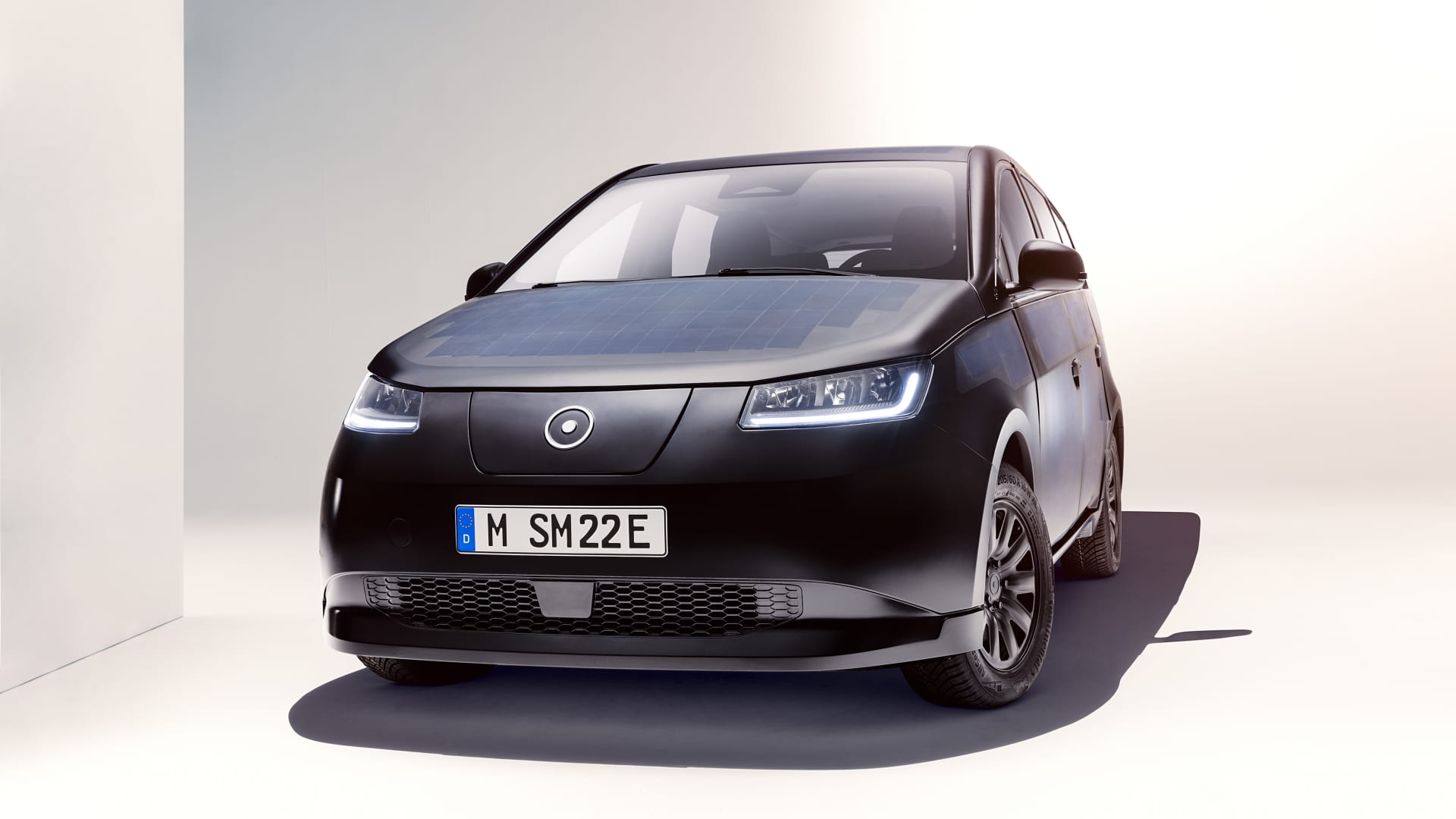
Germany company Sono Motors says it will bring a solar-powered electric vehicle to market in Europe in mid-2023. Sono has brought the car, called the Sion, on a tour throughout the U.S., in anticipation of its eventual domestic release.
Priced at $25,000, the car is more affordable than most EVs on the U.S. market. It features 465 integrated solar half-cells throughout the exterior of the car — roof, doors, fenders, hood and all. The company estimates that solar power alone can fuel about 70 miles of driving per week.
For longer trips though, the Sion has a lithium iron phosphate battery with a 190-mile range, made by Chinese electric vehicle and battery giant BYD.
Sono is contracting with Finnish company Valmet Automotive to produce the Sion, and the company says there are already 42,000 reservations for the car in Europe. The goal is to produce 257,000 Sions by 2030.
CEO Laurin Hahn says that contract manufacturing is the first thing that allows the company to keep costs down.
“Second is we have just one variant. This car comes in any color you like as long as it’s black. So basically there’s no options. That’s massive in saving costs. Third, is we do online direct sells. Fourth is we have no steel stamping. It’s an aluminum space frame, very safe car. And fifth is it has no paint. There is no paint job because it has solar panels on the outside. And for those five things, we can be so affordable.”
Sono uses a polymer-based solar technology that it developed.
“We have several patents, over 30 patents on that,” said Hahn. “And it’s a big difference because all other companies who try to integrate solar are using most mostly glass. Glass is heavy, slow in production and very cost expensive.”
An app on the car’s dashboard that gives drivers real-time information about how much solar power the car is generating at any moment. Drivers can also control power-sharing via the app, using the Sion’s battery to charge other electric devices, including EVs, at a price point of the owner’s choosing.
While there are no mass-market solar electric vehicles available today, Hahn believes this technology will take off soon.
“We think it has the potential to become a mainstream technology. Our mission is solar on every vehicle because there is no point of not putting it on it. It is very cost-effective. It doesn’t add a lot of costs onto the bill of material for the car. So there’s actually no reason why not to integrate it.”


