


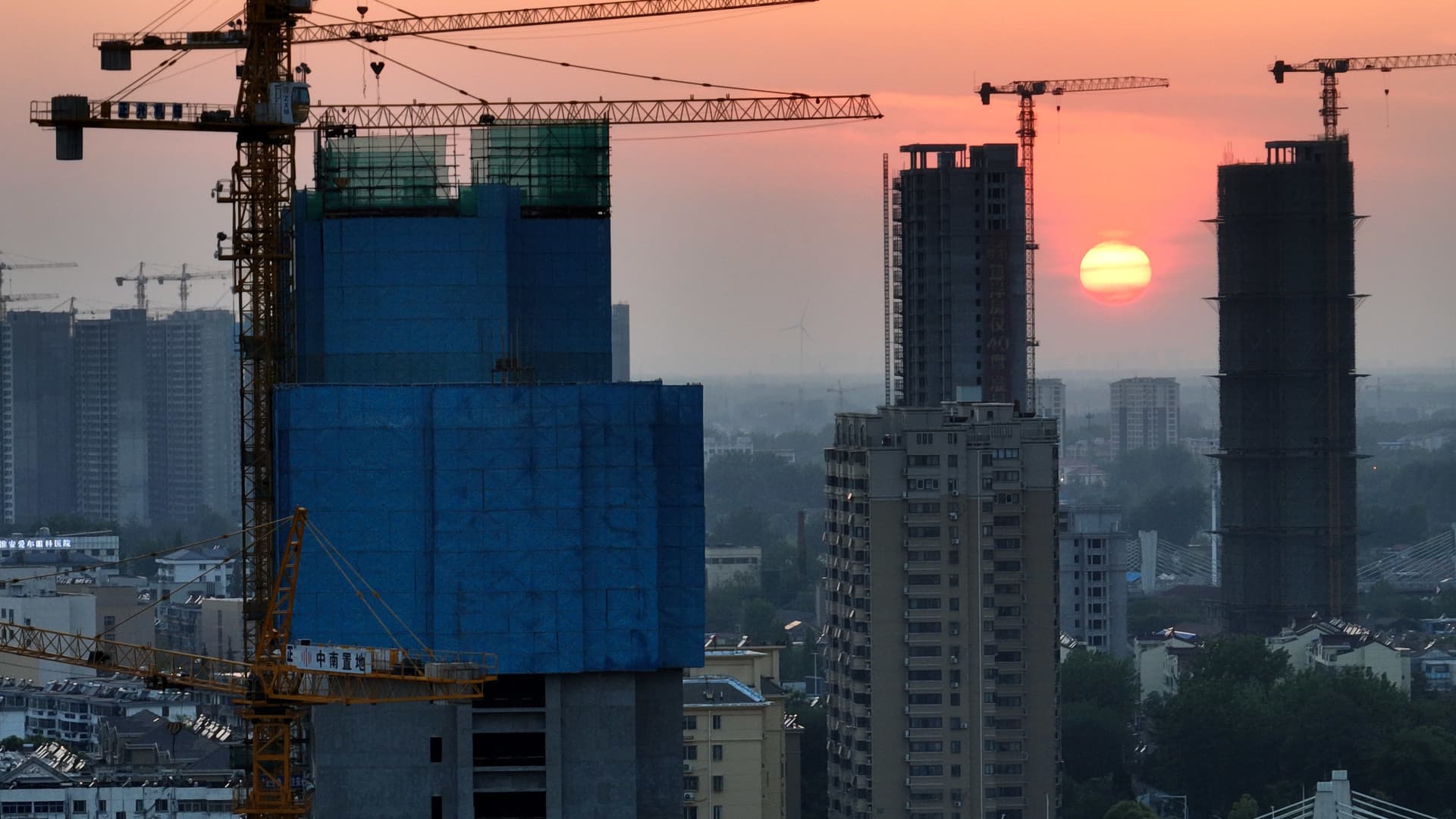
Real estate and related industries account for more than a quarter of China’s economy, according to Moody’s estimates.
CFOTO | Future Publishing | Getty Images
China’s real estate bonds were once key performance drivers for Asia junk bond funds, but the market share from property bonds has fallen as a result of the country’s property debt crisis.
As a result, investors of high-yield bonds in Asia must brace for lower returns, investment analysts tell CNBC.
The market capitalization of those real estate bonds has fallen from an average of over 35% to around 15% within some Asia high-yield funds as the debt crisis drove down prices of property bonds, according to portfolio managers and analysts who spoke to CNBC.
Property bonds traditionally form the bulk of the Asia high-yield universe. But as their market value fell, their share in the overall Asian junk bond market shrank as well. Consequently, fund managers turned to other kinds of bonds to make up for those losses, and investors in these high-yield funds might not be able to find the same kind of returns again.
High-yield bonds, also known as junk bonds, are non-investment grade debt securities that carry bigger default risks — and therefore higher interest rates to compensate for those risks.
“The share of China real estate has fallen substantially,” said Carol Lye, associate portfolio manager at investment manager Brandywine Global. “With China real estate bond supply down by near 50% year-on-year, the market remains pretty broken with only selected high quality developers able to refinance.”
The drop is mainly due to a combination of lower bond supply and defaulted bonds falling out of the indexes, according to financial research firm Morningstar.
“As a result, China real estate’s importance in [the] Asian credit universe is shrinking,” said Patrick Ge, research analyst at Morningstar.
Last December, the world’s most indebted property developer China Evergrande defaulted on its debt. The fallout from that crisis spread to other firms in China’s property sector. Other developers showed signs of strain — some missed interest payments, while others defaulted on their debt altogether.
Fund managers are pivoting to other areas to fill the gap left by China real estate, but analysts say these replacements are unlikely to offer better yields than their predecessors.
“Shifting to other sectors and countries [away from the very high yielding China property space] certainly reduces relative yield [to the index] in the portfolio,” said Elisabeth Colleran, emerging markets debt portfolio manager at Loomis Sayles.
“However, managers need to think about what yield can actually be achieved with the loss from a default,” she told CNBC.
With lower supply from China, interest in Indonesian high-yield has grown since the China property crisis.
Carol Lye
associate portfolio manager, Brandywine Global
In the past, funds that were more overweight on China’s real estate bonds outperformed those that had less weighting on Chinese property bonds, Ge said — but that is not the case anymore.
“It’s unlikely that this will be the case going forwards, at least for the short-term given the sector’s ongoing liquidity struggles and damaged reputation,” he said.
China’s massive real estate sector has come under pressure in the past year as Beijing clamped down on developers’ high reliance on debt and a surge in housing prices.
Filling the gap
As fund managers for Asia’s high-yield bonds move their money out of China property, the areas they are diversifying into include the renewable energy and metals sectors in India, according to Morningstar.
Some are also seeing potential upside in real estate in Indonesia, which they expect to benefit from low mortgage rates and extended government stimulus to support the Covid recovery, said Ge.
“With lower supply from China, interest in Indonesian high-yield has grown since the China property crisis,” said Lye of Brandywine Global. “Indonesia has been relatively more stable as it benefits from commodities, there is housing demand and inflation has not gone beyond control.”
Asia high-yield portfolios in Southeast Asia are likely to be less risky for investors, as they have “relatively stable” credit quality and lower default risk, according to a recent Moody’s report.
“Portfolio managers will have to rely on their bottom-up credit selection capabilities more than they have in the past to select the winners/survivors within this sector,” Morningstar’s Ge told CNBC. Bottom-up investing is an approach that focuses on analyzing individual stocks, as opposed to macro economic factors.
Going into other sectors is a “healthy” development as it helps to diversify the portfolios of investors, said Lye, who nonetheless warned it comes with other risks.
Road ahead for developers
China’s property debt crisis has resulted in plummeting investor confidence in the ability of its developers to repay their debt, after they received a spate of ratings downgrades.
Real estate firms there have also been facing challenges in attracting overseas financing — and that will keep liquidity and refinancing risks high, according to ratings agency Moody’s in a June report.
“The US dollar bond market remains largely shut to Asian [high yield] companies, raising concerns over companies’ ability to refinance their large upcoming maturities,” said Annalisa Dichiara, a senior vice president at Moody’s.
Moody’s expects more China real estate developers to default on debt this year — half of the 50 names that the agency covers are under review for downgrade, or have a negative outlook.
Data released earlier in June showed China’s real estate market remains subdued.
Real estate investment during the first five months of this year fell by 4% from the same period a year ago, despite growth overall in fixed asset investment, according to China’s National Bureau of Statistics.
Property prices across 70 Chinese cities remained muted in May, up 0.1% from a year ago, according to Goldman Sachs’ analysis of official data.
— CNBC’s Evelyn Cheng contributed to this report.


