


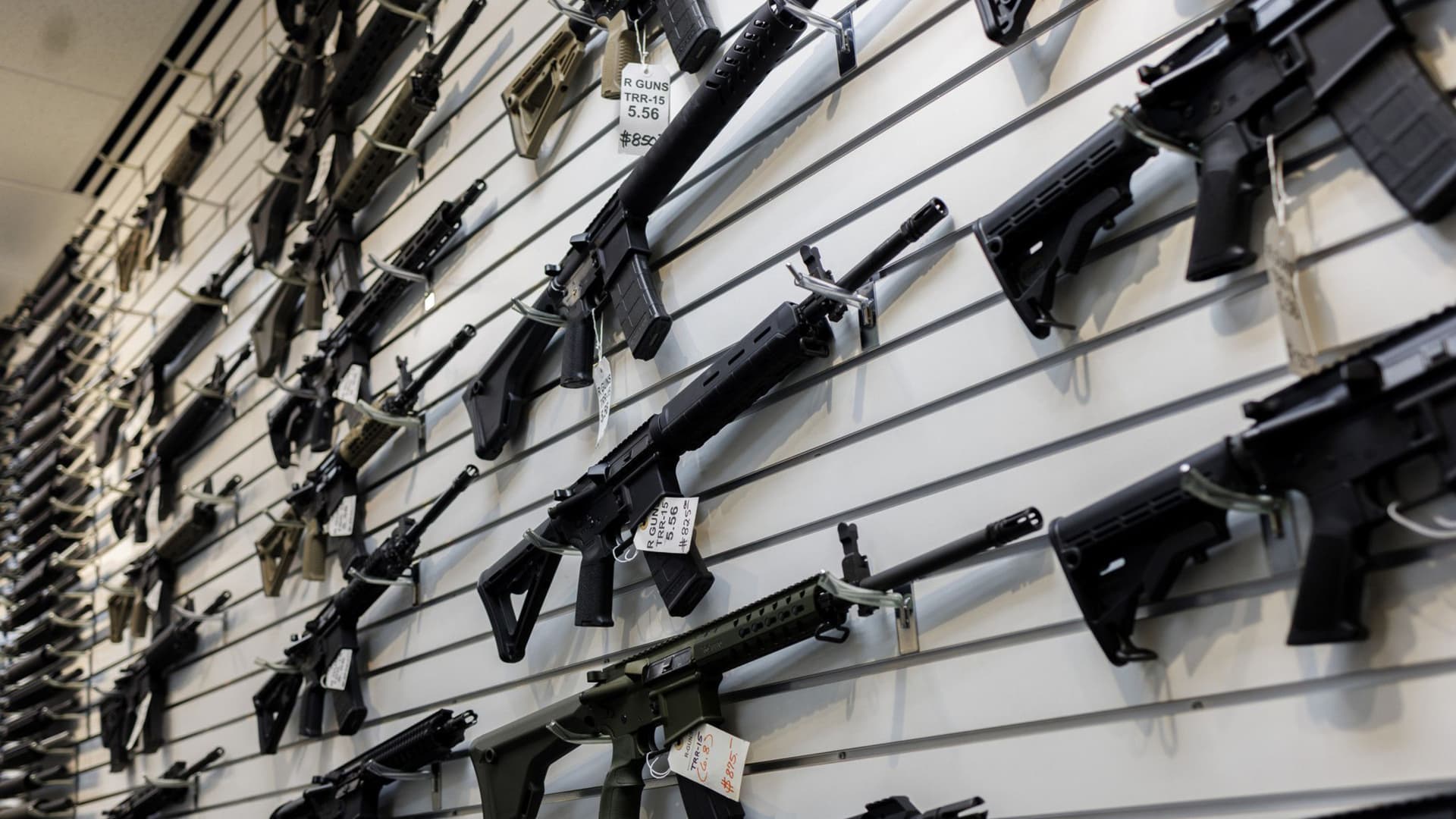
A selection of AR-15-style rifles hangs on a wall at R-Guns store on Jan. 11, 2023, in Carpentersville, Illinois, a day after the state ban.
Armando L. Sanchez | Tribune News Service | Getty Images
The largest firearm manufacturers in the U.S. are facing a post-Covid slump.
Gunmakers saw top-line benefits in recent years as Americans experienced feelings of insecurity and instability during the pandemic, protests over police killings of unarmed Black people, and the 2020 presidential election. But the past year has seen gun sales fall precipitously as demand wanes.
related investing news


American Outdoor Brands and Vista Outdoor have reported weaker sales in their shooting categories of late. Sturm, Ruger & Company, the largest publicly traded gunmaker in the U.S. by market value, reported a 28% year-over-year drop in net sales for fiscal third quarter, reporting $139.4 million, down from $178.2 million in the same period in 2021.
“These decreases are attributable to decreased consumer demand for firearms from the unprecedented levels of the surge that began in 2020 and remained for most of 2021,” CEO Christopher Killoy said of Sturm, Ruger’s November financials during an earnings call.
New gun ownership, as measured by the number of background checks for gun purchases, rose to 21 million in 2020, an all-time high for the industry, according to trade group National Shooting Sports Foundation. In 2019, that number had been just 13 million.
In 2021, background checks for gun purchases totaled 18.5 million, the industry’s second-biggest year. In 2022, they totaled 16.4 million.
NSSF warns background checks aren’t a perfect equivalent to new ownership because not all background checks are associated with individual sales of new guns, but they’re the best barometer of yearly sales trends. The organization has tracked the data since 2000.
“During the pandemic, people were worried about societal collapse in one way or another,” said Dru Stevenson, a law professor at South Texas College of Law Houston. “If you didn’t own a gun and you decided you better get one for self defense, you went and bought your gun, and now you’re done.”
Waning sales, alongside rising material and manufacturing costs, dented profitability for manufacturers.
Sturm, Ruger saw its gross margin tighten to 28% in the third quarter from 36% in the same period a year earlier. Sturm, Ruger & Company did not immediately respond to CNBC’s request for comment. The company reports its next quarterly results Feb. 22.
“We’re seeing that as you come off the highs, the market is settling out and we’re finding that new normal,” said Mark Oliva, managing director of public affairs at NSSF. This “new normal,” added Oliva, is what firearm manufacturers are trying to get their shareholders to understand.
Gunmaker Smith & Wesson reported second-quarter net sales of $121 million, a decrease of 47.5% from the same quarter last year. However, the company added that those results are still 6.4% higher than the comparable quarter in fiscal 2020, pre-pandemic. Smith & Wesson did not immediately respond to CNBC’s request for comment. The company is set to report its next batch of quarterly results March 2.
In a December conference call with investors, Smith & Wesson CEO Mark Smith said despite firearm sales reaching “more normal demand levels,” the company’s business model is “specifically designed for this” and has “effectively managed through these cycles before.”
Smith & Wesson’s stock is down 40% from a year ago, while Sturm, Ruger & Company saw its stock fall 19% in the same time frame.
Other gun manufacturers including American Outdoor Brands and Vista Outdoor, which purchased Remington Ammunition out of bankruptcy in late 2020, are seeing similar declines in gun sales.
American Outdoor Brands reported quarterly net sales were $54.4 million, a decrease of $16.3 million, or 23.1%, compared with net sales of $70.8 million for the same quarter last year, “resulting primarily from reduced demand in the shooting sports category.”
Vista Outdoor reported a sales decline of 4% to $432 million for its sporting products, which includes its Remington acquisition.
American Outdoor Brands and Vista Outdoor did not immediately respond to CNBC’s requests for comment.
Despite the drop in sales, Oliva said the “floor of this new market” remains “higher than the ceiling” of the last market. He said much of the losses seen now are likely to be recovered during the next surge in sales, which he said may come during the 2024 presidential election.


