


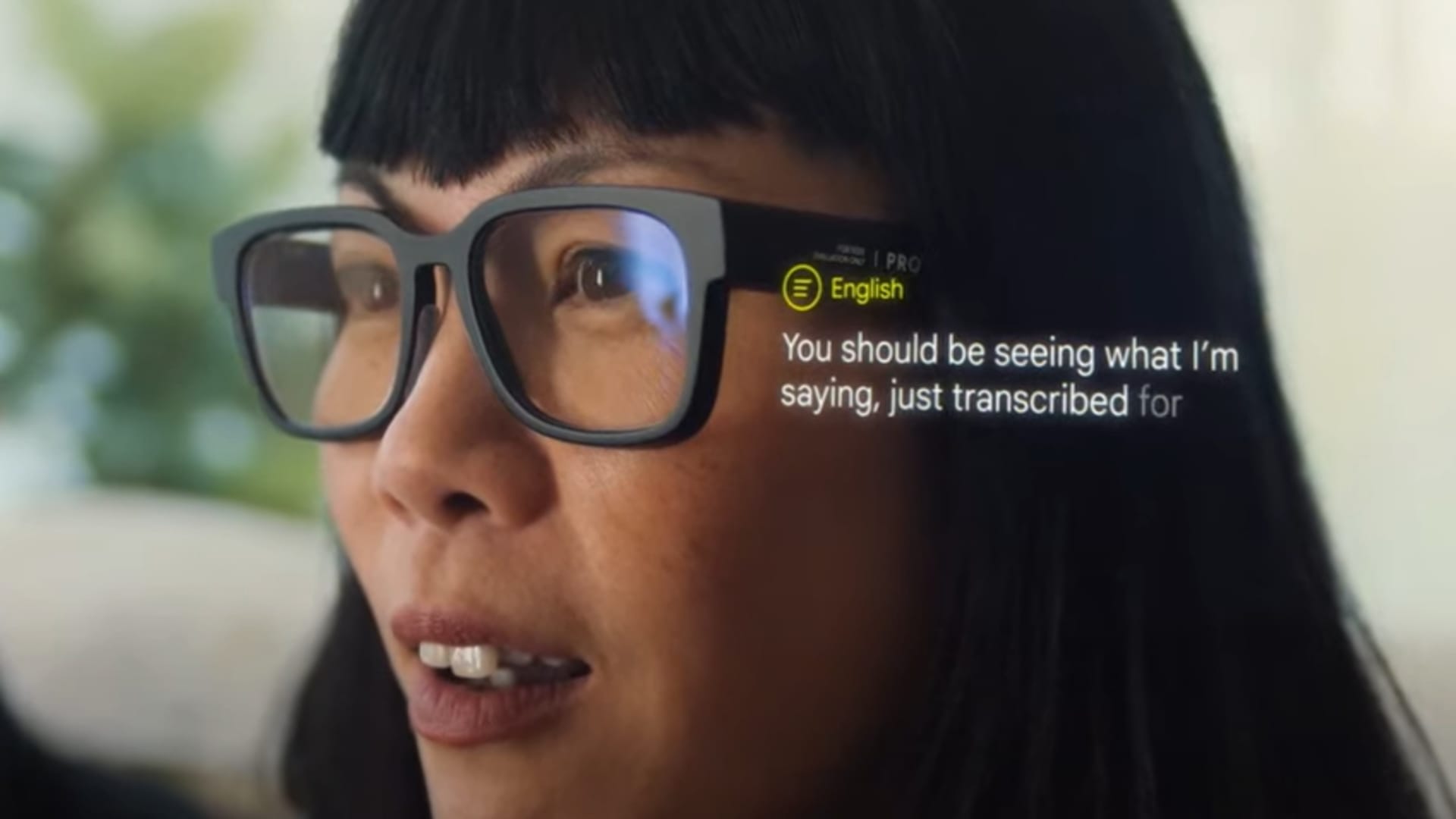
Google AR glasses prototype
Google will test augmented reality prototypes in public settings, the company said in a blog post on Tuesday.
Some prototypes will look like normal glasses and will be equipped with microphones and cameras as well as transparent displays.
The new glasses aren’t a product yet and aren’t available to the public, but Google wants to test apps like real-time translation or showing the user directions inside glasses lenses, especially in environments like busy intersections.
The tests represent a significant advance in Google’s development of augmented reality, a technology that many in Silicon Valley believe could be a major shift in computing like the smartphone and PC before it. Augmented reality superimposes computer-generated images over the real world, unlike virtual reality, which completely immerses the viewer in an artificial world or “metaverse.”
By announcing plans to test in public, Google is also trying to get ahead of the kind of privacy concerns that helped sink Google Glass, one of the first augmented reality devices, almost a decade ago.
Google Glass was equipped with a front-facing camera, and critics worried about users recording people without their permission. Glass wearers received a derogatory nickname, and in 2014 a woman wearing the glasses said she was attacked at a San Francisco bar. Eventually, Google repurposed the glasses to focus on business customers rather than consumers.
“It’s early, and we want to get this right, so we’re taking it slow, with a strong focus on ensuring the privacy of the testers and those around them,” Google product manager Juston Payne wrote in the blog post about the new product.
“These research prototypes look like normal glasses, feature an in-lens display, and have audio and visual sensors, such as a microphone and camera,” Google said in a support page about the testing.
The device features an LED light that turns on when the glasses are recording image data. Google says the glasses will not record video or take photographs for users to store and view later, but they may capture and use image data to perform functions like identifying objects or showing directions. Testers won’t wear the glasses in schools, government buildings, healthcare locations, churches, protests, or other sensitive areas, Google said. The testing will be conducted by “a few dozen Googlers and select trusted testers” and will take place somewhere in the U.S.
Google revealed its AR glasses at its developers conference in May with a focus on translating speech in real time, so that a person would see a foreign language translated in front of their eyes. One Google employee called the glasses “subtitles for the world” during the presentation.
Google is fiercely competing with other tech giants including Apple, Meta, and Microsoft to build the first next-generation augmented reality glasses. All four companies have invested billions in augmented reality software and hardware, hoping for a breakthrough that could enable a new computing platform, but current products have yet to catch on.
“The magic will really come alive when you can use them in the real world without the technology getting in the way,” Pichai said.
Apple is reportedly preparing to announce a mixed reality headset as soon as next year. Meta has announced an advanced mixed reality headset that supports augmented reality features releasing later this year. Microsoft’s Hololens is the most advanced augmented reality hardware on the market from a big tech company for now.
