


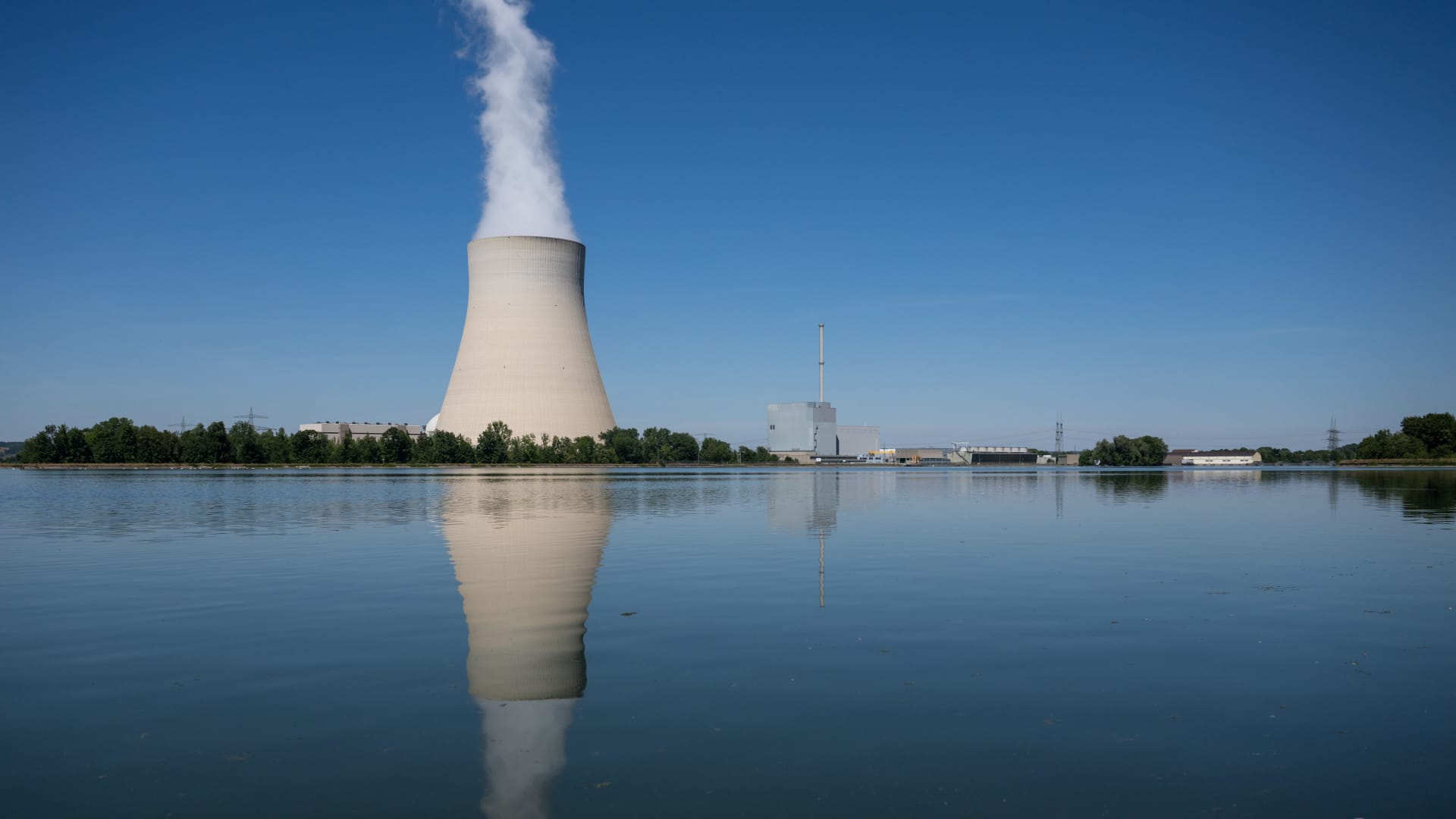
A nuclear power plant photographed in Germany, on August 4, 2022. Discussions about nuclear’s role in Europe’s biggest economy have been thrown into sharp relief following Russia’s unprovoked invasion of Ukraine in February.
Lennart Preiss | Getty Images News | Getty Images
Nuclear has a role to play in the years ahead but it should not be seen as a “transformational” technology, according to Goldman Sachs.
The comments from Michele Della Vigna come after a recent report from Goldman Sachs Research looked at whether Europe could bolster its energy independence following Russia’s unprovoked invasion of Ukraine, without compromising on goals related to climate change.
Among other things, the report said 10 trillion euros (around $10.23 trillion) of investment would be required by 2050 for what it called “Europe’s energy transformation.” This would be offset by a 10 trillion euro cut in net energy imports.
The report said natural gas — a fossil fuel — would remain “key” when it comes to Europe’s energy supply over the next two decades.
“Nuclear is not in the headlines of our report because we don’t think it’s one of the transformational technologies for the future,” Goldman’s Della Vigna told CNBC’s “Squawk Box Europe” on Thursday.
“We think wind, solar [and] hydrogen are, but not nuclear,” Della Vigna, who is the bank’s commodity equity business unit leader for the EMEA region, added.
“But at the same time, we do assume that nuclear will maintain its market share in the long-term energy mix in Europe,” he said.
This would mean “less retirement and some new builds,” including modular reactors.
“So we do believe that investment in nuclear should be ongoing, but it’s not one of the transformational technologies that we envisage for the future.”
Nuclear’s role
According to the International Energy Agency, nuclear power is responsible for roughly 10% of global electricity generation. In advanced economies, the IEA says it accounts for nearly 20% of the generation.
Noting that nuclear power has big upfront costs and long lead times, the Paris-based organization says it “has trouble in some jurisdictions competing against more economic and faster-to-install alternatives, such as natural gas or modern renewables.”
The development of “next generation installations” like modular plants could help redress this balance, it adds.
In addition, the IEA describes nuclear power plants as helping “contribute to electricity security by keeping power grids stable and complementing decarbonisation strategies since, to a certain extent, they can adjust their output to accompany demand and supply shifts.”
The need for this will only grow as more renewable sources like wind and solar — which are intermittent — come online in the years ahead, it says.
— CNBC’s Silvia Amaro contributed to this report.

