


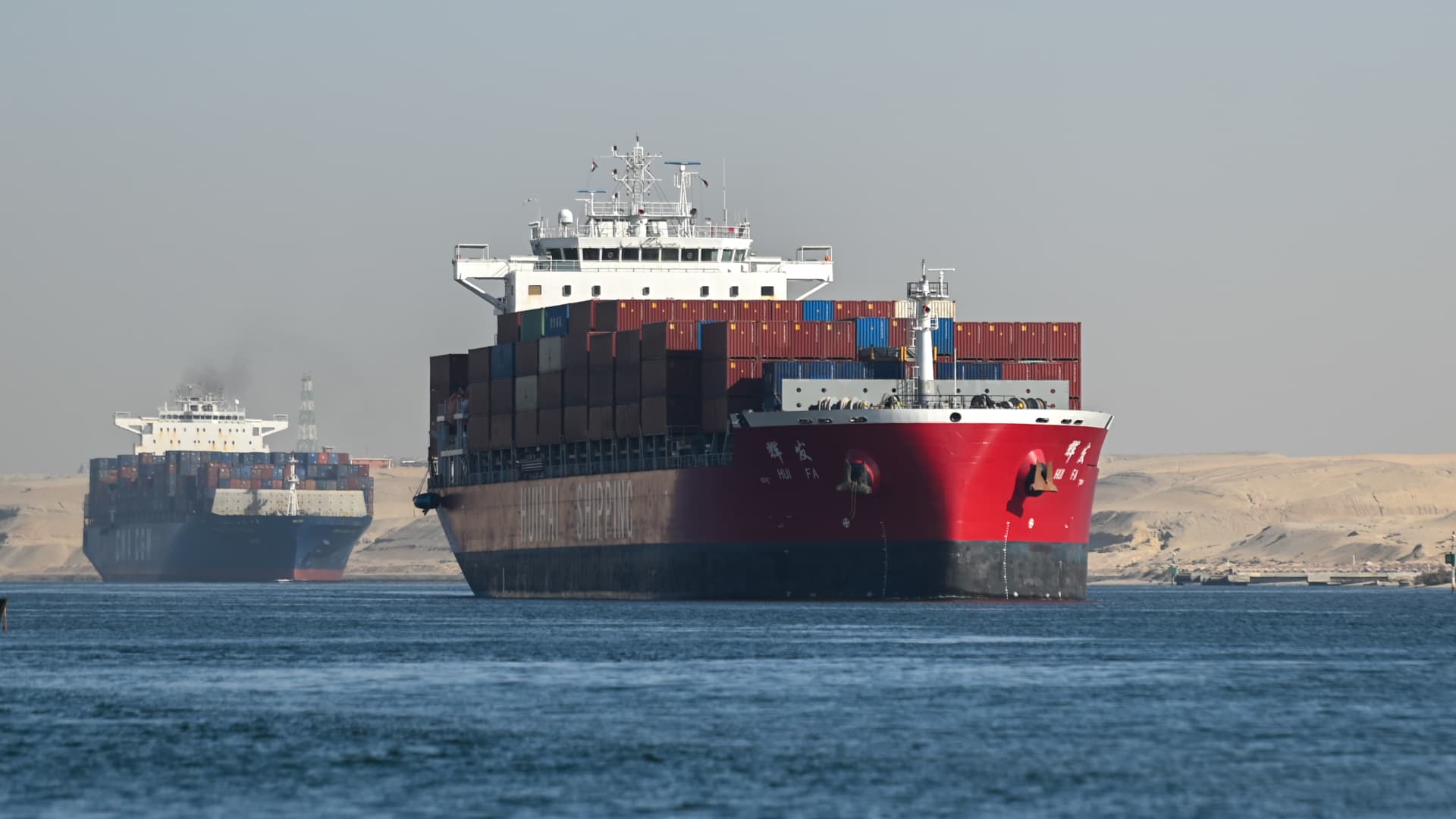
The global supply chain is feeling the fallout from Iran-backed Houthi rebels attacking vessels in the Red Sea. Freight prices are set to jump Monday, while longer transit times around Africa are disrupting and delaying deliveries of products.
Vessels aren’t able to come back to Asia in time, and ocean carriers are canceling sailings on short notice, both as a result of ship diversions, Honour Lane Shipping told clients in an email.
Spring clothing, footwear, home goods, electronics, patio furniture and pool supplies are just some of the products on these rerouted vessels. British clothing retailer Next recently warned of stock delays as a result of the longer ocean transit. Ikea also warned in December of its own supply chain crunches as a result of the Red Sea.
“The rerouting of vessels is leading to longer transit times and increased costs,” Jon Gold, vice president of supply chain at the National Retail Federation, told CNBC. “Unfortunately, the longer the disruptions occur, the more challenges will arise in ensuring supply chain reliability and efficiency.”
Gold said retailers are working on implementing mitigation strategies to avoid further disruption by moving up key shipment orders and diverting shipments to the West Coast.
The longer voyages are adding to the cost of freight, as well.
“This creates strong motivations for ocean carrier(s) to increase rate(s) by establishing General Rate Increases (GRIs), Peak Season Surcharge (PSSs), and other contingency or emergency surcharges,” the company said. “HLS warned Transpacific freight rates could spike to highs not seen since early 2022, with the Suez Canal route suspended, and the Panama Canal route restricted.”
MSC, the largest ocean carrier in the world, was the first shipping company to release rates for the second half of January. Starting Monday, container rates for MSC clients will be $5,000 for U.S. West Coast routes, $6,900 for the East Coast and $7,300 for routes to the Gulf of Mexico.
“This is really an unexpectedly huge rate increase,” HLS wrote.
Under the U.S. Shipping Act, all ocean carriers have to give a 30-day notice requirement before they can impose surcharges or GRIs, but the Federal Maritime Commission has waived this for shipments from Asia to the U.S. being rerouted around South Africa’s Cape of Good Hope.
Kuehne + Nagel analysts told CNBC that 419 vessels are currently being rerouted due to the Red Sea situation. The total container capacity is estimated at 5.65 million twenty-foot-equivalent units (TEUs, or containers), with a total value of $282.5 billion, according to calculations using MDS Transmodal estimates that trade in a single TEU is valued at $50 million.
Vessel volume in the Suez Canal has fallen 61% to an average of 5.8 vessels per day, compared with volumes before the Houthi attacks, according to logistics data firm Project44. Egypt, which owns and operates the Suez Canal, charges between $500,000 and $600,000 per vessel transit. This is resulting in massive losses for a country that is already hurt by a declining tourism industry and soaring inflation.
Meanwhile, Tuesday’s large-scale attack by the Houthis is fueling expectations the diversion route around the Horn of Africa will become more stabilized.
“As most carriers currently still reroute completely anyhow, we do not see more divisions than before,” Franziska Bietke, global sea logistics communication manager at Kuehne + Nagel, told CNBC on Wednesday. “The magnitude of yesterday’s attack is likely to reinforce the global carriers’ position that the passage is too risky.”
Vessel route changes are now happening on a daily basis, according to Bietke.
“The situation is extremely fluid and volatile,” she said.
Logistics companies are also warning clients of container shortages. This is something not experienced by shippers since Covid. Because of the delays in shipping, containers are not located where they need to be.
Mark Rhodes, regional director of ocean product for Asia-Pacific at Crane Worldwide Logistics, explained to CNBC that containers arriving in Europe through the diverted route will need to make their way back to the manufacturing hot spots in Asia.
“The container shortage remains fresh in our memories from the COVID pandemic,” Rhodes said. “The outbound leg from Asia to Europe is just the beginning of what could be more turbulent times ahead in 2024.”
Don’t miss these stories from CNBC PRO:


