


A global recession is not imminent, but brace for rising costs and slower growth, economists say.
“There will be no sudden ‘after’ of stagflation,” said Simon Baptist, global chief economist at the Economist Intelligence Unit, referring to a surprise recession after a period of stagflation.
As the war in Ukraine and pandemic disruptions continue to wreak havoc on supply chains, stagflation — marked by low growth and high inflation — will stick around “for at least the next 12 months,” Baptist told CNBC last week.
“Commodity prices will start to ease from next quarter, but will remain permanently higher than before the war in Ukraine for the simple reason that Russian supplies of many commodities will be permanently reduced,” he added.
The pandemic as well as the war in Ukraine have stifled supply of commodities and goods and upended efficient distribution through global supply chains, forcing up prices of everyday goods such as fuel and food.
But, while higher prices will cause pain for households, growth in many parts of the world, while slow, is still ticking over and job markets have not collapsed.
Unemployment levels across many economies have reached their lowest in decades.
For almost all economies of Asia, a recession is fairly unlikely, if we’re talking about successive periods of negative GDP.
Simon Baptist
Global chief economist, EIU
So, consumers — while wary of a repeat of the last global recession brought on by the U.S. subprime crisis over 10 years ago — need not start preparing for a recession.
“For almost all economies of Asia, a recession is fairly unlikely, if we’re talking about successive periods of negative GDP,” Baptist told CNBC’s Street Signs on Thursday.
Even if the global economy is at risk of a recession, many consumers have ample savings and have stocked up on household durables, the economist said.
“So to an extent, it won’t feel as bad as the immediate numbers look,” he said.
AMP Capital chief economist Shane Oliver doesn’t see the recession writing on the wall either, at least not for another 18 months.
“Yield curves or the gap between long-term bond yields and short-term rates have yet to decisively invert or warn of recession and even if they do now the average lead to recession is 18 months,” he said in a note.
He takes the view that a deep bear market can be avoided in the U.S. and in Australia.
At the same time, central banks across the globe are tightening up interest rates to combat inflation.
The U.S. central bank announced its biggest rate hike in more than 22 years earlier this month, raising its benchmark interest rate by half a percentage point and warning of further rate hikes.
Federal Reserve minutes released Wednesday indicated that officials were prepared to move ahead with multiple 50 basis points interest rate increases, as they attempt to bring down inflation.
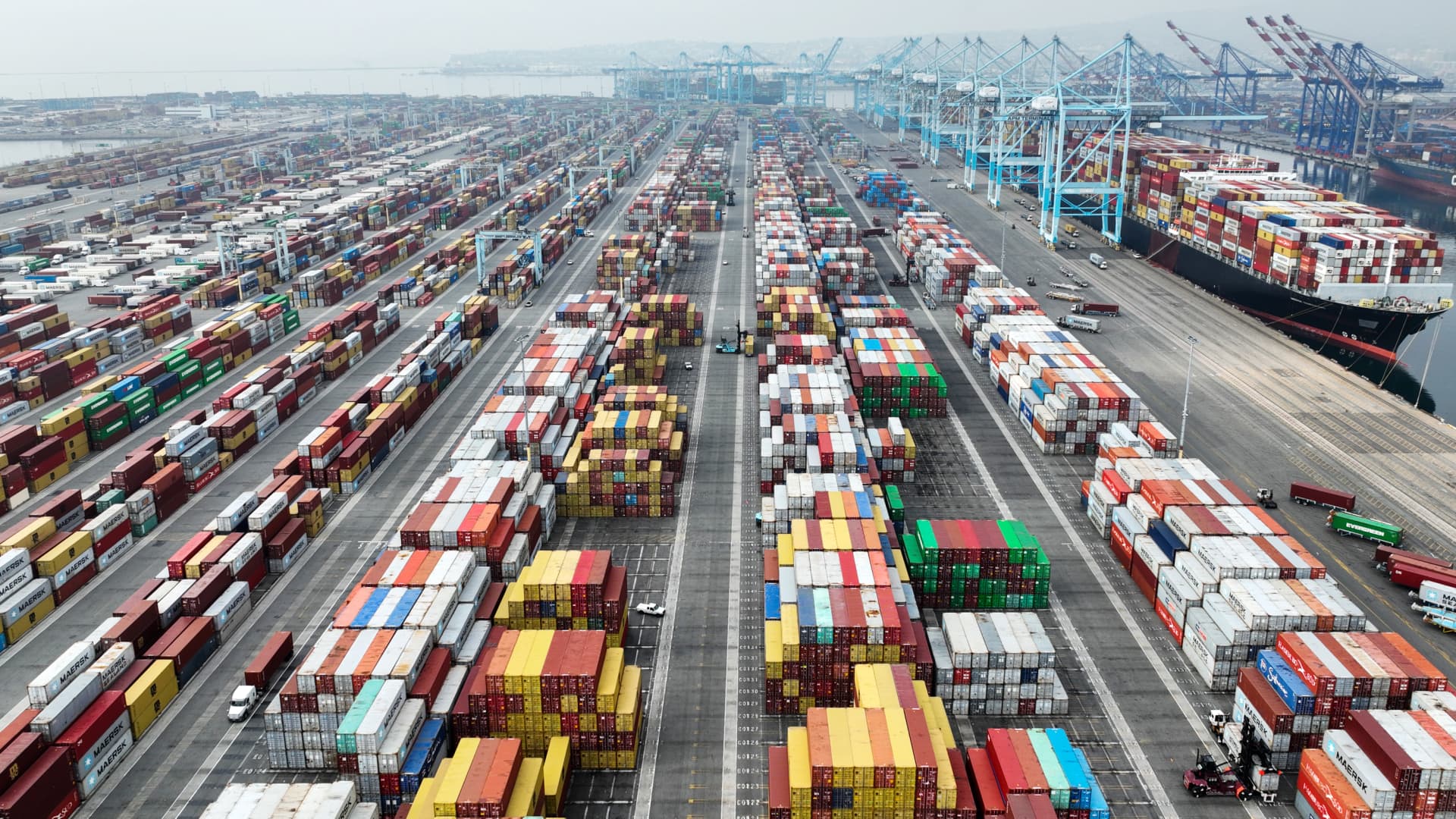
Aerial view of containers piled at the Port of Los Angeles on January 19, 2022 in San Pedro, California.
Qian Weizhong | VCG | Getty Images
Last week, the Reserve Bank of New Zealand, which has been tightening more than other central banks, raised its cash rate by another half a percentage point to 2%. It was the central bank’s fifth rate hike in a row, and signaled the cash rate would peak at a higher level than previously forecast.
The rate has now risen by 1.75 percentage points since the tightening cycle started in October.
“We are very committed to making sure that actual inflation tracks back to within our target range of 1 to 3% and at 6.9%, we are well north of that … we are resolute in our determination to contain inflation,” governor Adrian Orr said.
But there is always a risk the control of inflation will induce a recession, economists say.
Stagflation is notoriously hard to control as reining in high prices through raising interest rates could lead to even lower growth.
“The longer inflation stays high the more investment markets worry that central banks will not be able to tame it without bringing on recession. As Fed Chair Powell indicated, getting inflation to 2% will ‘include some pain,'” Oliver said.
But not everyone is concerned.
Capital Economics senior economic advisor Vicky Redwood said she was confident central banks would be able to dial down inflation without engineering a recession.
Planned rate rises in many places — such as in Europe, the UK and the U.S. — should be sufficient to bring inflation back to target, Redwood said.
“[But] if inflation expectations and inflation prove more stubborn than we expect, and interest rates need to rise further as a result, then a recession most probably will be on the cards,” she said in a note.
A Volcker-shock style recession might even be warranted, she added.
The Volcker Shock occurred when Fed Chairman Paul Volcker raised interest rates to the highest point in history in the 1980s, in an effort to end double-digit inflation in the U.S.

