


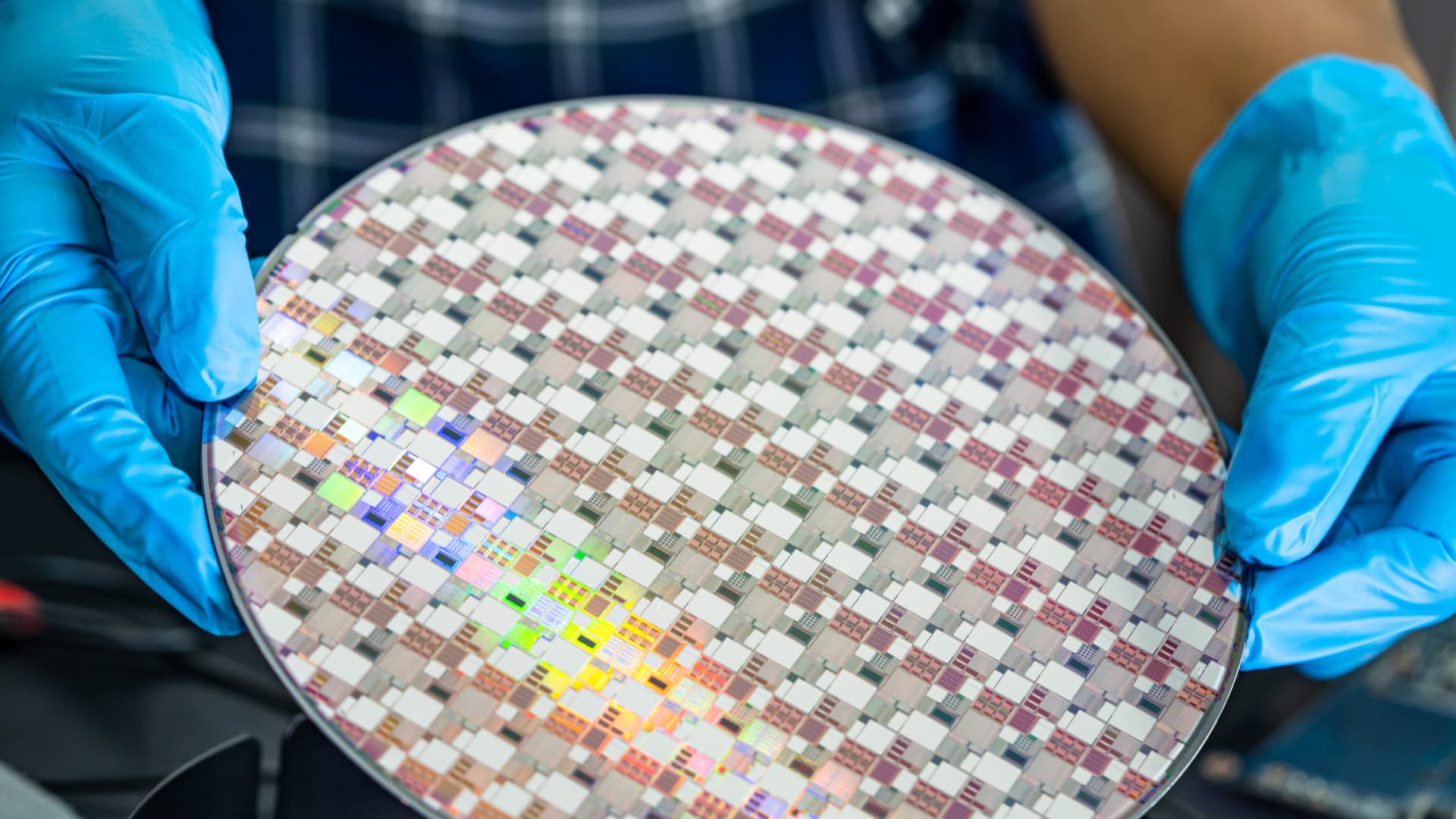
The global chip shortage will continue, and consumers will have to pay for it, an analyst from the International Data Corporation said.
Sasirin Pamai | Istock | Getty Images
The global chip shortage is not over yet, and the war in Ukraine continues to put a strain on supplies of important parts needed, one analyst told CNBC Tuesday.
“The semiconductor supply is not going to increase immediately. There are a lot of raw materials, gases, which were required for production of those semiconductors,” Vinay Gupta, the International Data Corporation’s Asia-Pacific research director told CNBC’s “Squawk Box Asia.”
Citing supply chain challenges due to Russia’s war in Ukraine, Gupta said the two countries capture a large part of the market share, with Russia and Ukraine being the largest exporters of krypton — a gas used in the chip production.
Neon is also critical for the chipmaking process and is used for lasers, known as lithography, where machines carve patterns onto tiny pieces of silicon made by the likes of Samsung, Intel and TSMC.
More than half of the world’s neon is produced by a handful of companies in Ukraine, according to Peter Hanbury, a semiconductor analyst at research firm Bain & Co.
Semiconductors are used in everything, from mobile phones and computers to cars as well as home appliances.
Supply chain disruptions and rising costs will also mean “the average selling price of the devices is going to rise and the infrastructure vendors would be then passing it down to the customers,” Gupta added.
‘Signs of recession’ for consumer spending
Rising inflation and expectations of more monetary tightening are already causing a “consumer-led slowdown,” said Gupta.
“IT spending, especially consumer IT spending, is showing signs of recession.”
While spending on enterprise IT — which includes software services, cloud and IT services — are still holding out, inflation has driven businesses to “protect their IT budgets right now.”
Coupled with rising interest rates all around the world, this slowdown is “going to bite,” he added.
“But the hopes are that this will be a shallow slowdown, because the government and central banks are trying to balance the rising inflation and … interest rates,” Gupta added.
Last week, statements from two officials indicated the Federal Reserve is on its way to another sharp interest rate hike in July and perhaps in September as well, even if it slows the economy.
In June, the Fed approved a 75 basis point, or 0.75 percentage point, increase to its benchmark borrowing rate, the biggest such move since 1994.
Slow hiring, less spending in Asia
On Tuesday, Bloomberg reported Apple’s plans to slow hiring and spending on growth next year to deal with a possible downturn. A “similar trend” will be observed across Asia’s tech sector, said Gupta.
“I believe that would be a trend which we will start seeing [in] late 2022 or early 2023 if the situation does not improve.”
“If we talk about the IT services in Asia, most of them are feeling margin pressures because of increasing salary costs and skill gaps … in the market.”
In India, for example, the margins for the tech giants are “a bit lower, despite more hiring in the first-quarter, Gupta added. But this may not last long.
“A lot of enterprises were shifting towards new digital technologies because of the pandemic, enabling their employees working from home, so [there were] a lot of new digital transformation projects,” he said.
“But we’ll start seeing some margin pressures because obviously the earnings of the enterprises will take a hit, if we see the entire scenario playing out like you’re seeing it right now.”

