


Here is an artists’ rendering of a Marvel Fusion power plant and facility.
Marvel Fusion
Nuclear fusion is the energy that powers stars. If it can be recreated on Earth, it has the potential to provide nearly limitless energy with zero carbon emissions — and unlike nuclear fission, which powers nuclear plants today, fusion does not leave behind long-lasting radioactive nuclear waste.
The technology has been seemingly just out of reach for decades now, but the reward is so high that billions of dollars are still flowing into the space. On Wednesday, the Biden White House unveiled a vision for spurring fusion investment, noting that commercial fusion “has the potential to revolutionize the energy industry.”
Marvel Fusion, founded in 2019, is one of the many start-ups taking a bet on commercializing fusion. The German company is pursuing an innovative approach using lasers instead of magnets, and has so far raised raised €60 million ($65.9 million), including a €35 million ($38.5 million) round in February led by Earlybird Venture Capital.
It’s still years — and billions of dollars — away from even building a prototype, but the company is testing the idea using computer models and believes its approach will be more efficient than competing efforts.
Two ‘religions’ of fusion
There are two “religions” in the landscape of fusion start-ups, Edward Morse, a professor of nuclear engineering at the University of California at Berkeley, told CNBC: magnetic confinement and inertial confinement.
Magnetic confinement often uses a tokamak, a round donut-shaped piece of machinery with very strong magnets to hold the plasma intact so the fusion reaction can occur. It’s the more battle-tested variety, with a number of start-ups and an international collaborative effort in France all pursuing it.
Inertial fusion confinement fusion is when the fuel is compressed so intensely and so quickly that it reaches the conditions necessary for fusion. In practice, lasers are used to compress the fuel.
“The Tokamak concept based on magnetic confinement is the most advanced fusion device,” Sehila M. Gonzalez de Vicente, a nuclear fusion physicist at the International Atomic Energy Agency, told CNBC.
“Nevertheless, laser-based concepts also represent a promising approach,” she said.
An artist rendition of a Marvel Fusion power plant.
Marvel Fusion is not the only start-up in the field working with lasers: HB11, EX-Fusion, and Focused Energy are among the others, according to Andrew Holland, CEO of the Fusion Industry Association.
In August, scientists took a significant step forward in laser fusion science in August at the National Ignition Facility at Lawrence Livermore National Laboratory in California. In what a lead scientist there called a “Wright Brothers moment” for the industry, a laser light was focused onto a target the size of a BB, generating tremendous amounts of energy.
Marvel’s approach
Marvel’s approach is slightly different. The NIF is pursuing indirect laser fusion, which uses a hollow cavity (or “hohlraum”) to convert laser energy into a bath of X-rays that shoot into the surface of a capsule holding the fuel source. In direct drive laser fusion, there is no hollow cavity — instead the lasers go directly into the fuel capsule.
Moritz von der Linden, a co-founder and CEO at Marvel Fusion, says that direct drive is more efficient.
“We need considerably less energy to ignite and burn our fuel than comparable thermonuclear models that rely on high temperatures,” he told CNBC.
Before starting Marvel, Linden spent 20 years in finance and technology. In his previous work, Linden collaborated with a physicist to do due diligence on another fusion company and the two determined the start-up they were assessing was not feasible. But that investigation inspired Linden and Karl-Georg Schlesinger to co-found Marvel Fusion.
Marvel Fusion’s fusion technology depends on ultra advanced lasers, and he claims the state of the art is 20 years ahead of the NIF’s lasers, which started the planning process decades ago.
Marvel Fusion also plans to use hydrogen-boron 11 as the fuel source, which results in even less waste than the deuterium-tritium fuel used in more convention fusion reactions. In the primary reaction, helium nuclei will be the only by product. In 0.1% of all the reactions, a “tiny number” of fast neutrons, which are responsible for the radioactive waste are produced, but this is not enough to produce any long-lived radioactive waste, Marvel Fusion said. (HB11, another fusion start-up, is also pursuing this approach.)
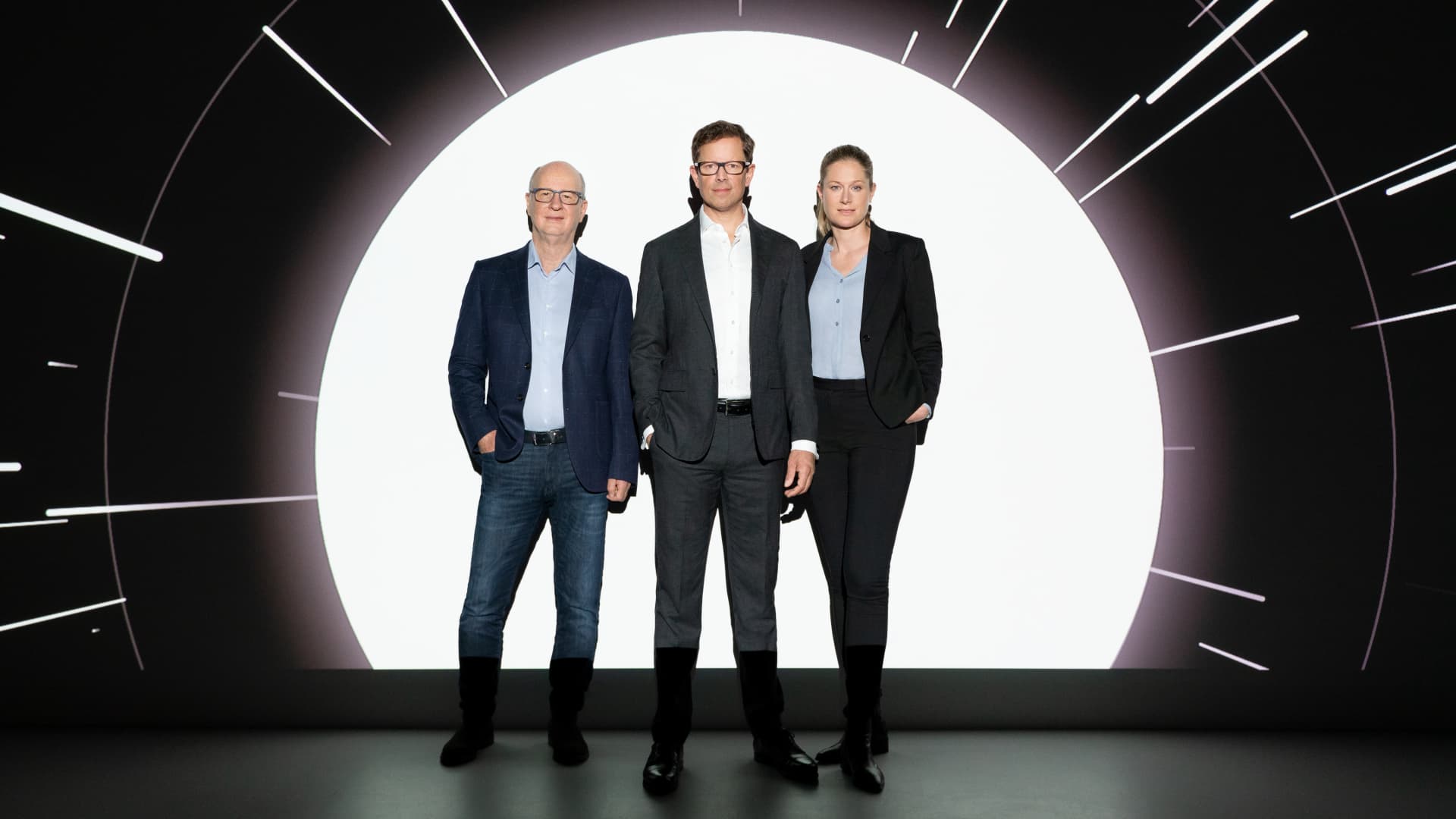
The Marvel Fusion executive team. Moritz von der Linden, center, is a co-founder and the CEO at Marvel Fusion. Heike Freund, right, is the chief operating officer and Georg Korn, left, is the lead scientist and chief technology officer.
Photo courtesy Marvel Fusion
Marvel Fusion is still in its very early days and has no more than a computer simulation — the money raised so far is not enough to build even a prototype, Linden told CNBC, “not by a longshot.” That will cost billions, and the goal is to have a physics facility in five to six years and a prototype power plant within the decade.
Morse, the Berkeley professor, cautioned that it’s too early to tell whether the start-up will be successful.
“Like most fusion start-up companies, they believe in their own miracle,” Morse told CNBC. “That’s what VC money people like — something that’s radical enough, it just might work. It just might make them 100 times their money. But the real thing is, they’ve got their fingers in 99 other pots … So somebody is going to have a bright idea. The other 99 won’t.”
