


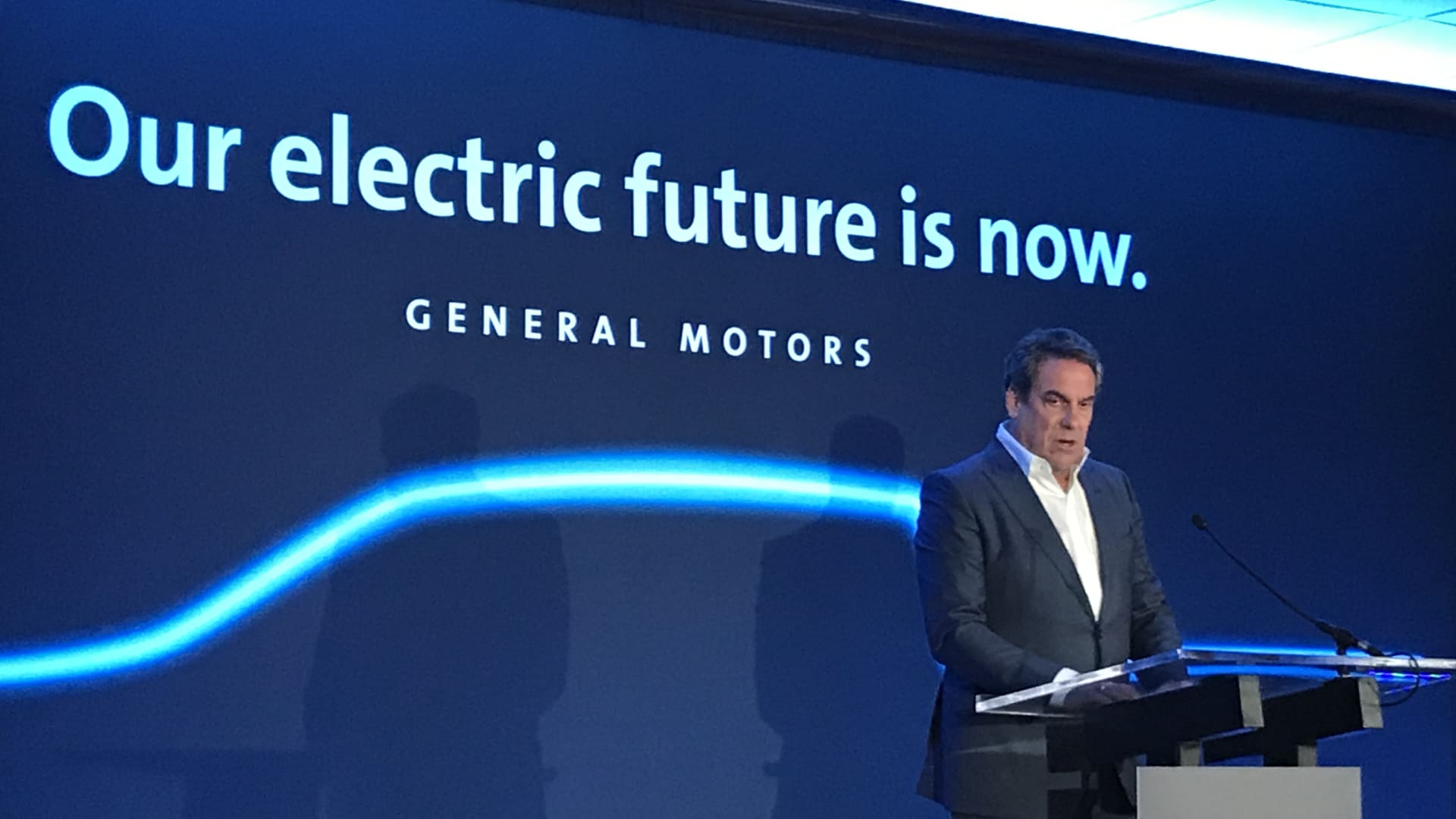
GM President Mark Reuss announces a $2.2 billion investment in the automaker’s Detroit-Hamtramck Assembly plant in Michigan for new all-electric trucks and autonomous vehicles on Jan. 27, 2020.
Michael Wayland / CNBC
DETROIT – General Motors is creating a new China-based premium import business focused on sales of high-margin, “iconic vehicles” from the U.S.
The business, which GM is calling a start-up within the automaker, will focus on vehicles and potentially brands that are currently not available in the Chinese market, according to GM President Mark Reuss.
“We’re going to bring in some pretty iconic vehicles into China,” he told CNBC during an interview. “It’s a strategy that I think is really neat because it’s uniquely American, in most cases.”
The products will include electric vehicles as well as ones with traditional internal combustion engines, Reuss said. He declined to specify what vehicles will be part of the new business but cited “a pretty aspirational Cadillac” and other “iconic” SUV-like vehicles.
“It’s some iconic vehicles but also some iconic brands as well,” Reuss said. “It’s exciting. It’s a different way to think about it.”
The new business is a change in strategy for GM. The automaker has not exported many vehicles to China, which is the automaker’s largest market by volume. It has instead localized production for China through joint venture partners within the country.
GM did not export any vehicles from the U.S. to China in 2021, according to a company spokeswoman. That compares with GM’s overall sales in China last year of 2.9 million vehicles. The company previously imported some U.S.-built vehicles to China, such as the Chevrolet Camaro, but in low volumes, according to research firm LMC Automotive.
Automakers typically don’t export many U.S.-built vehicles to China due to logistical costs and tariffs, which eat away at profit margins. The top five U.S.-built vehicles sent to China were from German luxury automakers BMW and Mercedes-Benz, according to LMC. Combined, they only totaled about 144,000 units, according to LMC.
The new import business “is being built from the ground up and will enjoy a high level of autonomy,” GM said in a statement. The automaker declined to disclose other information regarding the business, saying “additional details will be shared at a later date.”
The comments follow local Chinese media recently reporting GM’s China chief, Julian Blissett, confirming plans to create a new, independently owned premium brand in the country through the import of “halo cars.”
Halo vehicles are often iconic products that are unique in design and feature high-performance parts. They’re used to attract attention to a car nameplate or brand.
While the new business will likely be importing in low volumes, such vehicles could carry hefty profit margins for the automaker. GM’s Chinese operations earned about $1.1 billion in 2021, up $586 million from 2020, when the coronavirus pandemic weighed more heavily on the business.
“It’s Americana. It’s low volume, high-margin; it’s the whole notion of a halo,” said Jeff Schuster, president of global forecasting and the Americas at LMC. “I think there still is some aspiration to have Americana.”
He added: “As long as as long as that holds, and again, the volumes are going to be small, I suspect that it’s going to be an easy play that makes sense.”