


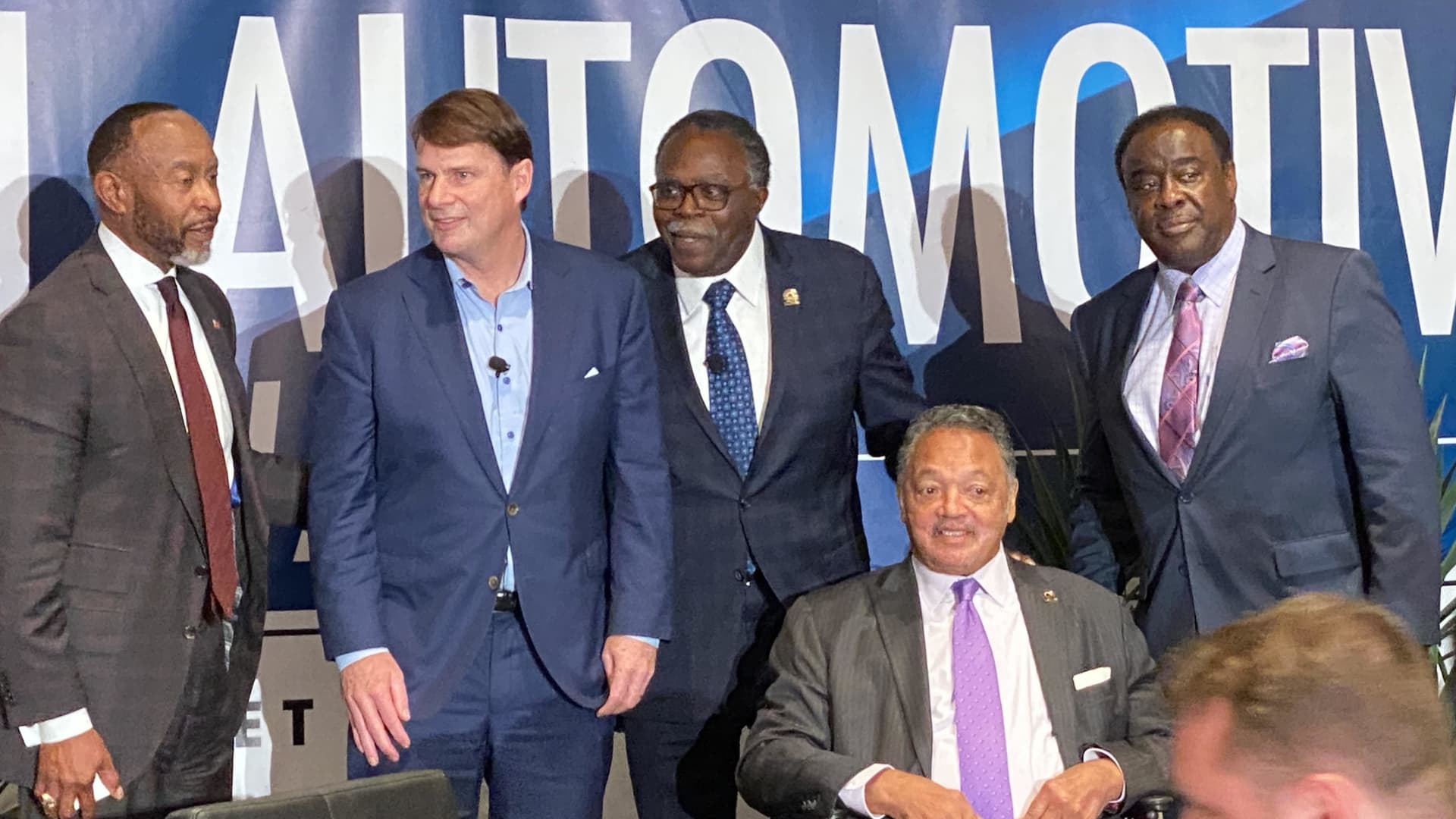
Ford CEO Jim Farley (left) with
Michael Wayland / CNBC
DETROIT – Ford Motor is attempting to build as many of its own parts as possible for its electric vehicles to offset an expected 40% reduction in workers needed to build such cars and trucks, CEO Jim Farley said Tuesday.
Farley compared Ford’s latest efforts to source its own parts to the early days of the auto industry, when companies including Ford controlled most, if not all, of the components going into a vehicle.
“We’re going back to where we were at the beginning of the century. Why? Because that’s where the value creation is. It’s a huge transformation,” Farley told reporters after an auto conference for the Rainbow Push Coalition, a human and civil rights organization founded by Rev. Jesse L. Jackson.
In addition to making sense for the business, he said retaining the jobs and workforce is another reason Ford wants to build more parts in-house rather than purchasing them from suppliers.
He said Ford plans to build such businesses rather than acquire them. For its increasingly popular Mustang Mach-E crossover, the company purchased motors and batteries. Going forward, Farley said that will no longer be the case.
Ford is building twin lithium-ion battery plants in central Kentucky through a joint venture with South Korea-based SK Innovation, called BlueOvalSK, as well as a massive 3,600-acre campus in west Tennessee. The company announced the $11.4 billion investment late last year.
Farley said the company would be “thrilled” to have union representation at its upcoming battery plants.
The comments come as the United Auto Workers union is attempting to organize a joint-venture battery plant between General Motors and LG Energy Solution in Ohio.
Such joint-venture battery plants have been a point of contention for the United Auto Workers union, as the companies have said it will be up to workers of the plants to decide whether to unionize.
Wall Street has historically considered union representation a negative for companies, since it traditionally drives up labor costs and increases the potential for workforce disruptions such as strikes.
The UAW last month said it had filed a petition with the National Labor Relations Board on behalf of about 900 workers at the GM-LG joint venture, known as Ultium Cells, after the companies refused to recognize the union.


