


Attendees look at the all-electric Ford F-150 Lightning pickup truck at the Washington Auto Show in Washington on Tuesday, January 25, 2022.
Bill Clark | CQ-Roll Call, Inc. | Getty Images
The cost to produce electric vehicles is primed to surge over the next four years, according to a new report, the result of scarcity in key raw materials needed to make EV battery cells.
“The tsunami of demand is coming,” said Sam Jaffe, vice president of battery solutions at E Source, a research firm in Boulder, Colorado. “I don’t think the battery industry is ready for it.”
The price of EV battery cells has declined in recent years as production rose around the world. Battery cells currently cost $128 per kilowatt-hour on average, and by next year could cost around $110 per kilowatt-hour, E Source estimates.
But the declines won’t last much beyond that: E Source estimates battery cell prices will surge 22% from 2023 through 2026, peaking at $138 per kilowatt-hour, before they resume a steady decline through 2031— possibly to as low as $90 per kilowatt-hour.
The projected spike is the result of growing demand for key raw materials, like lithium, needed to make tens of millions of battery cells, Jaffe said.
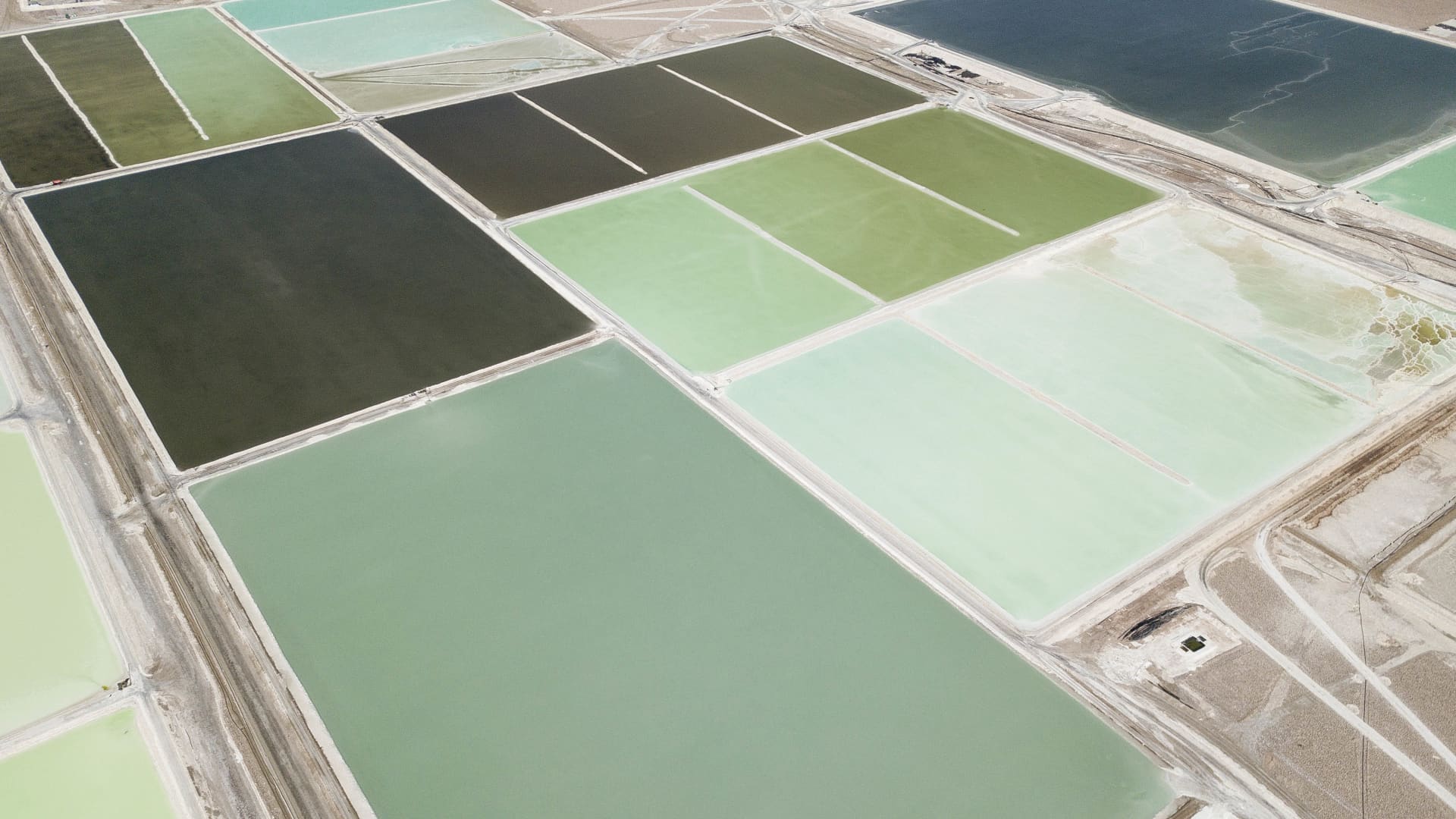
“There is a literal shortage of lithium, and there’s going to be an even sharper shortage of lithium. You cannot make the batteries if you don’t mine the lithium,” he said.
Brine pools at the Albemarle Corp. Lithium mine in Calama, Antofagasta region, Chile, on Tuesday, July 20, 2021.
Cristobal Olivares | Bloomberg | Getty Images
The expected surge in battery costs could drive the price of EVs sold in 2026 up anywhere between $1,500 and $3,000 per vehicle, E Source predicts. The firm has also reduced its EV sales projections for 2026 by 5% to 10%.
By then, EV sales are projected to top 2 million annually in the U.S., according to the latest forecast from consulting firm LMC Automotive. Automakers are expected to introduce dozens of electric models as more Americans embrace the idea of going electric.
Auto executives have increasingly warned about the need to produce more of the materials that are essential for EVs. Ford CEO Jim Farley called for more mining last month around the company’s launch of its all electric F-150 Lightning.
“We need mining permitting. We need processing precursor and refinement permitting in the U.S., and we need the government and private sector to work together and bring it here,” Farley told CNBC.
Tesla CEO Elon Musk, as early as 2020, urged the mining industry to increase its extraction of nickel.
“Tesla will give you a giant contract for a long period of time if you mine nickel efficiently and in an environmentally sensitive way,” Musk said during a July 2020 conference call.
Though industry executives and government leaders agree more needs to be done to source raw materials, E source says there’s still a surprisingly low number of mining projects.
“With the price of lithium having risen nearly 900% in the last eighteen months, we had assumed the capital markets would unleash the floodgates to establish dozens of new lithium mining projects. Instead, the investments have come in dribs and drabs, with most of it originating from China for the Chinese supply chain,” the firm said in its report.
— CNBC’s Meghan Reeder contributed to this article.

