


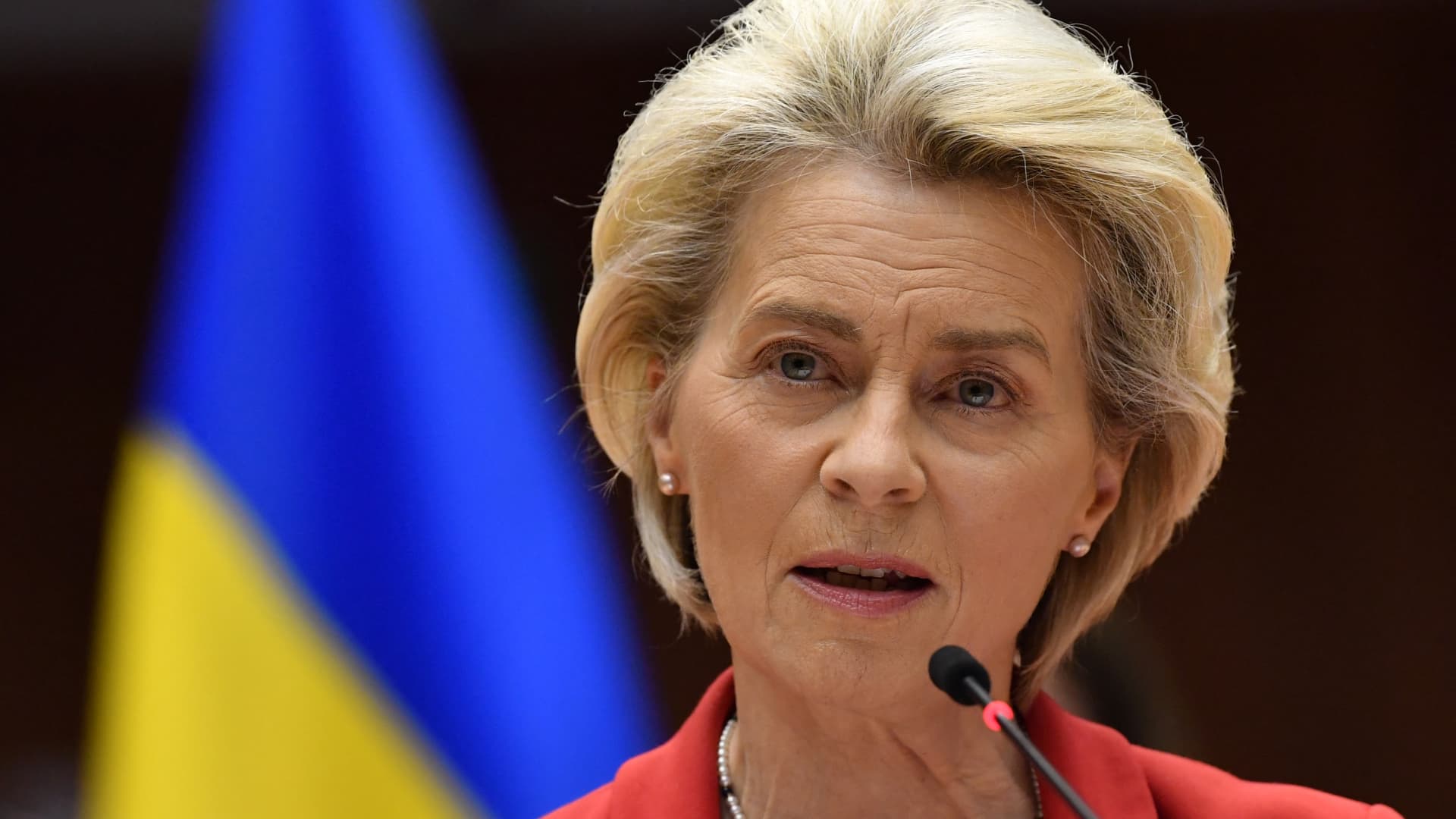
European Commission President Ursula von der Leyen delivers a speech during a plenary session of the European Parliament at the EU headquarters in Brussels, on March 23, 2022.
John Thys | AFP | Getty Images
LUXEMBOURG — The European Union is working on a new package of sanctions against Russia that is likely to restrict the leasing of airplanes and the import and export of products like jet fuel, steel products and luxury goods, two sources with knowledge of the discussions have told CNBC.
However, the bloc remains divided over whether to extend those sanctions to energy imports — despite mounting evidence of war crimes committed by Russian forces in Ukraine.
Ukraine’s top prosecutor has said 410 bodies had been found in towns recaptured from retreating Russian forces around Kyiv as part of an investigation into possible war crimes. Over the weekend, various international media organizations reported on the mass killings of civilians in the town of Bucha, a Ukrainian city close to the country’s capital of Kyiv, which had been under Russian occupation until recently.
The reports led to an array of calls from within the European Union for the bloc to go further in punishing Moscow for its unprovoked invasion of Ukraine. The bloc is now working on a fifth package of sanctions against Russia with the new round of measures expected to be approved later this week.
Two EU officials, who did not want to be named due the sensitive nature of the talks, told CNBC that a proposal for the next sanctions package includes airplane leasing, steel products, luxury goods and jet fuel. Both sources added that the package is still a work in progress and could change as talks continue in the coming days and ahead of a crucial meeting of EU ambassadors on Wednesday.
One of the officials added that “obviously, there is a big component missing,” in reference to the lack of measures on the Russian energy sector.
Imposing an immediate ban on Russian gas, oil or even coal has been a topic of huge debate within the EU since Russia invaded Ukraine on Feb. 24. While some nations are supportive of banning Russian energy, other EU countries argue that they are too dependent on Russian energy and they would hurt their own economies more than Russia’s.
France’s president, Emmanuel Macron, said Monday that the EU should agree on restricting Russian oil and coal following the atrocities reported in Bucha. Poland, for example, announced last month that it would stop imports of Russian coal.
However, there is a very vocal group of EU nations that are still against approving any energy sanctions.
“We want to be, [in the] short time, less dependent on Russian energy imports to the European Union and Germany will support further sanctions on Russia,” German Finance Minister Christian Lindner told CNBC in Luxembourg on Monday.
“We have to put more pressure on Putin and we have to isolate Russia — we have to cut all economic relationships to Russia, but at the moment it is not possible to cut the gas supplies,” he added.
When asked if for now, as Macron suggested, the EU should move ahead with sanctions on oil and gas, Lindner said, “No speculation from me.”
His Austrian counterpart was also against imposing a ban on Russian gas.
“Austria is not in favor of more sanctions concerning gas. We are very much dependent on the Russian gas and I think all sanctions which hit us more than the Russians wouldn’t be good for us. That is why we are against sanctions in oil and gas,” Magnus Brunner, Austria’s federal minister for finance, told CNBC.
The European statistics office estimates that Austria imported almost 59% of its natural gas from Russia during 2020. Bulgaria, the Czech Republic, Latvia and Hungary imported an even higher share of natural gas from Russia that same year, according to Eurostat.
