


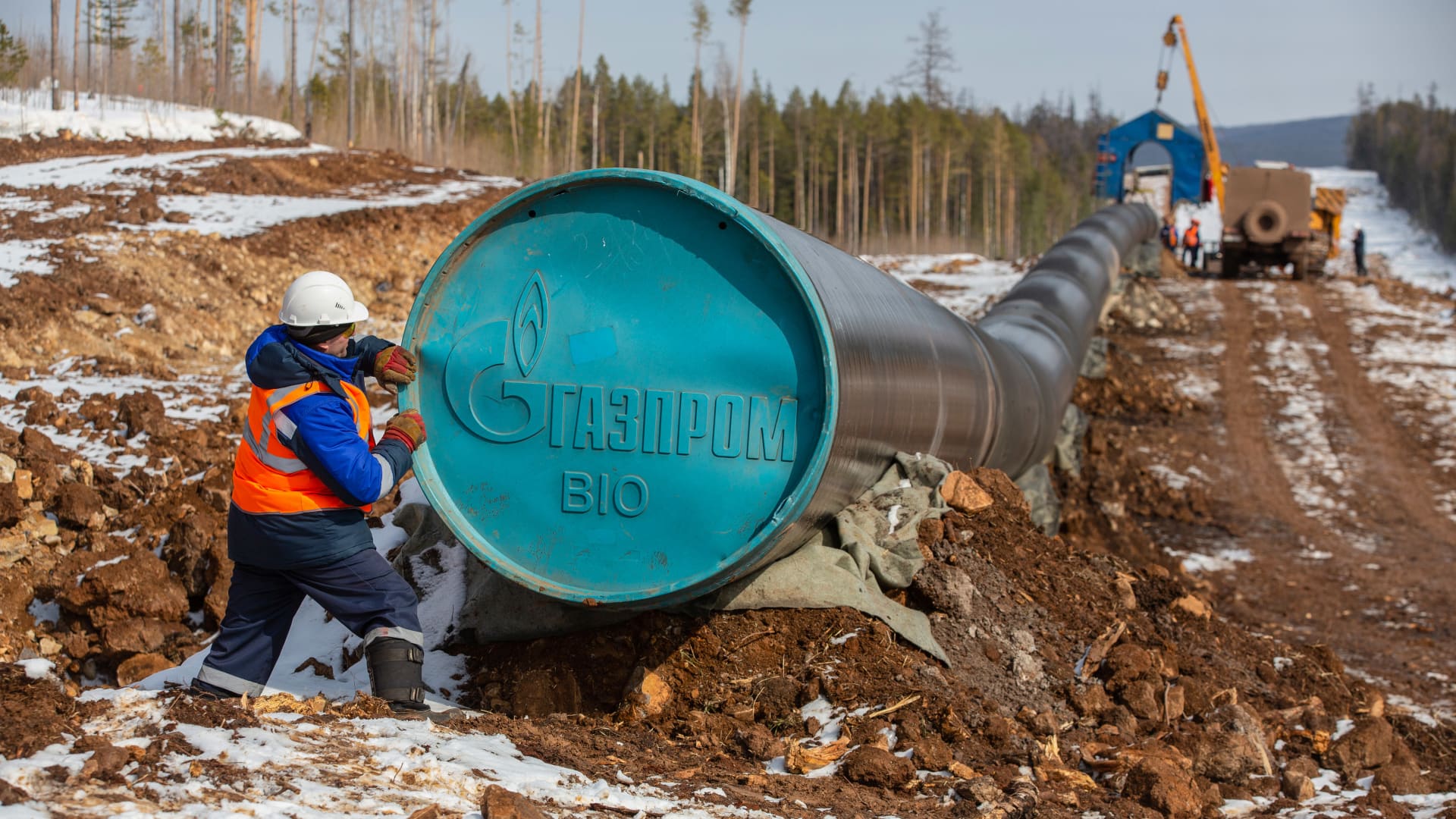
Russian state-owned energy giant Gazprom announced that it would halt gas supplies to Poland and Bulgaria after they refused to pay for gas in Russian rubles following the Kremlin’s demands.
Andrey Rudakov | Bloomberg via Getty Images
Europe could be pushed into recession if Russia’s gas squeeze widens, economists have suggested, after Gazprom cut off flows to Poland and Bulgaria.
The state-owned energy giant on Wednesday announced that gas supplies to the two Eastern European countries had ceased after they refused Moscow’s demand to pay for gas in rubles. Gazprom said that supplies would resume once these payments were made, prompting accusations of “blackmail” from Bulgarian Prime Minister Kiril Petkov.
With deadlines approaching in the coming weeks for payment from a host of other European countries that are unlikely to acquiesce to the Kremlin’s demands for ruble payment, concerns over President Vladimir Putin’s previous threats of a broad blockage of gas supplies to “unfriendly” nations have returned to the fore.
In a research note Wednesday, Berenberg Chief Economist Holger Schmieding and Senior Economist Kallum Pickering said the switch-off appeared to be a warning from Moscow that it could make good on this threat.
Gas accounts for around a quarter of the European Union’s energy generation, and Russia typically supplies around 40% of the bloc’s natural gas imports.
Europe faces concurrent economic shocks from the war in Ukraine and a surge in food and energy prices exacerbated by the conflict, which has prompted concerns about “stagflation” — an environment of low economic growth and high inflation.
Berenberg suggested that the current headwinds will likely maintain stagflationary pressures in the second quarter of 2022.
“A sudden stop of Russian gas supplies to Europe could push Europe into a recession. The precise impact of such an immediate gas embargo is hard to predict,” Schmieding and Pickering said.
“Calculations that it would lower the level of euro zone GDP in 2023 by 3 percentage points relative to a baseline call … seem to be slightly too pessimistic, in our view, but it would certainly be a major hit to activity until the end of the next cold season in the spring of 2023.”
However, such a move would also be costly for Russia and tricky to implement, and although the decision to stop flows to Poland and Bulgaria may strengthen the EU’s resolve to end its dependency on Russian gas, many member states oppose an immediate embargo of imports.
While Poland had announced plans to phase out all Russian fuel imports by the end of this year, the EU plans to drastically reduce gas purchases by the end of 2022 while working toward a total phase-out by 2030.
As such, Berenberg’s base case is that the EU will reduce gas imports as quickly as is feasible without risking a physical shortage, likely resulting in an end to imports in 2024.
“In such a case, energy prices would remain high but would likely not rise further. Europe could gradually digest the energy price shock, likely returning to significant growth over the summer unless Chinese COVID-19-related lockdowns and the resulting supply shortages were to get much worse beyond Q2,” the economists added.
However, they noted that the cessation of Russian gas flows remains a tail risk that would probably force some European countries to ration gas supplies to certain areas of industry in late 2022 or early 2023.
Euro zone inflation surged to a record-high 7.5% in March as the war in Ukraine and subsequent sanctions against Russia drove up energy prices. Russia’s move increases the upside risks to the inflation forecast, but Capital Economics Commodities Economist Edward Gardner noted on Thursday that any further rise would likely be small in comparison to those that have already occurred since the Russian invasion.
“We are currently forecasting euro-zone inflation of 7% and 3% this year and next. If European natural gas prices rose to €150 per MWh and remained there, rather than falling to €75 by the end of next year as we currently forecast, headline inflation would be 0.2ppts higher than in our forecasts,” Gardner said.
He added that Wednesday’s announcement from Gazprom increased the risk of outright gas shortages, which would “exacerbate the recession” that Capital Economics is already projecting for the euro zone in 2022.
“If Russia cut off gas exports to Germany, the government would probably ration gas consumption. Households would probably be protected, so industry (especially chemical and metallurgy) would be worst hit, causing a deep recession,” Gardner said.
