


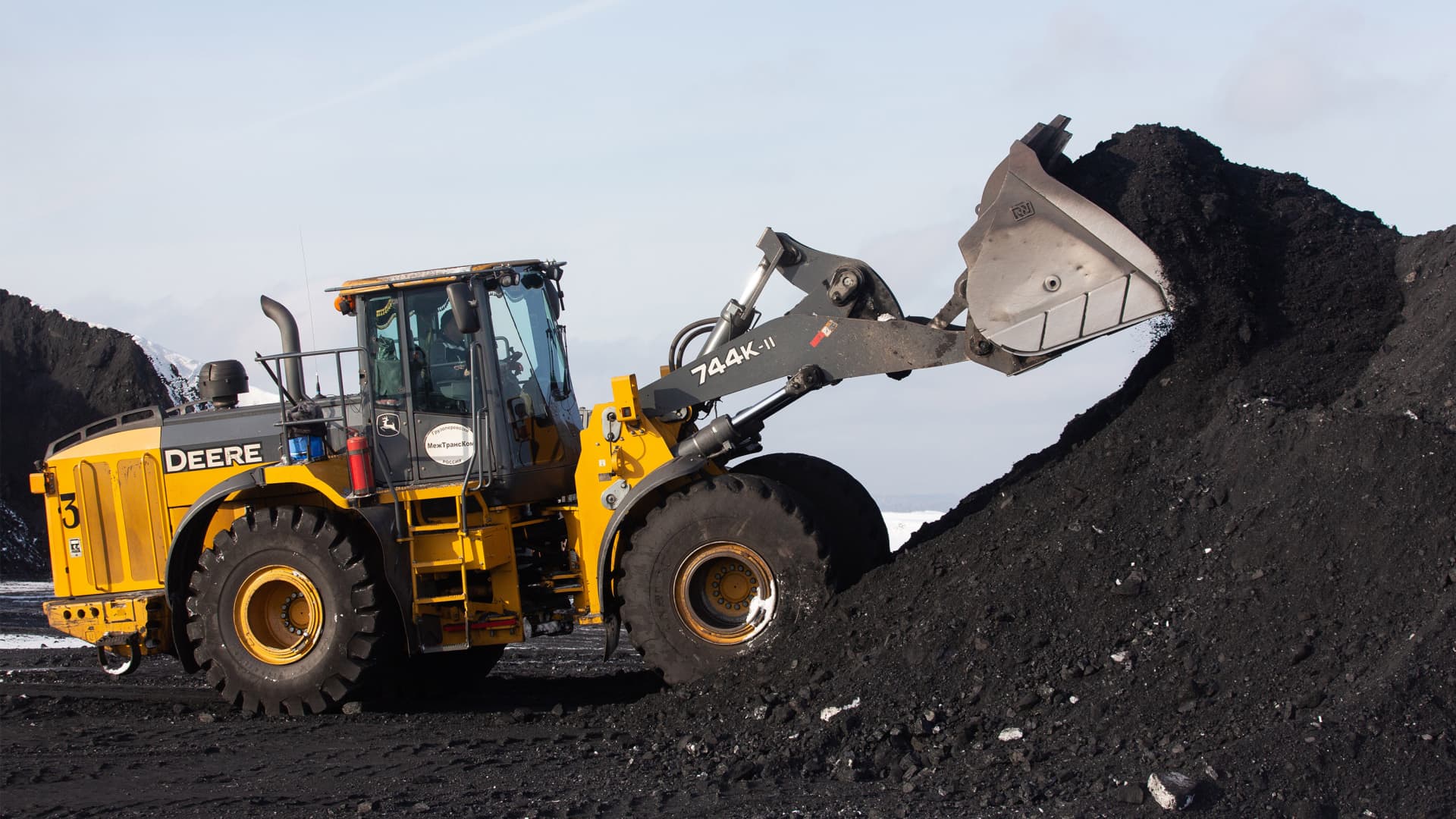
A front loader collects a shovel of coal from a pile at the Raspadsky open-pit coal mine, operated by Raspadskaya PJSC, in Mezhdurechensk, Russia, on Friday, Feb. 5, 2021.
Andrey Rudakov | Bloomberg | Getty Images
The European Union’s proposed ban on coal imports from Russia is not expected to take full effect until August — a month later than expected, two sources told CNBC Thursday.
Earlier this week, the European Commission, the executive arm of the EU, proposed the ban in the wake of mounting evidence of atrocities by Russian troops against Ukrainians in Bucha and other areas.
The original plan was to phase out coal imports within three months, an EU official, who did not want to be named due to the sensitivity of the talks, told CNBC. However, the same official added that this period had now been extended to four months — bringing the full implementation of the ban to August.
“There seems to have been an effective German lobby to extend the phase out period for existing coal contracts to four months,” a second EU official confirmed to CNBC Thursday.
Germany is one of the most skeptical nations when it comes to blocking energy supplies from Russia, but it’s not the only one. Austria and Hungary, for instance, are questioning it too.
These nations have the highest energy dependencies on Russia and argue that banning energy supplies from the country could have a bigger impact on their own economies than on Russia’s.
Germany, for instance, bought 21.5% of its coal from Russia in 2020. That number rose to 35.2% for oil imports and to 58.9% for natural gas, according to data from the European statistics office.
Approving energy sanctions has been a major challenge for the EU, given its high dependency on Russian supplies.
The region is heavily reliant on Russia’s oil and natural gas, although it is less dependent on coal imports — a key reason why this is the first energy sanction the European Commission has proposed.
Over 19% of the EU’s coal imports came from Russia in 2020, according to official European statistics. In contrast, 36.5% of its oil imports were from Russia, as were a whopping 41.1% of its gas imports.
However, momentum for a ban on Russian oil is building too.
Earlier this week, European Commission President Ursula von der Leyen said her team was working on oil sanctions.
“We are working on additional sanctions, including on oil imports, and we are reflecting on some of the ideas presented by the member states, such as taxes or specific payment channels such as an escrow account,” she said.
EU foreign affairs ministers will debate an oil ban on Monday next week, but they are unlikely to move ahead with such a measure for now as there needs to be consensus among all 27 member states to impose further sanctions.
Brent crude traded about 1.3% higher Thursday at $102.44 a barrel. Prices have been on the rise since Russia’s unprovoked invasion of Ukraine on Feb. 24.
