


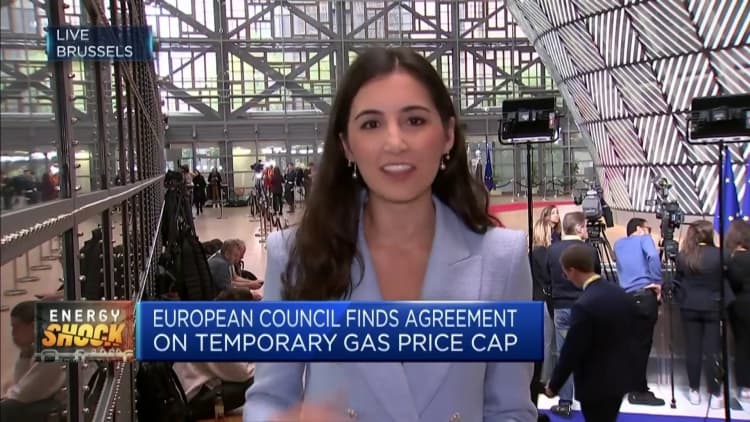
BRUSSELS — The European Union on Friday moved a person stage closer to developing a cap on gasoline price ranges following a number of months of conversations, with Germany now conceding that the strategy “makes perception.”
The EU has been battling towards an unprecedented electrical power shock stemming from Russia’s invasion of Ukraine. On the other hand, motion as a result considerably to curb gas charges has arrive typically from national governments alternatively than at the EU-extensive level.
Just one of the greatest stumbling blocks had been over irrespective of whether to impose a cap on fuel price ranges, with Germany and a couple others wary of likely market place repercussions from this plan.
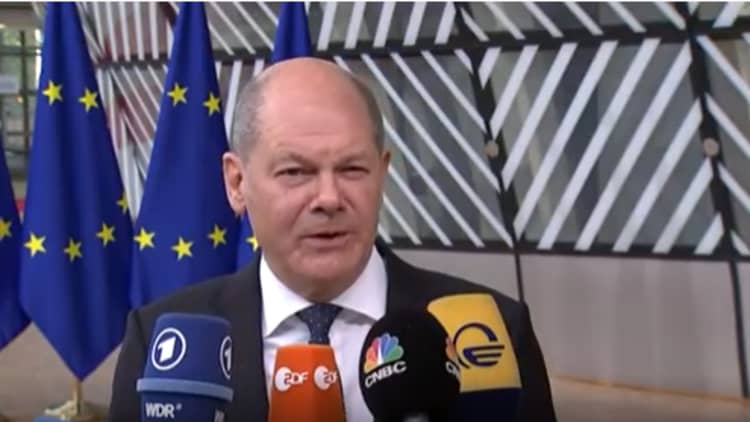
German Chancellor Olaf Scholz reported in Berlin on Thursday that this “normally harbors the chance that the producers will then sell their gasoline elsewhere.”
Having said that, after negotiations with his European counterparts that dragged into the early several hours of Friday morning, Scholz agreed to go in advance with the evaluate — albeit with caveats these as the need to have to design it in a way that it does not travel-up intake.
Belgian Primary Minister Alexander de Croo explained to CNBC on Friday that Germany experienced “reputable issues.”
De Croo mentioned that the heads of state listened to 1 an additional and seemed to bridge all their discrepancies. “This is a large phase ahead,” he extra.
Just before their accumulating started out, expectations to see the 27 leaders coming jointly on a price tag cap were being pretty small.
The prime minister of Luxembourg, Xavier Bettel, pointed out that there have been “a great deal of taboos,” but that these have been resolved through the summit.
“We did not decide everything, but we gave homework [to their energy ministers] and we ended up in a position to concur on the listing of points to do which is … a massive move,” he told CNBC.
‘Dynamic price tag cap’
The political help from all 27 heads of state indicates that, in the coming weeks, European electrical power ministers and the European Fee ꟷ the government arm of the EU ꟷ will be functioning on the technicalities of how a “short-term dynamic selling price corridor” is heading to operate.
This is predicted to set up a adaptable array for gasoline price ranges, but a lot more specific information are anticipated in the future two to 3 weeks.
After that, Belgium’s de Croo claimed that the implementation could be “pretty fast.”
Regardless of the specifics, the cap is only a short-term policy that is not envisioned to be in put after a 2nd benchmark is founded.
At the moment, European pure fuel rates are reflected by using the Dutch Title Transfer Facility. But EU leaders have agreed that this benchmark no more time displays the fact that most of them are receiving liquefied organic fuel alternatively than pipeline gasoline, and so they strategy to have a second benchmark in position by the close of the to start with quarter of 2023.
European gasoline charges have spiked in the wake of tensions with Russia, which applied to be Europe’s key seller of pure gasoline.
At their peak, costs climbed above 340 euros ($332.6) for every megawatt hour in late August. The agreement traded at about 30 euros for every megawatt hour in August 2021.
Markets seemed to have welcomed the final result of the EU leaders’ assembly with price ranges slipping from about 127 euros for every megawatt hour on Thursday to 110 euros per megawatt hour in afternoon trade on Friday.