


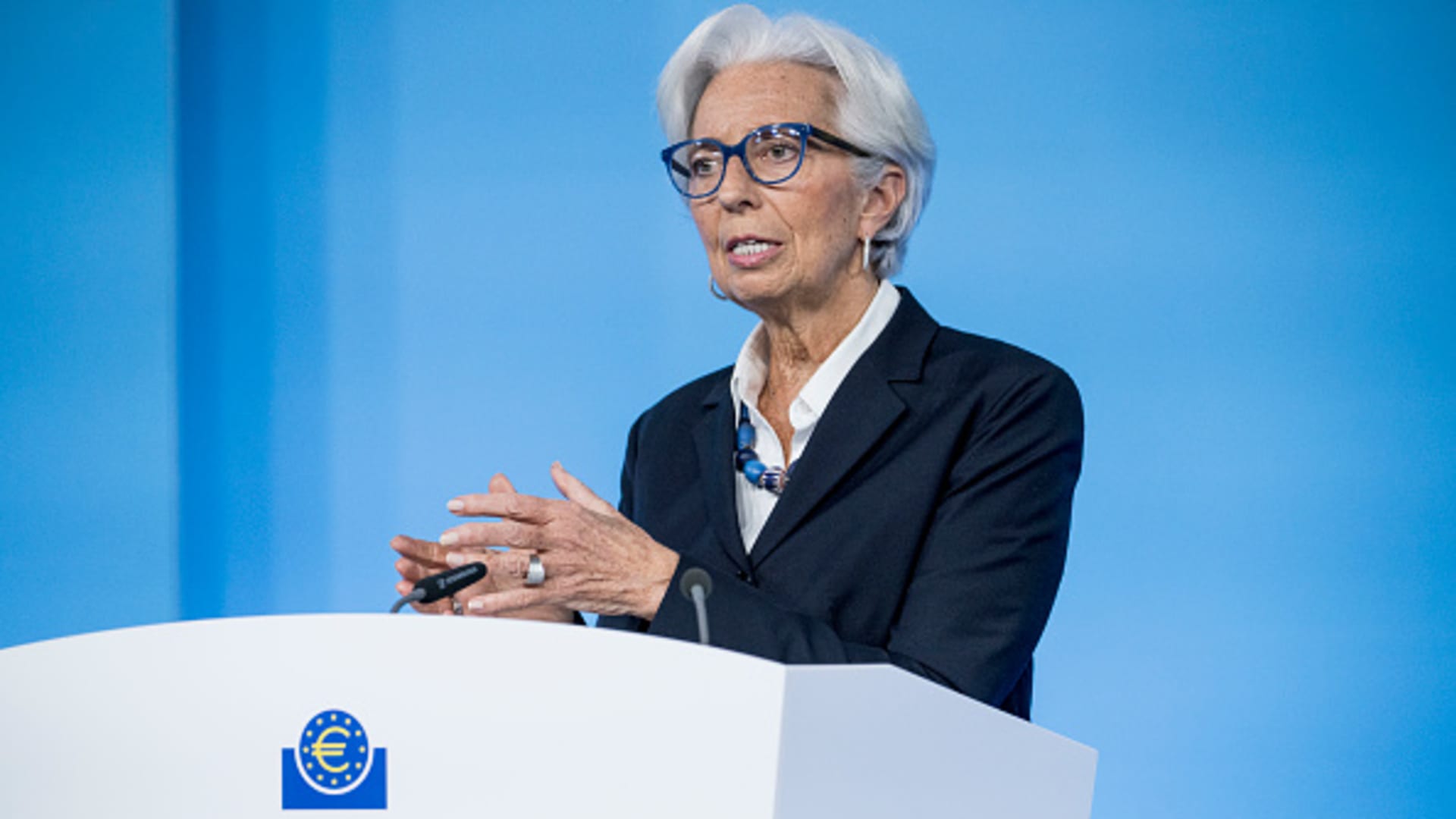
The European Central Bank faces a tough balancing act, with inflation running at record highs while the war in Ukraine casts a shadow over the growth outlook.
Thomas Lohnes | Getty Images News | Getty Images
The European Central Bank on Thursday kept its monetary policy unchanged but confirmed it will end its bond buying in the third quarter.
The Governing Council faces a dilemma, with inflation hitting a record high of 7.5% in March, while the economic growth outlook weakens due to the war in Ukraine.
The ECB said in a statement Thursday that it now expects to conclude its net asset purchases under its APP (asset purchase program) in the third quarter. It had previously said this would be the course of action if supported by the data.
“At today’s meeting the Governing Council judged that the incoming data since its last meeting reinforce its expectation that net asset purchases under the APP should be concluded in the third quarter,” the bank said Thursday.
Once the bond buying program is completed, the ECB is expected to begin hiking interest rates, following the same path as the Bank of England and the U.S. Federal Reserve.
The interest rate on the ECB’s main refinancing operations and the interest rates on the marginal lending facility and the deposit facility will remain unchanged at 0.00%, 0.25% and -0.50% respectively, the statement said.
“Any adjustments to the key ECB interest rates will take place some time after the end of the Governing Council’s net purchases under the APP and will be gradual,” the Governing Council said.
“The path for the key ECB interest rates will continue to be determined by the Governing Council’s forward guidance and by its strategic commitment to stabilize inflation at 2% over the medium term.”
Economists had broadly expected the ECB to keep policy steady for now and lay the groundwork for action at its June 9 meeting, once the uncertain outlook for growth and inflation has been established.
Minutes from the last meeting on March 10 showed the Governing Council engaged in fractious discussion over the pace of policy normalization.
The war in Ukraine and subsequent heavy sanctions on Russia, supply chain bottlenecks, high energy prices and concern about a general scarcity of commodities needed for many industrial processes have darkened the economic outlook significantly.
At the same time, inflation rates continue rising and there are tentative signs that this surge is not solely fueled by energy prices, but could be more systemic.
– CNBC’s Annette Weisbach contributed to this report.