


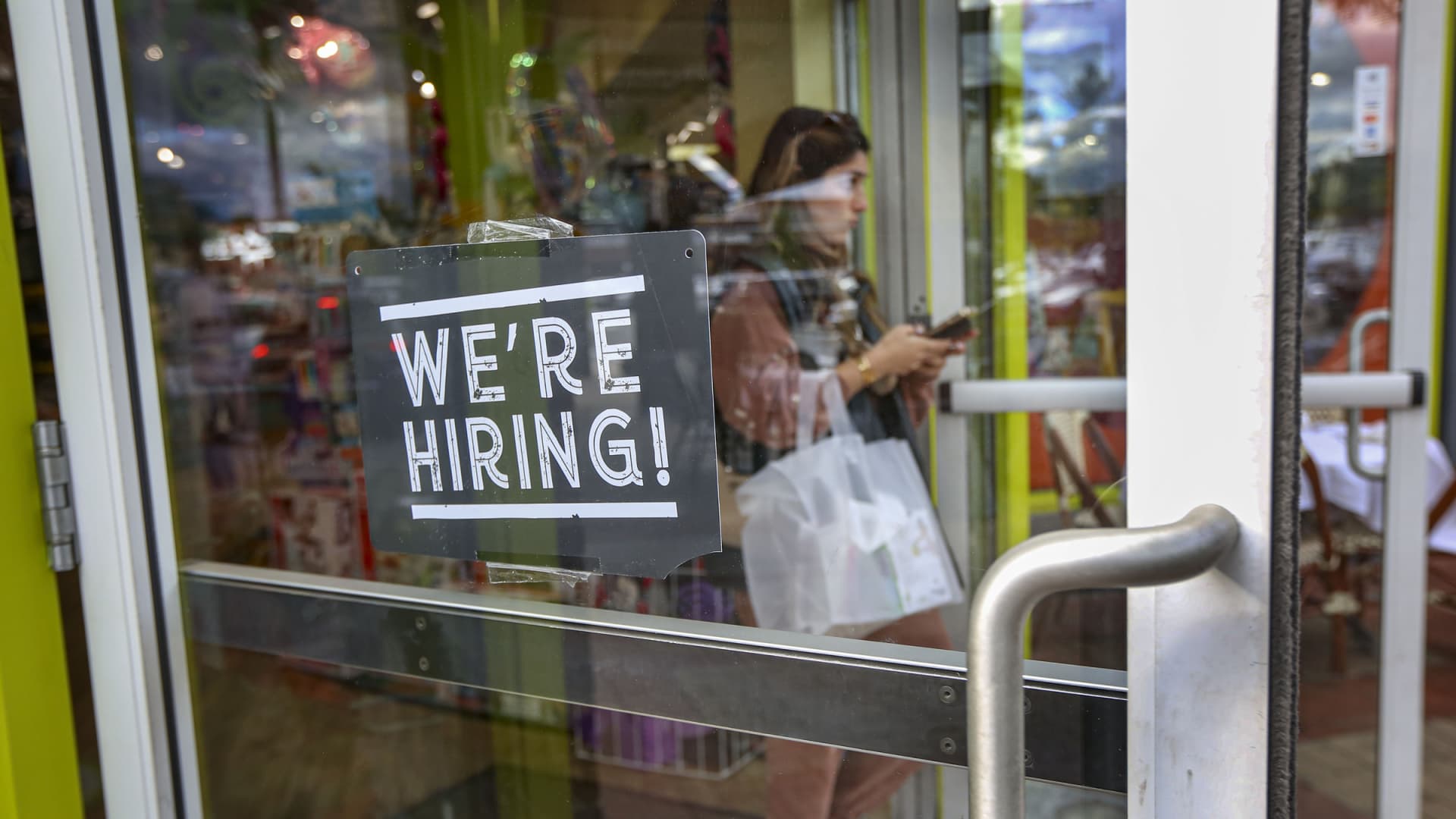
A “We’re Hiring” sign hangs on the front door of a toy store in Greenvale, New York, on Sept. 30, 2021.
John Paraskevas/Newsday RM via Getty Images
State cuts to pandemic unemployment benefits last summer had a small impact on hiring, suggesting enhanced funding for the unemployed didn’t play a big role in labor shortages, according to research.
The federal government greatly expanded the social safety net for the jobless in March 2020. It offered hundreds of dollars in additional weekly benefits to individuals and gave aid to millions of previously ineligible people, like gig workers and the self-employed.
Governors of roughly half the states, most of them Republican, withdrew federal benefits in June or July 2021 — a few months before their scheduled expiration nationwide on Sept. 6.
There was a debate as to how much the enhanced unemployment benefits were contributing to hiring challenges employers seemed to be having.
Some officials believed federal assistance kept people from looking for work; others thought factors like ongoing pandemic health risks and family care duties (kids home from school, for example) played a bigger role.
An analysis by researchers at the Federal Reserve Bank of San Francisco found states that withdrew benefits early likely didn’t experience the intended effect of spurring jobs. It compared hiring rates from July to September 2021 in the states that ended benefits relative to those that kept them intact.
Hiring picked up by 0.2 percentage points in the “cutoff” states relative to those that kept the federal funds — a “quite small” increase compared to states’ average monthly hiring rates of about 4%-5%, according to the analysis.
Put differently, if a state that maintained federal benefits had a 4.5% hiring rate, a state that cut them would have had a 4.7% rate.
“That would be pretty much imperceptible,” said Robert Valletta, senior vice president and associate director of research at the Federal Reserve Bank of San Francisco, who co-authored the analysis.
More from Personal Finance:
Stocks are dropping. What should you do?
What to do if you missed the April 18 tax filing deadline
74% of people think they’ll never achieve high-net-worth status
The hiring rate measures the number of hires during a month relative to overall employment; it serves as a “natural starting point” to assess the policy impact, the analysis said.
Earlier research into the effects of pandemic unemployment benefits have largely had similar findings.
One study in August 2021 also found little impact on jobs and suggested an early withdrawal of benefits might harm state economies. Other studies have examined a $600 weekly enhancement offered from March to July 2020 and found it didn’t prove to be a big disincentive to return to work.
However, there is some conflicting research. For example, a paper from December found a large uptick in employment among “prime age” unemployed workers (ages 25 to 54) in states that opted out of federal benefit programs in June.
Varying results boil down to different economic data sets that researchers have used to examine the dynamic, according to Valletta.
One caveat to the Federal Reserve Bank of San Francisco’s new research is that it doesn’t account for different labor market conditions in the “cutoff” states versus those that maintained federal benefits.
For example, might the small hiring impact in cutoff states be attributable to labor markets that had already rebounded to a greater degree than the other states? In this case, there might be less room for a hiring boom, which may have led to muted hiring.
It’s important to keep in mind that some meaningful fraction of people suffered real hardship.
Robert Valletta
senior vice president and associate director of research at the Federal Reserve Bank of San Francisco
Valletta and his colleagues have studied this point in preliminary follow-up work, he said. So far, they’ve also found subdued hiring rates in the other half of states (i.e., those that lost federal benefits in early September) — suggesting the elimination of benefits didn’t cause a big pickup in hiring regardless of the state’s relative labor market conditions, Valletta said.
However, Valletta and the research co-authors offer an additional way to interpret their findings: While hiring didn’t surge, evidence doesn’t suggest cutting benefits early harmed the states’ labor markets, either.
“But it’s important to keep in mind that some meaningful fraction of people suffered real hardship as a result,” Valletta said.


