



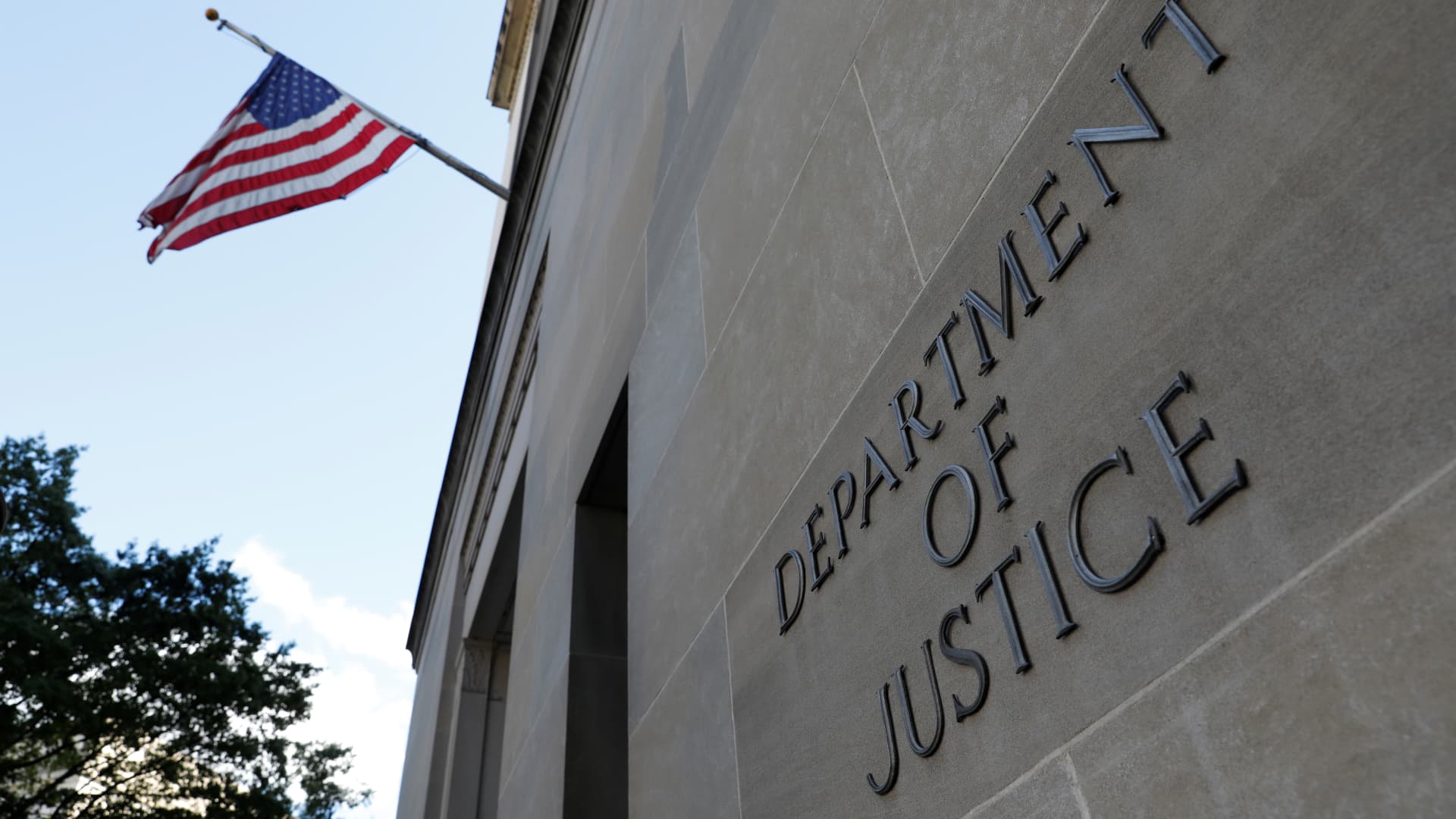
Signage is seen at the United States Department of Justice headquarters in Washington, D.C., August 29, 2020.
Andrew Kelly | Reuters
Federal prosecutors in Brooklyn have charged the founder of a U.S.-based cryptocurrency payments firm with operating what they allege was a sophisticated international money laundering scheme that moved over half a billion dollars on behalf of sanctioned Russian banks and other entities.
Iurii Gugnin, a 38-year-old Russian national living in Manhattan, was arrested and arraigned Monday and ordered held without bail pending trial.
Gugnin faces a 22-count indictment accusing him of wire and bank fraud, violating U.S. sanctions and export controls, money laundering, and failing to implement legally required anti-money laundering protocols.
“The defendant is charged with turning a cryptocurrency company into a covert pipeline for dirty money, moving over half a billion dollars through the U.S. financial system to aid sanctioned Russian banks and help Russian end-users acquire sensitive U.S. technology,” Assistant Attorney General Eisenberg said in a statement.
Prosecutors said Gugnin used his companies — Evita Investments and Evita Pay — to process about $530 million in payments while concealing the origins and purposes of the funds. Between June 2023 and January 2025, he allegedly funneled the money through U.S. banks and cryptocurrency exchanges, primarily using tether, a widely used, dollar-pegged stablecoin.
Clients included individuals and businesses linked to sanctioned Russian institutions such as Sberbank, VTB Bank, Sovcombank, Tinkoff, and the state-owned nuclear energy firm Rosatom.
To carry out the scheme, Gugnin allegedly misrepresented the scope of his business, falsified compliance documentation, and lied to banks and digital asset platforms about his ties to Russia. Prosecutors say he masked the source of funds through shell accounts and doctored more than 80 invoices, digitally erasing the identities of Russian counterparties.
Investigators also cite internet searches indicating he knew he was under scrutiny, including queries like “how to know if there is an investigation against you” and “money laundering penalties US.”
The Justice Department said Gugnin maintained direct ties to members of Russia’s intelligence service and officials in Iran — countries that do not extradite to the U.S.
He is also accused of helping the export of sensitive U.S. technology to Russian clients, including an anti-terrorism-controlled server.
Gugnin was profiled last fall in a Wall Street Journal article about high-net-worth renters in Manhattan, where he reportedly paid $19,000 per month for an apartment.
If convicted on bank fraud charges, he faces a statutory maximum sentence of 30 years in prison, but if convicted on all counts, Gugnin could be given a consecutive maximum sentence significantly longer than his lifetime.

