


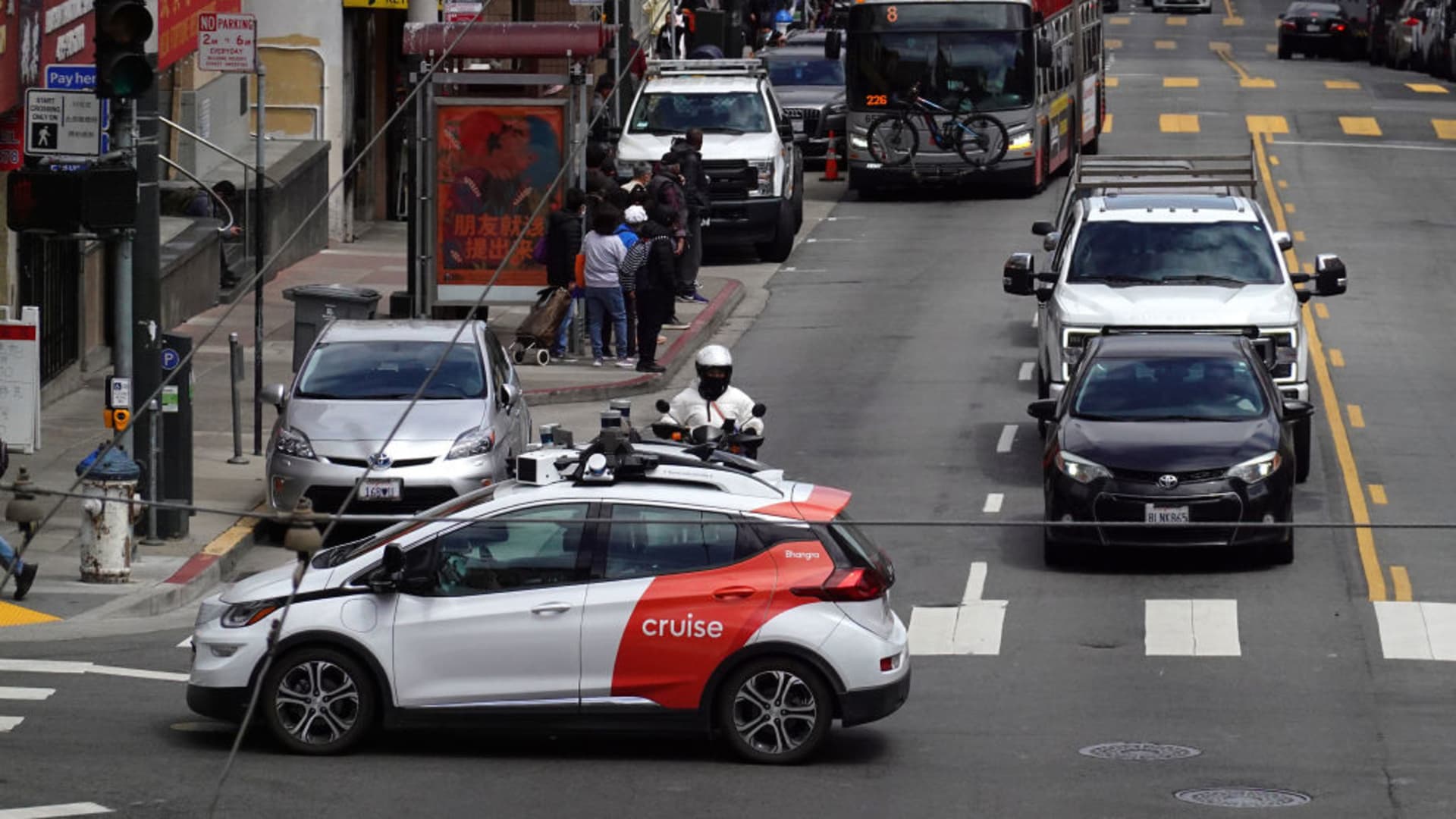
On Thursday, California regulators voted to approve spherical-the-clock robotaxi provider in San Francisco from two rival companies: Waymo and Cruise. By Friday night time, a group of Cruise vehicles experienced stopped brief in the city’s North Beach front community, flashing hazard lights and causing a website traffic backup, according to reports.
The assistance growth, authorized in a 3 to 1 vote by California’s Public Utilities Fee, created San Francisco the very first significant U.S. town to let two robotaxi companies to compete for service “at all hrs of working day or night.” It allows Waymo, owned by Google guardian-organization Alphabet, and Cruise, owned by Standard Motors, to extend their fleets as essential and demand for fares at any time of day.
But on Friday evening at about 11 p.m., pedestrians documented recognizing as a lot of as 10 of Cruise’s driverless automobiles stopped on and close to Vallejo Road in North Beach front, trapping human-driven cars for at minimum 15 minutes, according to reports. The organization cited mobile phone company challenges similar to a close by audio pageant, which it explained hampered its skill to route the motor vehicles.
Cruise did not reply to a request for comment.
The weekend website traffic jam adopted strong opposition to the regulators’ final decision from some teams, such as San Francisco’s law enforcement and fire departments. In a listening to past 7 days, officials from the city’s fireplace division, police office and municipal transportation agency prepared a report of at the very least 600 incidents with driverless automobiles considering the fact that June 2022, together with unpredictable operations in the vicinity of an crisis response zone, obstructing travel to an unexpected emergency, call or around misses with staff or products and far more.
Prior to Thursday’s vote, equally Waymo and Cruise had been confined in their means to work in San Francisco. In Cruise’s scenario, if there wasn’t a safety driver present in the car or truck, it could supply fared provider in specified places from 10 p.m. to 6 a.m. If the rides were free, it could present that provider at any time. If the car did have a safety driver, then the firm could charge for fares all-around-the-clock.
In Waymo’s circumstance, just before regulators’ selection, the company could not cost fares for experience-hailing at any time if there was not a protection driver. But if a basic safety driver was present in the automobile, then the organization could demand travellers for rides at any time.
Waymo stated it experienced far more than 100,000 signups on a waitlist for company, and in a statement Friday, Tekedra Mawakana, co-CEO of the company, explained that the company expansion “marks the true starting of our business operations in San Francisco.”
Waymo declined to share the weekend’s trip-hailing numbers with CNBC, or comment on irrespective of whether the Cruise traffic jam impacts its operations strategies going forward. But Chris Ludwick, the company’s merchandise management director, instructed CNBC in a assertion that the organization is seeing “extremely higher demand from customers” for its provider.
“We have always taken an incremental method to deploying our know-how and will proceed to grow our company and fleet in SF slowly, with safety and the demands of local communities in brain,” Ludwick additional.
In a July 25 earnings call, Cruise CEO Kyle Vogt discussed ideas to “blanket a metropolis like San Francisco” with Cruise motor vehicles, declaring the organization would want to ramp up producing if it did so, and expressed probable strategies to introduce quite a few thousand robotaxis in the location.
“You can find more than 10,000 human experience-hail drivers in San Francisco, possibly a great deal far more than that, relying on how you count it,” Vogt stated on the contact. “All those motorists, of study course, usually are not performing 20 hours a day like a robotaxi could. So it does not make a quite superior range to create significant income in a town like San Francisco. But certainly, there is potential to absorb many thousand per metropolis at minimum amount.”
