


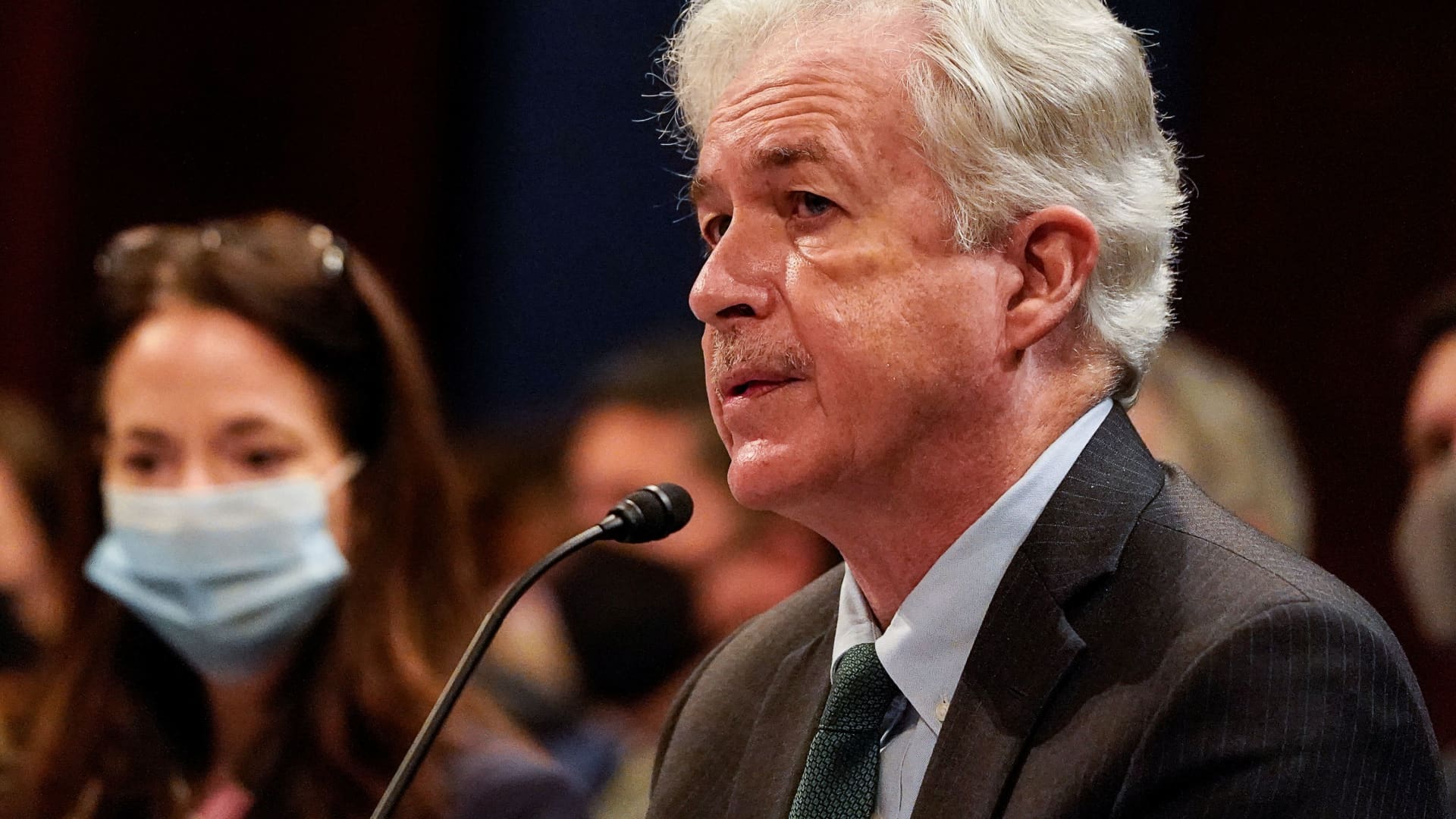
CIA Director Bill Burns testifies next to Director of National Intelligence Avril Haines during a House (Select) Intelligence Committee hearing on diversity in the intelligence community, on Capitol Hill in Washington, October 27, 2021.
Elizabeth Frantz | Reuters
CIA Director William Burns believed there was a real risk in the fall of 2022 that Russia could use nuclear weapons on the battlefield against Ukraine, though he said the West should not be intimidated by Russian President Vladimir Putin’s threats.
“None of us should take lightly the risks of escalation,” Burns said Saturday in a moderated conversation with the U.K.’s secret intelligence chief Richard Moore at the Financial Times Weekend Festival.
“There was a moment in the fall of 2022 when I think there was a genuine risk of the potential use of tactical nuclear weapons,” Burns said.
“I have never thought, however, and this is the view of my agency, that we should be unnecessarily intimidated by that. Putin’s a bully. He’s going to continue to saber-rattle,” Burns added.
At President Joe Biden’s order, Burns met with his Russian counterpart, Sergey Naryshkin, at the end of 2022 to reiterate “the consequences” of nuclear escalation, the CIA director recounted.
“We’ve continued to be very direct about that,” Burns said Saturday.
The White House did not immediately respond to CNBC’s request for comment sent outside of regular business hours.
In the more than two years since Russia invaded Ukraine in February 2022, the Kremlin has regularly signaled that it would consider using nuclear weapons in the war.
Those hints have grown louder since Ukraine’s offensive into Russia’s Kursk region in early August, which Putin has pledged to match with a “worthy response.”
The Kursk offensive boosted morale for Ukrainian troops, Burns said, and in turn, rattled the Kremlin: “It has exposed some of the vulnerabilities of Putin’s Russia and of his military.”
Russia’s official nuclear doctrine is defensive in nature and founded on the principle of deterrence. It allows the use of nuclear weapons in response to an attack with nuclear or other weapons of mass destruction against Russia or its allies, as well as a conventional attack that threatens the existence of the Russian state.
But in the wake Ukraine’s incursion into Kursk, Deputy Foreign Minister Sergei Ryabkov said last Sunday that the Kremlin is working on amendments to the nuclear code.
“There is a clear direction to make adjustment,” Ryabkov said, though he did not specify details on whether the nuclear doctrine changes would ultimately be finalized.

