


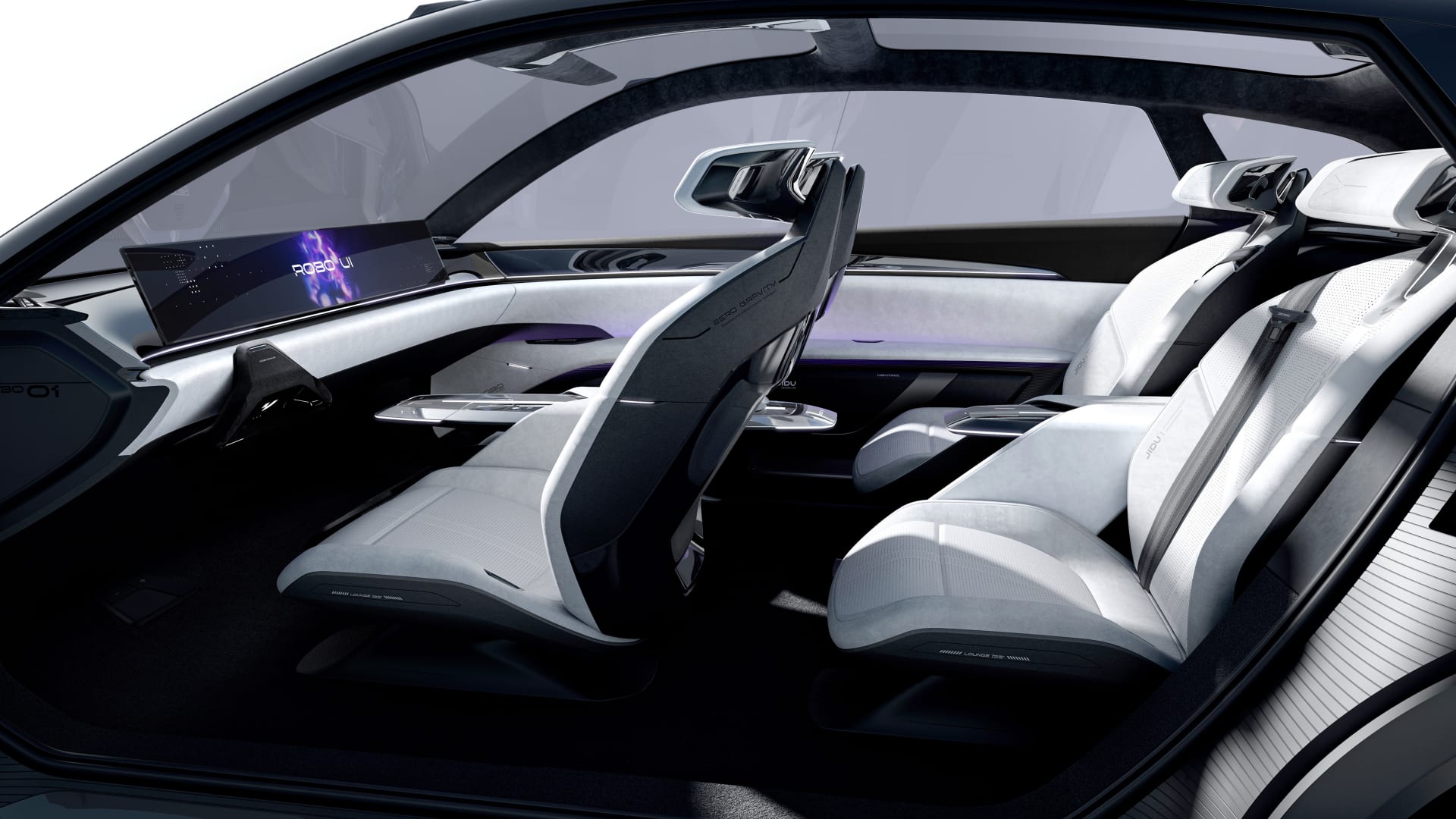
Jidu, Baidu’s electric car venture alongside Geely, revealed its first concept car on June 8, 2022.
Baidu
BEIJING — As Chinese companies race for a slice of the world’s largest car market, they’re betting heavily on assisted driving technology.
China sold nearly 21.5 million passenger cars last year. That’s roughly the equivalent of sales in the United States, Europe and Japan combined, according to industry data accessed through the Wind database.
Electric cars have grabbed a growing share of that Chinese market. Tesla, start-ups like Nio and traditional automakers have jumped in. After initially competing on battery driving range and in-car online entertainment, companies increasingly emphasize assisted driving capability.
Chinese tech giant Baidu and automaker Geely are among those rushing to make a bet on making assisted driving a reality.
Just 15 months since the companies’ Jidu electric car project launched as part of a tie-up, the brand revealed Wednesday a concept car it says is 90% of what customers will get next year for about $30,000. Tesla’s Model Y runs closer to $50,000 in China.
Evolution of ‘smart cars’
“It’s a car, and, even more so, a robot,” Jidu CEO Joe Xia said during the livestreamed event in Mandarin, translated by CNBC. “We use a concept car to quickly prove our early stage design and idea.”
The four-seat vehicle, called Robo-01, has replaced the dashboard with a long screen extending across the front of the car and removed cockpit buttons — since the driver can use voice control instead, Xia said.
Theoretically, the half-moon of a steering wheel can fold up, paving the way for a cockpit seat with no window obstructions, once full self-driving is allowed on China’s roads. Two large external sensors for assisted driving can retract, for aesthetics and for protection in the event of an emergency.
Xia claimed Jidu “can become the standard for self-driving cars.” But the company declined to share what level of assisted driving software would come with the car.
Consumers are considering two important factors in intelligent vehicles. First of all, the most important one is autonomous driving.
Xuan Liu
vice president, DeepRoute.ai
Many electric cars, including Tesla, Nio and Xpeng, offer some form of tech-enabled driving assistance. In late May, Chinese self-driving tech start-up WeRide said it received a strategic investment from German engineering company Bosch to produce an assisted driving software system for mass production and delivery next year.
“I think the definition of smart cars has evolved a lot,” said Xuan Liu, vice president at autonomous driving software start-up DeepRoute.ai, said in a phone interview Wednesday.
“Consumers are considering two important factors in intelligent vehicles,” he said. “First of all, the most important one is autonomous driving. I think they are also interested in this so-called intelligent cabinet, so they want the interaction with the vehicle system.”
Jidu plans to launch a limited version of its first production model in the fall. Deliveries are set to begin next year, with a target market of family passenger vehicles priced above 200,000 yuan ($29,985), Baidu CEO Robin Li said on an earnings call in late May.
Baidu has majority ownership of Jidu, and the search giant has rolled out commercial robotaxis in parts of China using its Apollo autonomous driving system. That’s the same system, along with other tech from Baidu, that will be used in Jidu’s concept car (above).
Baidu
Baidu has majority ownership of Jidu, and the search giant has rolled out commercial robotaxis in parts of China using its Apollo autonomous driving system. That’s the same system, along with other tech from Baidu, that will be used in Jidu’s concept car.
Co-investor Geely did not have an official release about Jidu’s concept car, after increasing its capital support earlier this year.
Geely has pushed into the electric car industry with its own vehicles, and announced in November a multi-year plan to build up the software component of the cars. The automaker said it aimed to commercialize full self-driving under specific conditions, called “Level Four” autonomous driving in a classification system, by 2025.
Earlier this month, Geely announced its subsidiary has launched the first nine of 72 satellites to support mapping and autonomous driving.
Competing for customers
Though electric car sales have surged, interest in Jidu’s first concept car appeared modest.
About 50,000 people viewed one of the main streams on the WeChat messaging app Wednesday night.
In contrast, Nio’s annual car release event in December drew about 200,000 views, though it included a musical performance. That event introduced a new sedan and custom augmented reality glasses that can impose digital images over the real, physical world.
For companies focused on self-driving technology, they’re looking at a market at least a year or two into the future.
For Chinese consumers, the main draw of self-driving cars is getting assistance during the commute home after a long day at work, Liu said. As for the business side, it’s the possibility that lower software costs will speed up widespread use, he said.
DeepRoute.ai in April announced it cut the price of autonomous driving software from $10,000 per car to $3,000. Liu said the company was able to slash the price by using cheaper sensors but better software, and he expected the price could fall further once the start-up is able to work with automakers for mass production and deployment from 2024 onward.
While regulators have yet to allow full self-driving cars on most roads en masse, companies like DeepRoute.ai, Baidu and others are building data records through their robotaxi operations.
Liu said such data can help improve algorithms for self-driving technology, and build a track record to support potential changes in regulation.

