


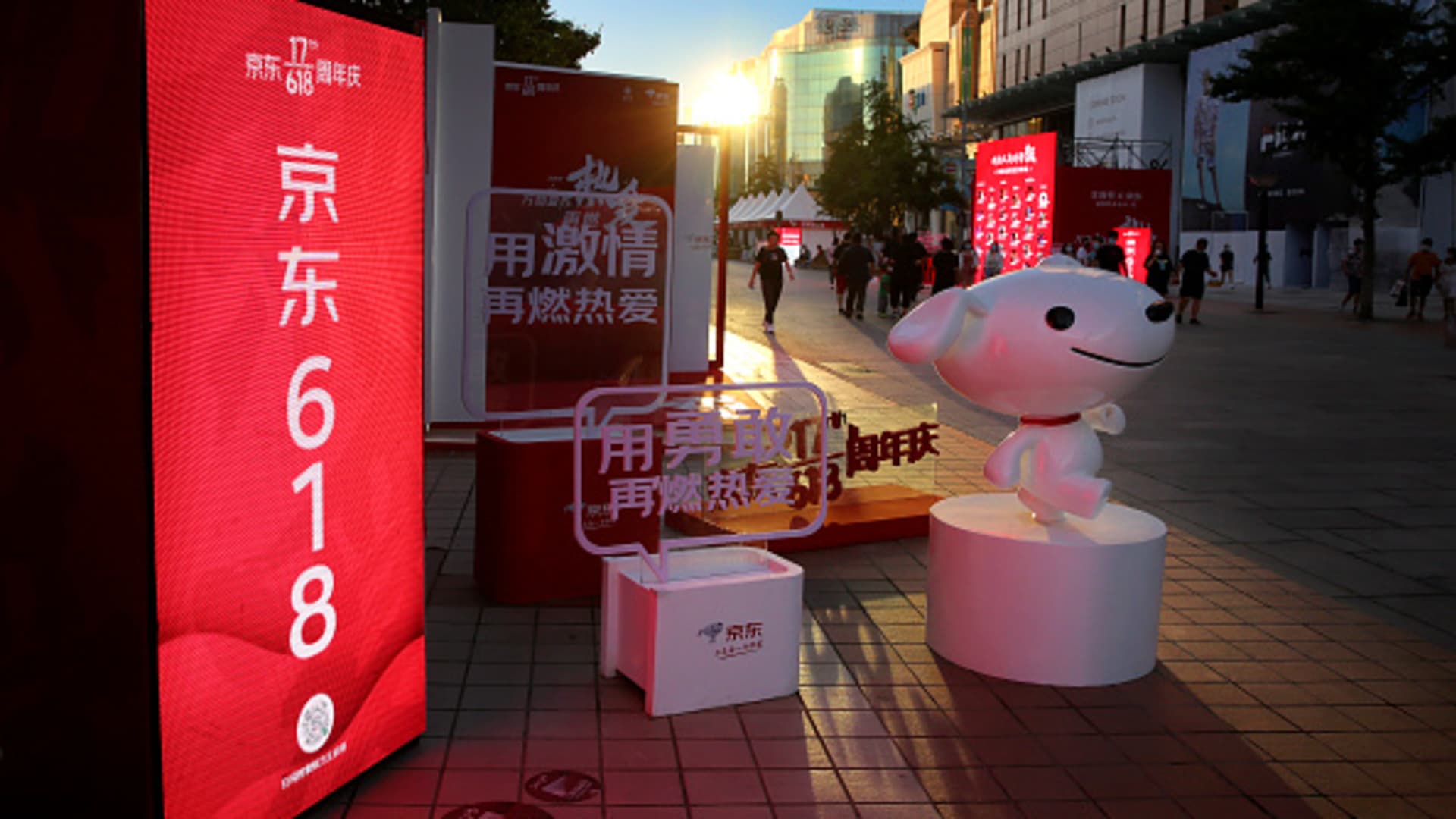
China’s annual 618 shopping festival sees domestic e-commerce giants including JD.com rack up billions of dollars of sales across their platforms. The 2022 edition comes against a backdrop of slowing economic growth in China and sluggish consumer spending.
VCG | Getty Images
EMBARGO to lift at 6am Singapore on Friday, June 17
Regulation on China’s technology sector is not loosening, it’s just becoming more “rational,” a top executive at e-commerce firm JD.com told CNBC.
Over the past 16 months, Beijing has enacted sweeping regulation on the internet industry, a move that has contributed to billions of dollars of value being wiped off from China’s internet sector.
But a resurgence of Covid in China, accompanied by lockdowns in major parts of the country, has hurt economic growth. The government is looking for ways to boost the economy, and there are signs the crackdown on technology companies may be easing.
Xin Lijun, CEO of JD Retail, told CNBC in an interview aired on Friday, that regulation is not necessarily easing, but it is becoming more stable.
… as the regulation becomes more stable, the overall development [of the internet sector] and the market will be more stable.
“In fact, each country follows the same path when developing a certain areas, China and U.S. included, which is to encourage innovation and provide loose environment at the early stages, and then conduct moderate regulation when the sector develops to a certain level,” Xin said.
“The Chinese tech sector or internet sector is going through this process. Thus I wouldn’t say regulation [is] loosening. I’d say regulation [it] is conducted in a more rational way.”
China’s tech crackdown came in thick and fast in areas from antitrust to data protection and seemed to have taken investors off guard with the speed in which it was enacted. But more recently, regulatory action appears to be less intense.
“The current regulation is gradually going onto a normal track. It’s normal that there might be some unexpected negative impacts when trying to impose regulation on a new sector. But as the regulation becomes more stable, the overall development [of the internet sector] and the market will be more stable.”
JD.com has largely escaped major regulatory action — unlike its rival Alibaba which was hit by a $2.8 billion antitrust fine last year.
Last month, China’s Vice-Premier Liu He pledged support for the technology sector and plans for internet companies to go public, in a sign of potentially more supportive policies.
Shopping festival clouded by Covid
Xin spoke to CNBC ahead of the 618 shopping festival which takes place on June 18 every year. However, in recent years, 618 has tended to stretch over a number of days leading up to day.
It’s usually a multi-day period of big discounts in which China’s e-commerce giants JD.com, Alibaba and Pinduoduo rack up billions of dollars worth of sales across their platforms.
But this year’s edition comes against a backdrop of Covid resurgence in China that has led to lockdowns in major cities, most notably the financial powerhouse of Shanghai. Economists are predicting a slowdown in the Chinese economy this year while consumer spending remains under pressure.
A certain level of slowdown in China’s economic growth also affects Chinese consumers’ willingness or confidence to consume.
Xin Lijun
CEO of JD Retail
In May, retail sales fell 6.7% year-on-year, though that was less than expected.
Xin said the pandemic resurgence and China’s Covid policies have affected merchants with physical stores because they’ve had to close or suspend operations. Some of JD’s logistics operations were also suspended.
The Chinese consumer has also been affected and Xin said this was seen in the lead-up to this year’s 618 sales period.
“A certain level of slowdown in China’s economic growth also affects Chinese consumers’ willingness or confidence to consume,” Xin told CNBC. “Of course we are optimistic about Chinese economy in the long run, but it is under pressure in short term.”
The CEO of JD’s largest business segment said he’s optimistic about the Chinese economy in the second half of this year.
“The government has been introducing massive policies together with companies and I believe these measures should show effects in Q2 and Q3. I believe the Chinese economy is going to improve in H2 and show better performance for next year,” Xin told CNBC.
He also said that JD has introduced some measures to help merchants during 618, such as cutting fees on the platform as the economy slows down.

