




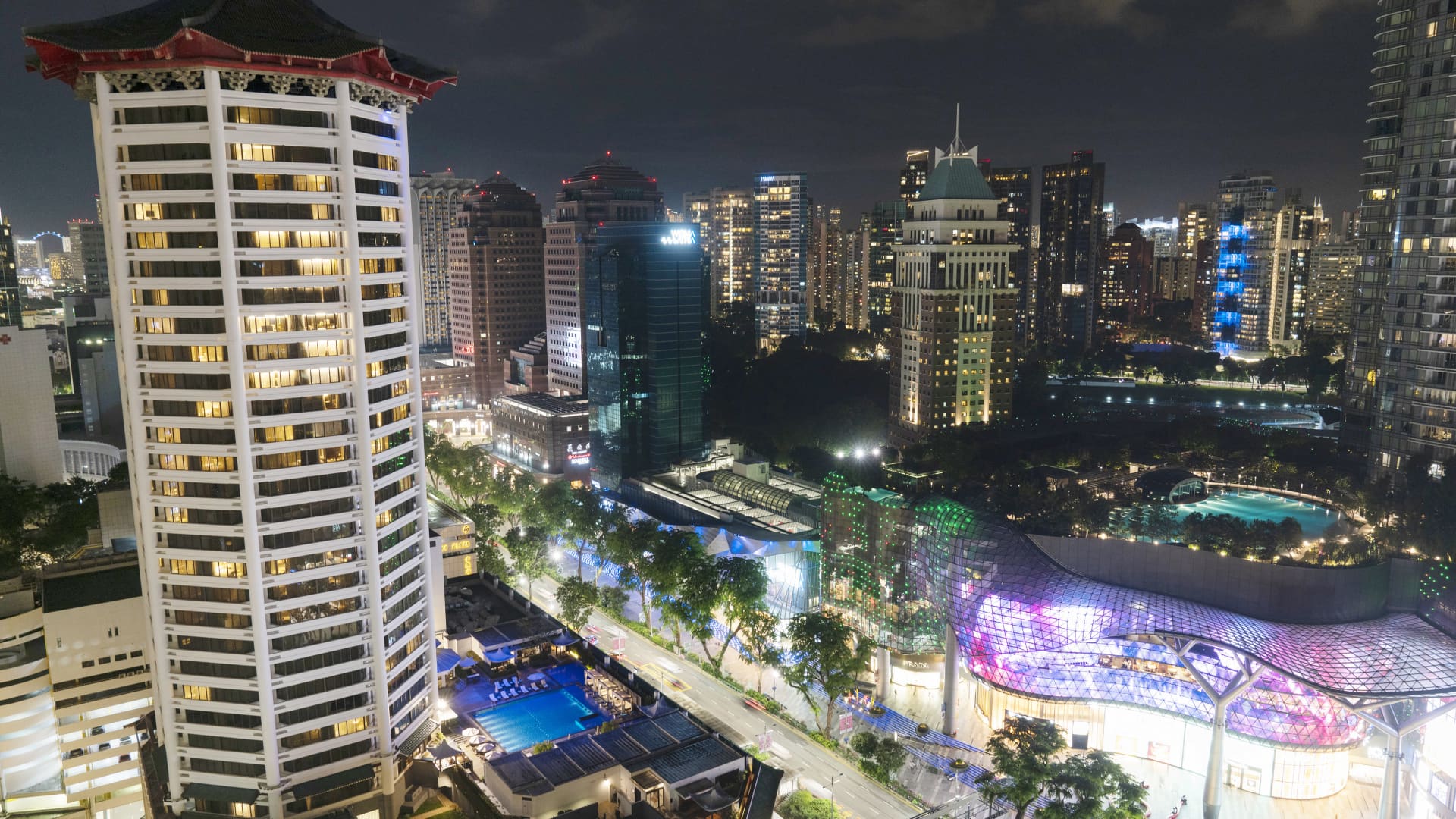
As Beijing pushes for “common prosperity” and political turmoil threatens Hong Kong, Singapore has become a safe harbor for some of the region’s wealthiest tycoons and their families.
Wei Leng Tay | Bloomberg | Getty Images
More and more wealthy Chinese are worried about keeping their money on the mainland and some see Singapore as a safe haven.
Since protests disrupted Hong Kong’s economy in 2019, affluent Chinese have looked for alternative places to store their wealth. Singapore proved attractive because of its large Mandarin Chinese-speaking community and, unlike many countries, it doesn’t have a wealth tax.
The trend appeared to pick up last year after Beijing’s sudden crackdown on the education industry and emphasis on “common prosperity” — moderate wealth for all, rather than just a few.
That’s according to CNBC’s interviews with firms in Singapore that are helping wealthy Chinese move their assets to the city-state via the family office structure.
A family office is a privately held company that handles investment and wealth management for an affluent family. In Singapore, setting up a family office typically requires at least $5 million in assets.
Over the last 12 months, inquiries about setting up a family office in Singapore have doubled at Jenga, a five-year-old accounting and corporate services firm, according to its founder Iris Xu. She said the majority of inquiries come from people in China or emigrants from the country.
[Wealthy Chinese] believe there are plenty of opportunities to make a fortune in China, but they are not sure whether it is safe for them to park money there.
About 50 of her clients have opened family offices in Singapore — each with at least $10 million in assets, Xu said.
China’s rapid economic growth has minted hundreds of billionaires in just a few decades. Hundreds more joined their ranks their last year, according to Forbes.
That brought the total number of billionaires in China to 626, second only to the United States’ 724 billionaires, the data showed.
But mainland China’s tight capital controls — an official limit of $50,000 in overseas foreign exchange a year — limit these billionaires’ options for investment and keeping their wealth secure.
Xu said her Chinese clients “believe there are plenty of opportunities to make a fortune in China, but they are not sure whether it is safe for them to park money there,” according to a CNBC translation of the interview in Mandarin.
‘Common prosperity’ worries
New family office-related work is coming disproportionately from Chinese clients, said Ryan Lin, a director at Bayfront Law in Singapore. His firm also has clients from India, Indonesia and parts of Europe.
Although capital controls mean many Chinese clients are opening family offices with smaller amounts of capital, Lin said most own revenue-generating business outside the mainland.
Family office as a way to immigrate
Covid-related restrictions on international travel also accelerated the interest of wealthy Chinese in establishing family offices in Singapore, Xu said. The country has a global investor program that allows adults who invest at least 2.5 million Singapore dollars ($1.8 million) to apply for permanent residency.
Since the pandemic began, some Chinese citizens found that China’s government could suspend passport issuing and renewal services on grounds of virus control.
In response to an online question in August about passport suspension, China’s National Immigration Administration said it would issue such documents only to those with essential or emergency reasons for leaving the country.
Singapore’s family office boom
Many billionaires worldwide have used family offices to manage their wealth. Another part of Singapore’s appeal is that its location gives investors proximity to other investment opportunities in Asia.
Since late 2020, Bridgewater founder Ray Dalio and Google co-founder Sergey Brin have opened family offices in Singapore to take advantage of its friendly tax policy, according to Bloomberg reports.
How long can it last?
The ongoing war between Russia and Ukraine has brought uncertainty to Chinese citizens who want to open family offices in Singapore.
China has said it opposes sanctions. Beijing has also refused to call Russia’s attack on Ukraine an invasion, and state media often blames the U.S. for the conflict.
In contrast to China’s attempt to take a neutral stance on the war, Singapore joined the U.S. and the EU in imposing sanctions on Russia earlier this month, reportedly freezing local bank accounts held by sanctioned Russian individuals and entities.
Jenga’s Xu said the news of the asset freeze gave some potential Chinese clients pause in their plans to open a family office in Singapore.