


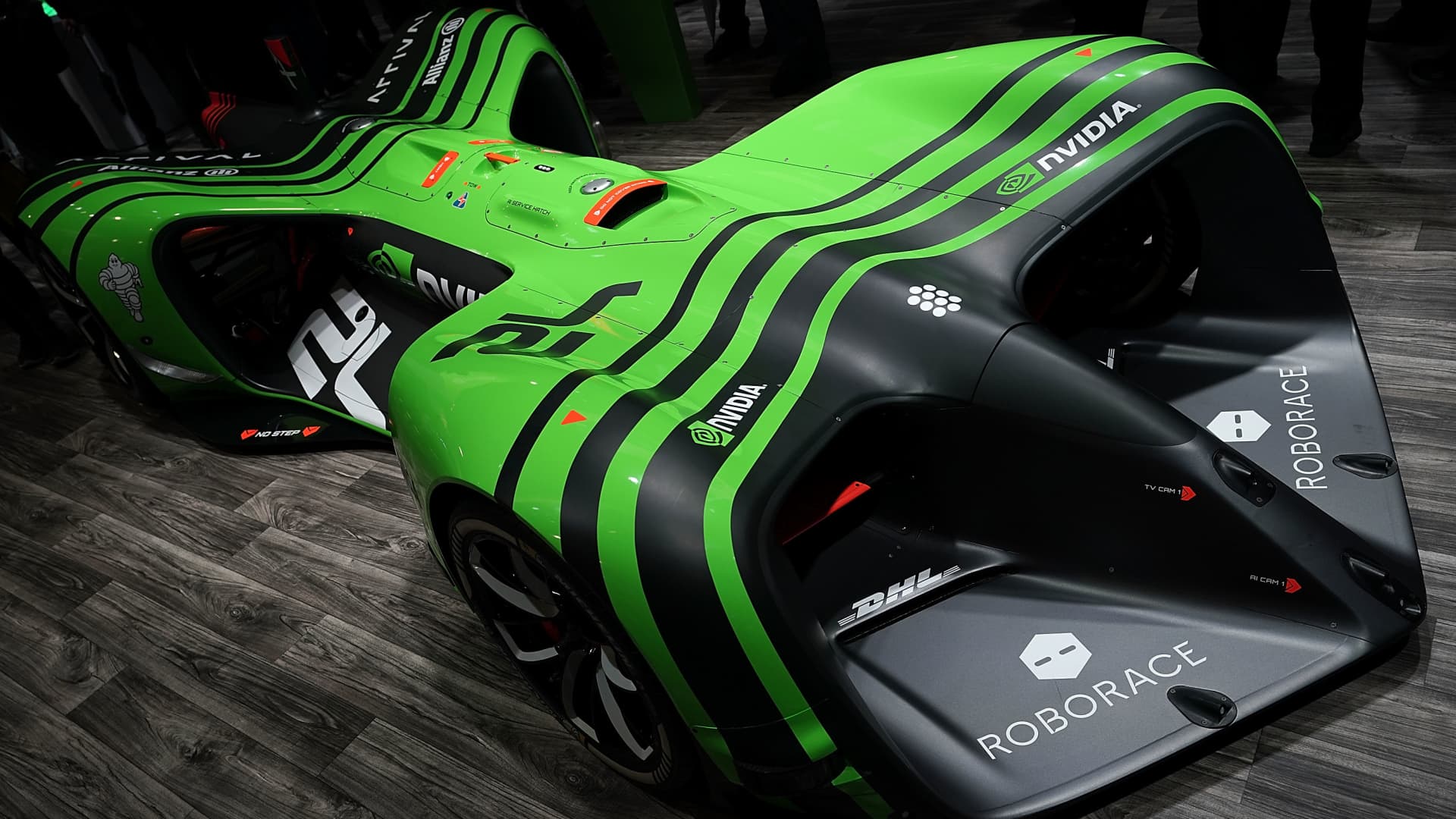
Nvidia automotive segment primarily sells chip systems for assisted driving. CEO Jensen Huang has touted it as the company’s “next billion-dollar business.”
Alex Wong | Getty Images News | Getty Images
BEIJING — U.S. chipmaker Nvidia this week soundly beat analysts’ expectations for major revenue lines — except in automotive — as Chinese demand for electric cars moderates.
The automotive segment primarily sells chip systems for assisted driving. Nvidia CEO Jensen Huang touted it last year as the company’s “next billion-dollar business.”
But the unit’s growth has slowed this year. Huang didn’t repeat such projections in the latest earnings call.
In the three months ended July 30, automotive revenue fell by 15% from the prior quarter — the first sequential decline in more than a year.
The sequential decrease primarily reflects lower overall auto demand, particularly in China.
Colette Kress
Nvidia’s Chief Financial Officer
The $253 million segment revenue was also well below the $309.3 million forecast by a FactSet analyst poll.
“The sequential decrease primarily reflects lower overall auto demand, particularly in China,” Nvidia’s Chief Financial Officer Colette Kress said in a statement on the quarterly results.
She said demand for self-driving systems helped automotive revenue grow by 15% from the year-ago period.
Although still a fraction of the chipmaker’s business, automotive revenue has grown rapidly from just over $100 million a quarter two years ago.
China is the world’s largest auto market. In the last few years, the country has become a driver of the global push toward electric cars.
Local EV players such as BYD and Xpeng are creating stiff competition for traditional automakers, partly by playing up technological features.
Chinese original equipment manufacturers are Nvidia’s primary market, said Brady Wang, associate director at Counterpoint Research.
He said the sequential automotive revenue decline could be the result of excess inventory among Chinese manufacturers, as well as their downward revisions of sales forecasts for high-end vehicles in the coming two quarters.
Xpeng exec joins Nvidia
Nio, which sells premium-priced electric cars, is set to release quarterly results on Tuesday. Earlier this month, Xpeng reported a wider-than-expected loss in the second quarter.
Xpeng is one of the few local electric car companies to offer driver-assist software in select Chinese cities. Tesla’s “Full Self-Driving” tech for navigating city streets isn’t fully available yet in China.
On Thursday, Xpeng’s former head of autonomous driving, Xinzhou Wu said he was starting a new job at Nvidia on Friday. That’s according to Wu’s statement on social media, which included a repost of a picture of himself with Xpeng CEO He Xiaopeng and Nvidia’s Huang.
Nvidia is building out an automotive tech business. Pictured here are its autonomous vehicle test cars at the company’s auto garage in Santa Clara, California, on June 5, 2023.
Bloomberg | Bloomberg | Getty Images
Counterpoint’s Wang pointed out that Nvidia’s products are concentrated in the high-end automotive segment. “In the mid-range market, NVIDIA still faces competition from other vendors, such as Horizon Robotics, Mobileye, and some startups,” he said.
Other automotive chip companies are also seeing sequential revenue declines in the segment.
Analog Devices on Wednesday reported automotive revenue of $747.6 million for the three months ended July 29, down by 5% from the prior quarter.
“We think [Analog Devices] may well be a leading indicator of the cresting of the automotive chip cycle,” David Wong, a technology strategy research analyst at Nomura, said in a report Thursday. He pointed out that Mobileye‘s and Qualcomm‘s automotive chips also saw quarter-on-quarter revenue declines.
A $10 billion-plus opportunity
Nvidia jumped into the automotive opportunity relatively recently.
In an annual report in late February 2022, the company claimed it had $11 billion worth of automotive projects lined up over the next six years.
A year later, Nvidia said in its annual report that automotive project pipeline was now worth $14 billion over the next six years.

But in May, Nvidia said quarter-on-quarter automotive revenue growth “moderated as some NEV customers in China are adjusting their production schedules to reflect slower-than expected demand growth.”
The company said it would “expect this dynamic to linger for the rest of calendar year.”
In July, retail sales of new energy passenger cars fell by 3.6% from June to 641,000 vehicles, according to the China Passenger Car Association. It said sales for the first seven months of the year are up by about 36% from a year ago.
The slowdown in the fast-growing segment comes as penetration of new energy vehicles, which include hybrid and battery-powered cars, this year reached about one-third of new passenger cars sold in China, according to trade association data.
Longer term, car manufacturers are still planning to buy parts for assisted-driving capabilities.
Hesai, which makes light detection and ranging (LiDAR) units often used for driver-assist systems, this month reported second-quarter revenue of 440.3 million yuan ($60.7 million), beating the company’s earlier guidance.
The company shipped about 60,000 assisted-driving LiDAR units last year and has already exceeded that in the first half this year. In all, CEO David Li expects the number of units to more than double this year.
He said the company is shipping with six original equipment manufacturers this year, with 11 planned for next year.
“It’s not really because of the hardware itself.”
“It’s about the combined experience the OEMs are providing to the customer as an ADAS function,” he said referring to the advanced driver-assistance system.
Hesai this month announced further collaboration of its products with Nvidia’s autonomous driving system and simulation platform.