


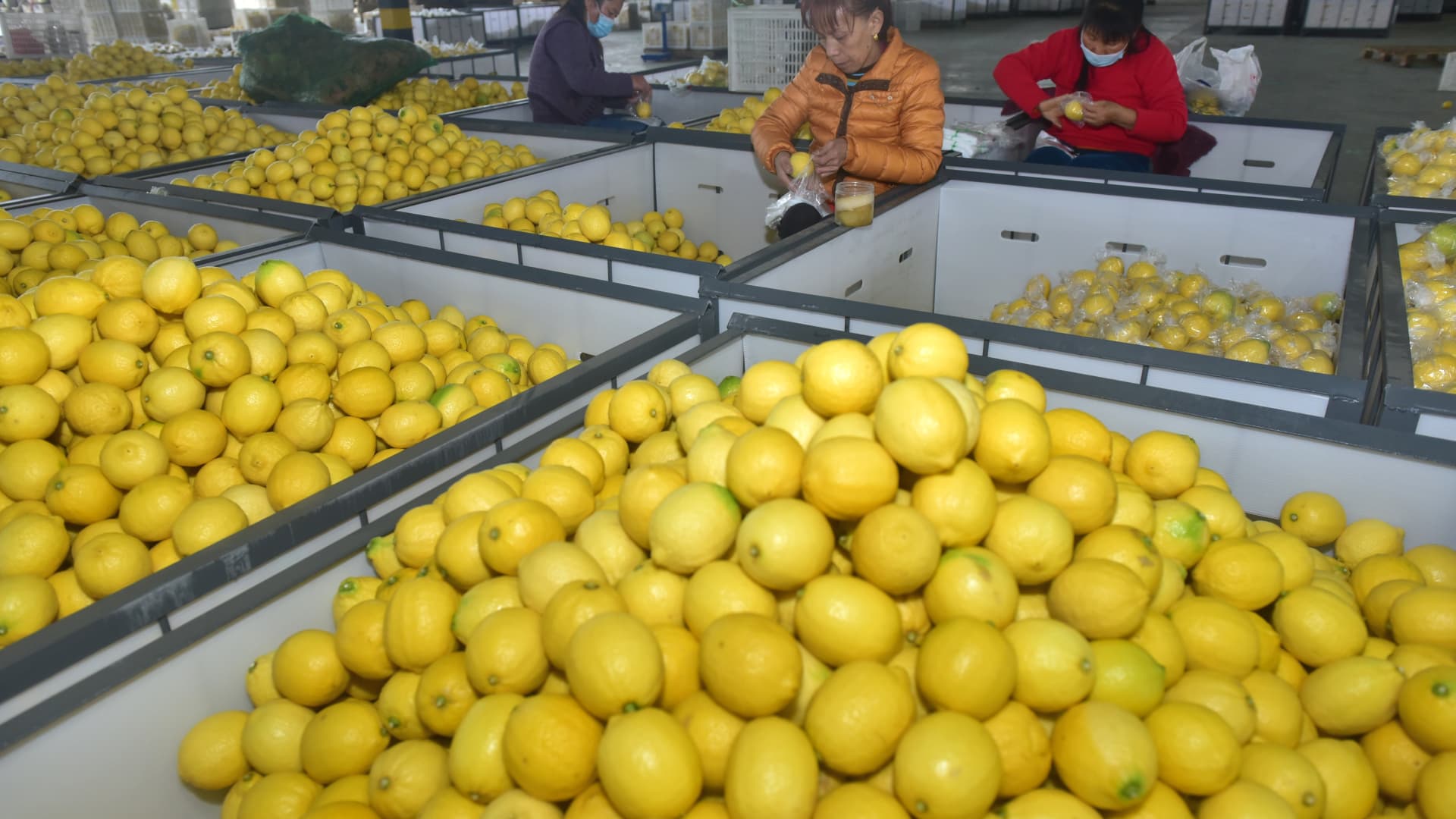
Farmers sort and package lemons at a workshop on November 24, 2020 in Neijiang, Sichuan Province of China.
Huang Zhenghua | Visual China Group | Getty Images
Covid cases in China saw a spike following the country’s relaxation of strict Covid rules. Also rising: the prices of traditional Chinese medicine and lemons, as Chinese citizens scramble for protection from the virus.
Prices of fruits rich in vitamin C and antioxidants are seeing surges due to higher demand.
This month, one grocery store in Beijing charged 13 yuan ($1.86) for two lemons, which is about twice the typical price.
Other locals have taken to social media platforms such as Weibo to complain about lemon inflation, with one user saying she forked out 12 yuan ($1.72) for three lemons.
“I did not know that lemon prices could triple in one day,” posted another Weibo user.
At one point, lemons were out of stock in Chengdu on e-commerce platform Dingdong Maicai, according to a local media report.
Canned peaches are seeing a swell in demand. Fresh Hippo, another e-commerce merchant owned by Alibaba, reported that week-on-week sales of canned yellow peaches popped almost 900%.
A notice is posted at a community health service station in Beijing, China, December 14, 2022, showing that Chinese patent medicines such as Lianhua Qingwen granules are temporarily out of stock.
CFOTO | Future Publishing | Getty Images
Shares of Chinese pharmaceutical companies involved in the production of traditional Chinese medicine notched their highest levels in a year earlier this month, following a spike in Covid caseloads and endorsements by officials for the herbal remedies.
Shijiazhuang Yiling Pharmaceutical, which produces the popular herbal treatment Lianhua Qingwen, surged 184% in early December from a year earlier.
China Resources Sanjiu Medical & Pharmaceutical similarly saw a more than 142% spike in the end of November compared with the same period last year.
The president of the Beijing Hospital of Traditional Chinese Medicines, Liu Qingquan, said in a December briefing that traditional Chinese medicine, if taken with Western remedies, “has a very good effect” on stimulating gastrointestinal functions as well as treating fever and other symptoms linked to the Omicron strain.
In the past few weeks, local and central government authorities in China U-turned from their draconian zero-Covid measures which, among other things, had required people to stay home and many businesses to operate mostly remotely.
On Monday, China announced that inbound travelers no longer need to quarantine upon arrival on the mainland starting next year.
– CNBC’s Evelyn Cheng contributed to this report


