


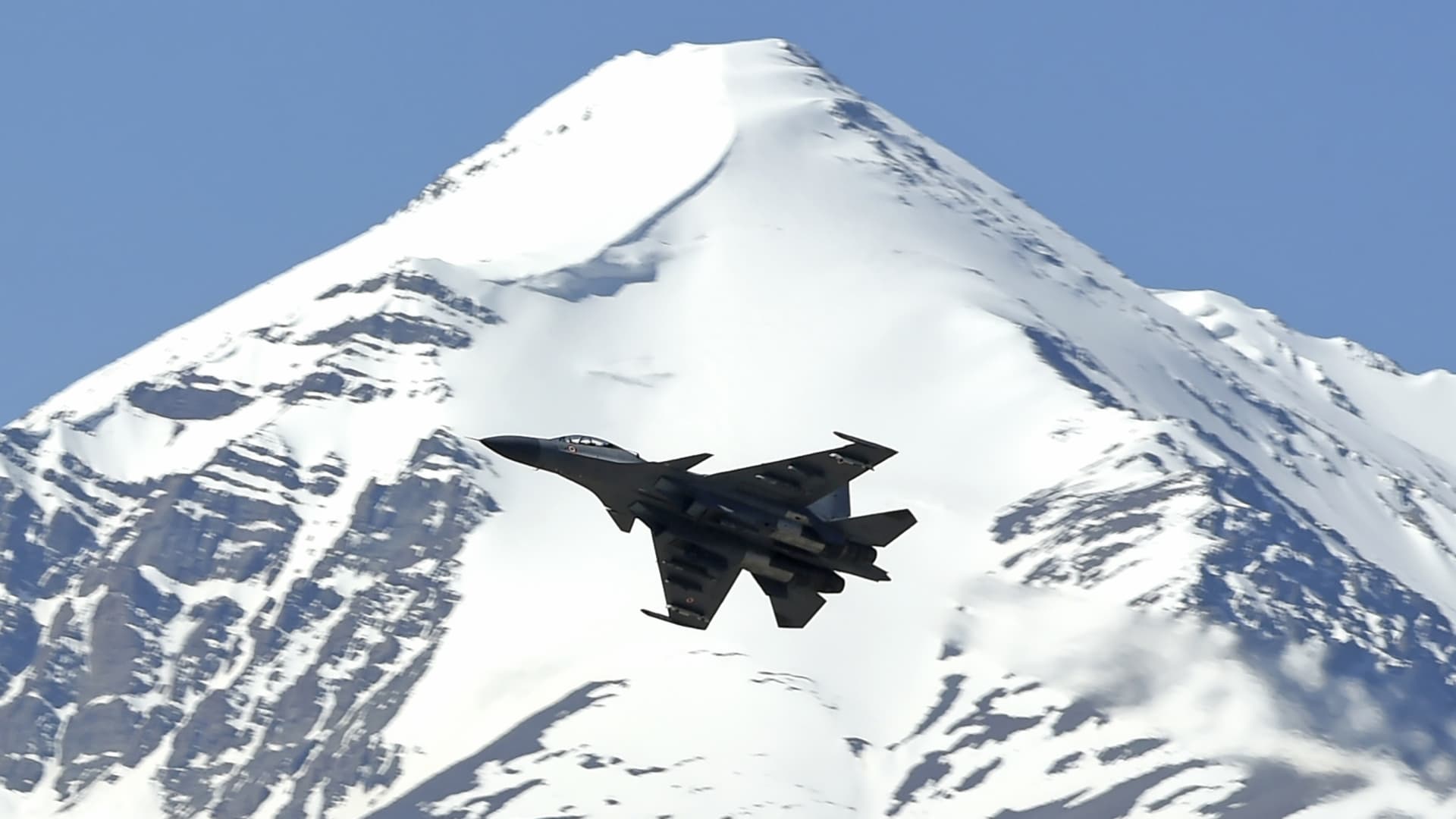
An Indian fighter jet flies over a mountain range in Ladakh at the height of a military confrontation with China in June 2020 during which 20 Indian soldiers died.
Tauseef Mustafa | Afp | Getty Images
China is building a bridge across a lake in Ladakh on China’s Himalayan border with India — a move condemned by the Indian government, which called it an “illegal construction.”
It is the second and sturdier of two Chinese bridges across the Pangong Tso lake.
Speaking to CNBC, a retired general of the Indian Army, who used to be stationed in Ladakh, said the new bridge is capable of supporting tanks and armored personnel carriers and would help China speed up deployment between the river banks.
“What the bridge adds to Chinese capabilities is the ability to speedily move forces between the north and the south banks of Pangong Tso lake, which they were earlier lacking” said General Rohit Gupta, who served with the Fire and Fury Corps of the Northern Command of the Indian Army.
Ladakh is the site of an ongoing confrontation between the two nations.
It was a flashpoint between India and China in mid-2020, when violent clashes killed 20 Indian soldiers and five Chinese soldiers, according to their respective governments. Other reports set the Chinese death toll higher, at between 38 and 45 Chinese soldiers.
Pangong Tso lake is in disputed territory claimed by both countries. China has controlled two-thirds of the lake since the 1960s, and India holds the remaining one-third.
“We have seen reports of a bridge being constructed by China on Pangong Lake alongside its earlier bridge. Both these bridges are in areas that have continued to be under the illegal occupation of China since the 1960s,” India’s external affairs ministry spokesman Arindam Bagchi told reporters last week.
“We have never accepted such illegal occupation of our territory, nor have we accepted the unjustified Chinese claim or such construction activities,” he said.
According to Gen. Gupta, the new bridge — which shortens the 130-kilometer distance between the southern and northern banks of the lake — is part of an attempt to negate a tactical Indian advantage in the area.
Interdiction of such known terrain entities is possible, especially through precision munitions delivered from a variety of resources.
Rohit Gupta
Retired Brigadier General Staff, Indian Army
Gen. Gupta said India had also built a lot of infrastructure to assist “better tactical, operational” deployment of forces. While the new Chinese bridge was a matter of concern, it could be neutralized, he added.
“Interdiction of such known terrain entities is possible, especially through precision munitions delivered from a variety of resources,” he said, adding that the Indian side had a clear view of the bridge from positions it held.
The dispute about the bridge would likely have been discussed as part of overall security discussions in the Quad meeting, visiting scholar in the Asia program at Carnegie Endowment for International Peace, Deep Pal, told CNBC on Monday, before the Quadrilateral Security Dialogue on Tuesday.
A leaders’ meeting of the four-nation Quad — made up of Australia, India, Japan and the U.S. — was held in Tokyo on Tuesday. The group’s goal is to counter China’s growing assertiveness in the region.
“But there is no immediate response that the Quad could make,” Pal added, pointing out that the grouping was not an “Asian Nato.“
Of the four nations comprising the Quad, India is the only one which shares a border with China. The 3,488-km-long unmarked border between India and China is the world’s longest disputed border.
Former Indian trade secretary Ajay Dua told CNBC on Tuesday that Quad nations should work together militarily, even if it’s at the risk of angering China.
“I would like to see Quad nations getting together to provide greater military security,” he told CNBC’s “Street Signs Asia,” adding it is the “need of the hour.”
China and India still have tens of thousands of troops massed on the border despite 15 rounds of talks to de-escalate military tensions after a violent confrontation in 2020.
In June that year, the two nuclear-armed Asian giants fought a brutal and bloody skirmish without guns, in hand-to-hand combat with metal rods, bludgeons with nail filings and other such improvised weapons.
Under previous treaties, both countries have agreed not to carry or use firearms to prevent escalation.
Highlighting China’s belligerence at its border with India and with neighbors in the South China Sea, Dua noted the Quad was formed in 2007 as a security dialogue — not as a trade agreement.
“I would like to see [Quad countries provide] military security irrespective of the Chinese reaction,” he said, adding that China had already conducted a disinformation campaign, labeling the Quad as an anti-China grouping.
“No country in the region can handle China alone. The U.S. on its own can,” he said.