


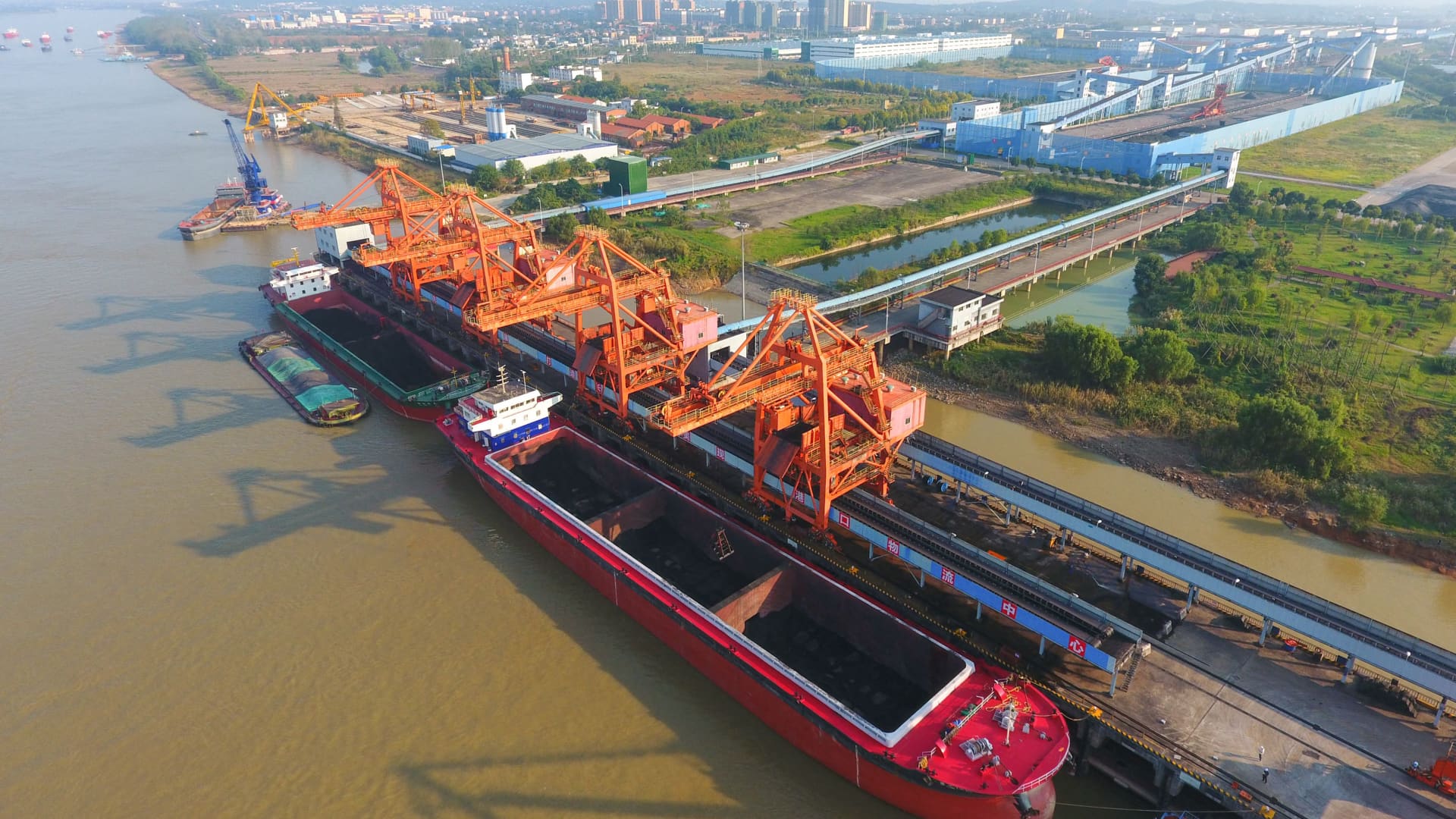
This photo taken on October 24, 2021 shows coal being loaded on a cargo ship in Jiujiang, in China’s central Jiangxi province.
STR | AFP | Getty Images
Russia’s coal shipments to China have been rising even though overall shipments to China have declined, new data from S&P Global Market Intelligence showed.
Russian seaborne coal deliveries to China surged 55% to 6.2 million tonnes in the first 28 days of June compared to the same period last year, S&P’s Commodities at Sea database showed. In May, Russian seaborne supply to China also rose by 20% year-on-year to 5.5 million tonnes.
Domestic production in China has also been increasing. The latest data from the National Bureau of Statistics of China showed that between January and May, raw coal production rose 10.4% year-on-year to 1.81 billion tonnes, while imports dropped to around 96 million tonnes — down 13.6% compared to a year ago.
“Despite lower demand and higher domestic coal production, China has been buying significantly higher Russian coal since May 2022,” S&P Global Market Intelligence associate director Pranay Shukla said told CNBC.
“This is because Russia has been offering very steep discounts on prevailing international coal prices.”
Russia is a major global coal producer and exporter. But since its invasion of Ukraine, Moscow has been forced to sell coal at a discount after countries like Japan banned Russian imports of the commodity.
Russian seaborne coal shipments to mainland China
| Month | 2022 (million tonnes) | 2021 (million tonnes) |
|---|---|---|
| January | 2.9 | 2.5 |
| February | 3.0 | 3.3 |
| March | 2.4 | 4.0 |
| April | 3.8 | 4.0 |
| May | 5.5 | 4.6 |
| 1-28 June | 6.2 | 4.0 |
Source: Commodities at Sea, S&P Global Market Intelligence
“Overall coal imports into mainland China were lower due to reduced demand due to the implementation of lockdown in line with the strict ‘dynamic Zero COVID’ policy,” Shukla said in an email.
“In addition, record-high international coal prices, as well as increasing domestic coal production in China, were also responsible.”
Accordingly, data from S&P showed Russian seaborne coal shipments to China in March fell 40% year-on-year, as Omicron outbreaks took hold in China, before they picked up in April as discounts in Russian coal kicked in.
Global sanctions on Russia
In April, the Group of Seven wealthy countries pledged to move away from Russian energy as they stepped up sanctions on Russia.
Alongside Japan, the European Union also announced a ban on Russian coal in its fifth package of sanctions in April but the ban has been pushed back to August.
During a summit last week, the G-7 nations reinforced their commitment to support Ukraine indefinitely. The group also sought to impose new sanctions including a proposal to cap the price of Russian oil.
Oil prices have been rising this year as a result of Russia’s war on Ukraine and tighter global supplies.
The market will be keeping a very watchful eye on third quarter demand from China as a rise in demand here could see international coal prices rise to unimaginable levels.
Pranay Shukla
S&P Global Market Intelligence
Some countries and major oil companies have also stopped buying Russian oil. The European Union, for example, plans to cut its Russian oil imports by 90% before year end.
Overall, S&P Global Market Intelligence expects global shipments of coal from Russia to rise in the second quarter, alongside shipments from Indonesia, another major coal exporter.
China demand
Separately, Shukla said all eyes will now be on China, to see if it will ramp up coal imports as the economy reopens and Covid travel restrictions ease.
More demand for coal from China could push up coal prices, adding to already rising global inflation.
“The market will be keeping a very watchful eye on third quarter demand from China as a rise in demand here could see international coal prices rise to unimaginable levels,” Shukla said.
Chinese customs data show Indonesia, Russia and Mongolia are now top coal exporters to China, with once major supplier Australia edged out after China imposed restrictions on Australian coal in 2020.
