



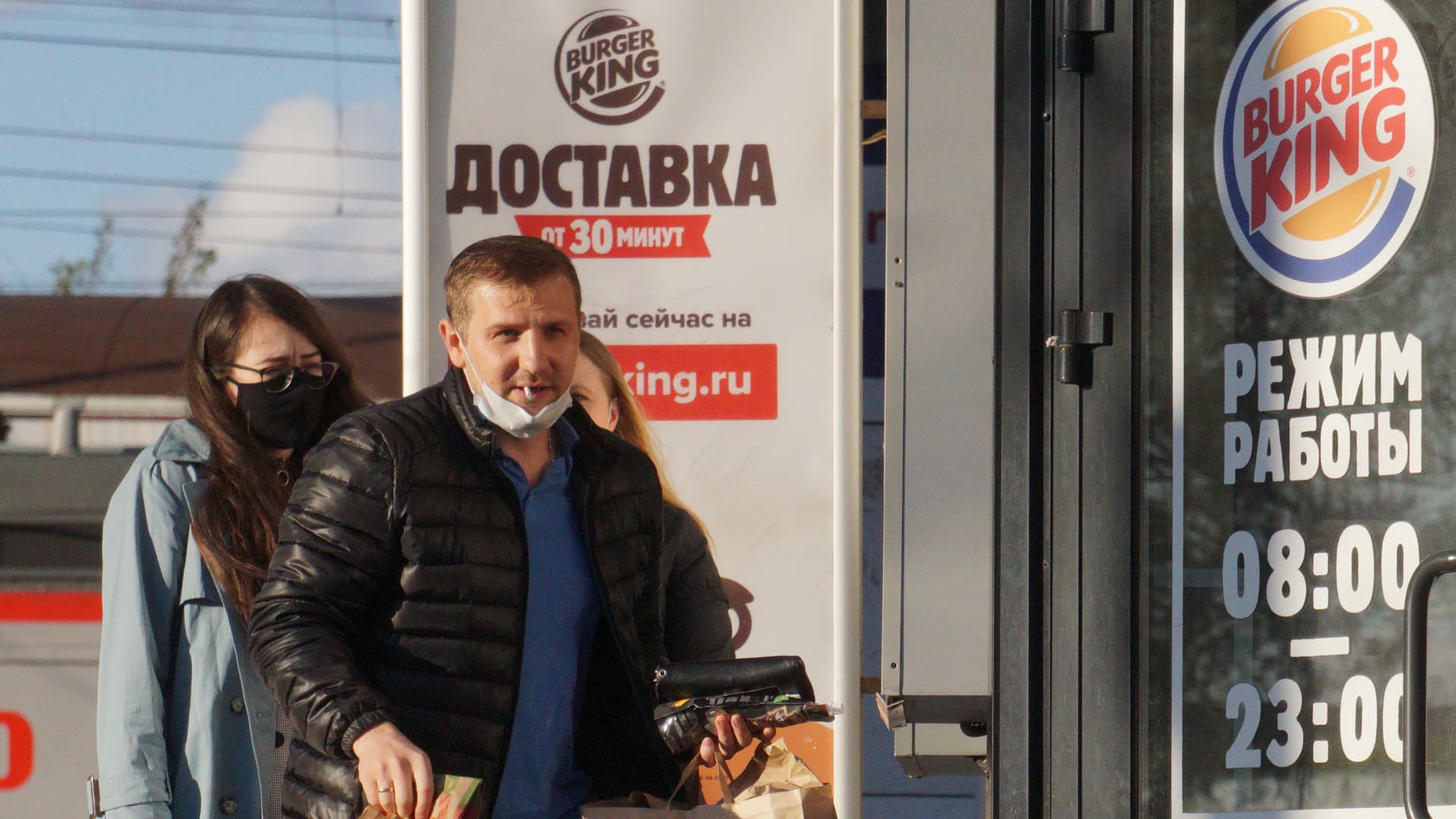
A man holds meals from the Burger King restaurant on May, 15, 2020 in Dedovsk, Russia.
Mikhail Svetlov | Getty Images
Burger King is moving to divest its 15% stake in its Russian business, but the burger chain said it can’t legally suspend operations in the market right away.
The Restaurant Brands International chain announced last week it was suspending all corporate support for its 800-plus franchised locations in Russia in response to the Kremlin’s ongoing attacks on Ukraine. The suspension includes refusing approvals for further investment or expansion and pausing operations, marketing and its supply chain.
But the company’s International President David Shear laid out in an open letter to employees on Thursday that the structure of the company’s Russian business hampers its ability to shutter restaurants in the market like some of its competitors.
“Would we like to suspend all Burger King operations immediately in Russia? Yes. Are we able to enforce a suspension of operations today? No,” Shear said.
Burger King entered Russia through a joint venture with businessperson Alexander Kolobov, Investment Capital Ukraine and VTB Capital, which has been hit by U.S. sanctions as an affiliate of a major Russian bank.
Shear said the burger chain contacted Kolobov, who is responsible for the day-to-day operations and oversight of the Russian locations, and “demanded the suspension of Burger King restaurant operations in Russia.” Kolobov refused, according to Shear.
Burger King owns a 15% stake in the joint venture, and none of the partners has a majority stake. According to Shear, Burger King can’t immediately shut down the business on its own.
“There are no legal clauses that allow us to unilaterally change the contract or allow any one of the partners to simply walk away or overturn the entire agreement,” he wrote. “No serious investor in any industry in the world would agree to a long-term business relationship with flimsy termination clauses.”
Shear said the company has started the process of divesting its stake in the joint venture, but it will take some time to unwind based on the terms of the agreement. He also said that Burger King is in full compliance with all applicable sanctions.
Enforcing Burger King’s contract would require the support of Russian authorities, which is unlikely to happen anytime soon because of the ongoing conflict and tensions with the West.


