



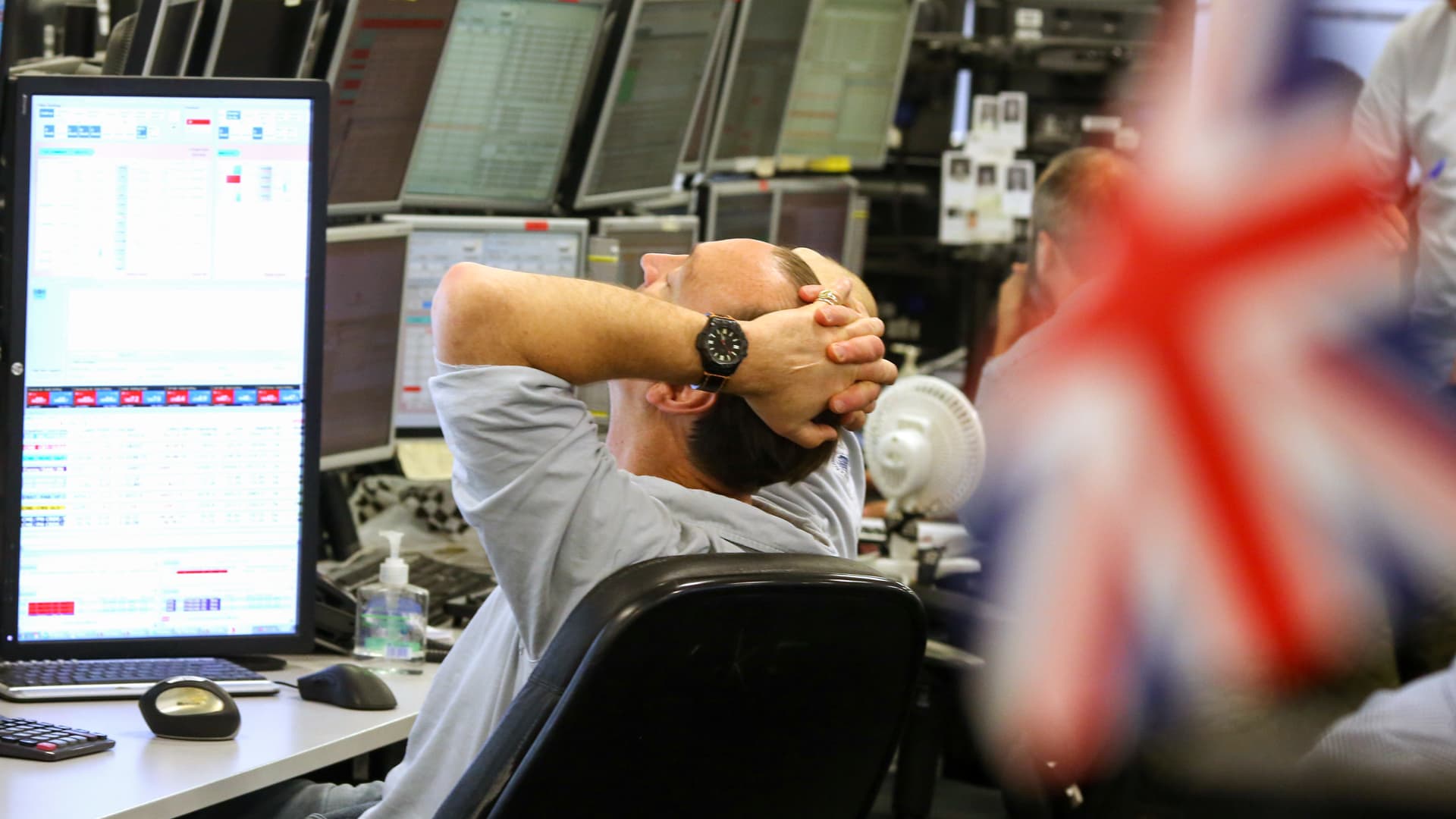
A trader pauses while monitoring financial data on computer screens at ETX Capital, a broker of contracts-for-difference, in London, U.K. on Friday, Oct. 7, 2016.
Chris Ratcliffe | Bloomberg | Getty Images
LONDON – Sterling is in danger of becoming an “emerging market” currency as falling growth and growing risks cause investors to flee the pound, according to Bank of America.
As of Tuesday afternoon in Europe, sterling was down 7% against the dollar year-to-date, trading just below $1.26 having been as low as $1.22 earlier this month.
Short positions have been mounting against the currency as the global economic challenges of the war in Ukraine, inflation, supply chain bottlenecks and slowing growth converge with domestic risks stemming from the Bank of England’s unique predicament and the fallout from Brexit.
In a research note Monday, BofA Senior G-10 FX Strategist Kamal Sharma said further weakness can be expected in the pound through the rest of 2022.
He also dismissed comparisons between the monetary tightening paths of the U.S. Federal Reserve and the Bank of England, arguing that the reaction functions of the two central banks are different.
“The challenges facing the BoE are unique along with a supply dynamic that it remains wholly unwilling to discuss: Brexit. This has resulted in a confusing communication strategy: hiking rates against a sharply slowing economy is never a good look for any currency,” Sharma said.
“An alleviation of the current risk off environment and fiscal stimulus may provide some relief but the damage has been done and the outlook for GBP looks grim.”
The preferred means of capitalizing on sterling’s “epic” fall from grace for BofA is through the advance of the euro against the pound, Sharma added.
This was echoed on Tuesday by George Saravelos, Deutsche Bank’s global co-head of FX research, who told CNBC that greater optimism about European growth, as well as the “non-linear” effects of the European Central Bank returning to positive rates, meant the euro is poised to outperform both the dollar and the pound.
“If you look at what was happening into U.K. inflows, they were going sideways and as soon as the ECB went negative you saw a big acceleration of inflows into the U.K. – purchases of, for example, U.K. gilts,” Saravelos said.
“As that dynamic changes and the Bank of England is much closer to stalling – it’s a reluctant tightness, so to speak – you should see euro-sterling significantly higher. We see it above 90 pence by next year.”
As of Tuesday afternoon, the euro was trading at just above £0.85.
The U.K. economy shrank by 0.1% in March and economists are expecting further contractions this year, as the country’s cost-of-living crisis entrenches itself. Inflation jumped out to an annual 9% in April as food and energy prices spiraled.
Parallels to the 70s
Central to the gloomy outlook for the pound, Sharma noted, is that the U.K.’s Net International Investment Position has deteriorated in recent years as foreign investors hold a large stock of U.K. assets.
The NIIP measures the difference between U.K. owned asset claims on non-residents and foreign-owned claims on U.K. residents, an important gauge of a company’s creditworthiness.
“This carries with it two risks: overseas investors could repatriate part of this portfolio of U.K. assets on deteriorating confidence in the U.K. economy (asset allocation shift due to the end of negative interest rates elsewhere); or that the large stock of foreign holdings of U.K. assets will continue to weigh on the primary income balance,” Sharma said.
“Whatever the reason, the external trade position will become an increasing focus for markets as the UK economy struggles under the weight of higher inflation and slower growth.”
U.K. assets are now more expensive than they were in 2021, when inflows to the country were significant, and the pound is increasingly considered less “undervalued” than models suggest, he added.
The Bank of England is expected to continue raising interest rates to rein in inflation, after a fourth consecutive hike took its base rate to a 13-year high of 1% early in May. The Bank sees inflation to rise to roughly 10% this year as a result of the Russia-Ukraine war and persistent lockdowns in China.
Bank of America strategists are increasingly skeptical that the Bank’s defense mechanism can rescue the pound, however.
“Though not our central scenario, we think sterling finds itself in an increasingly invidious position, where central bank communication has been increasingly challenging; where imbalances are rising and where the specter of Brexit still looms large on the domestic political scene,” Sharma said.
“Investors are increasingly discussing GBP as taking on emerging market characteristics whilst parallels to the 1970’s resonate as being one of the worst post-war decades for the UK.”
He added that the Wall Street giant is concerned that the “increasing politicization” of U.K. policy undermines the pound in ways that “would appear EM-like,” suggesting investors begin hedging for the pound to lose its status as a respected global currency.