In this handout provided by the National Aeronautics and Space Administration (NASA), a United Launch Alliance Atlas V rocket with Boeing’s CST-100 Starliner spacecraft aboard is seen illuminated by spotlights on the launch pad at Space Launch Complex 41 ahead of the NASA’s Boeing Crew Flight Test on May 4, 2024 at Cape Canaveral Space Force Station in Florida.
Joel Kowsky | NASA | Handout | Getty Images
Boeing and NASA are moving forward with the launch of the company’s Starliner capsule, set to carry U.S. astronauts for the first time, despite a “stable” leak in the spacecraft’s propulsion system.
“We are comfortable with the causes that we’ve identified for this specific leak,” Boeing Vice President and manager of the company’s Commercial Crew program, Mark Nappi, said during a press conference on Friday.
“We know we can manage this [leak], so this is really not a safety of flight issue,” Nappi added.
Boeing is now targeting June 1 for the first crewed launch of its spacecraft, with backup opportunities on June 2, June 5 and June 6.
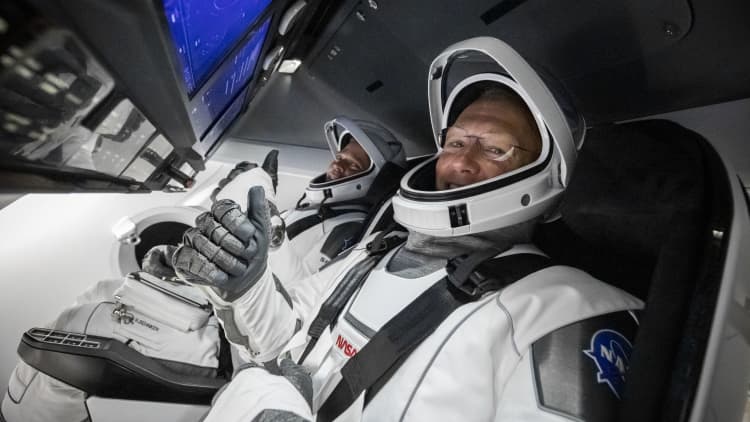
The mission – known as the Starliner Crew Flight Test – is intended to serve as the final major development test of the capsule by delivering a pair of NASA astronauts to and from the International Space Station before flying routine missions.
Sign up here to receive weekly editions of CNBC’s Investing in Space newsletter.
Starliner’s crew debut is years delayed, with SpaceX’s competing Dragon capsule flying astronauts for NASA regularly since 2020 under the agency’s Commercial Crew program. To date, Boeing has eaten $1.5 billion in costs due to Starliner setbacks, in addition to nearly $5 billion of NASA development funds.
Boeing’s Starliner spacecraft is seen before docking with the International Space Station on May 20, 2022 during the uncrewed OFT-2 mission.
Boeing
NASA and Boeing called off a launch attempt on May 6 about two hours before liftoff due to an issue detected with the Atlas V rocket that will lift Starliner into orbit. Atlas V is built and operated by United Launch Alliance (ULA), a joint venture of Boeing and Lockheed Martin.
During the press conference Friday, a ULA official noted that the rocket’s problematic valve was replaced in the week after the postponement.
But after calling off the launch attempt, a “small” helium leak with Starliner was identified, causing Boeing and NASA to begin new assessments of the capsule and its safety for the mission. NASA Associate Administrator Ken Bowersox, one of the agency’s most senior officials, explained to press on Friday that “it’s taken a while for us to be ready to discuss” the helium leak problem.
“It’s so complicated. There’s so many things going on. We really just needed to work through it as a team,” Bowersox said.
After analysis, NASA and Boeing believe the source of the leak is a seal in one of the flanges of the spacecraft’s helium propulsion system. In testing after the May 6 postponement, NASA’s Commercial Crew Program manager Steve Stich said that teams “have seen that the leak rate isn’t changing.”
Stich explained that the plan is to monitor the leak in the lead up to launch and, after reaching the International Space Station, reassess the leak rate.
“We don’t expect the other [seals] to leak, and I think that’s a confidence that we have,” Stich said.
Stich also emphasized that NASA has “flown vehicles with small helium leaks” before, including “a couple of cases” from missions flown by the Space Shuttle and SpaceX’s Dragon.
NASA, Boeing and ULA will hold another review on May 29 to review the leak. They plan to roll the rocket and capsule out to the launch pad on May 30 for the June 1 attempt.