

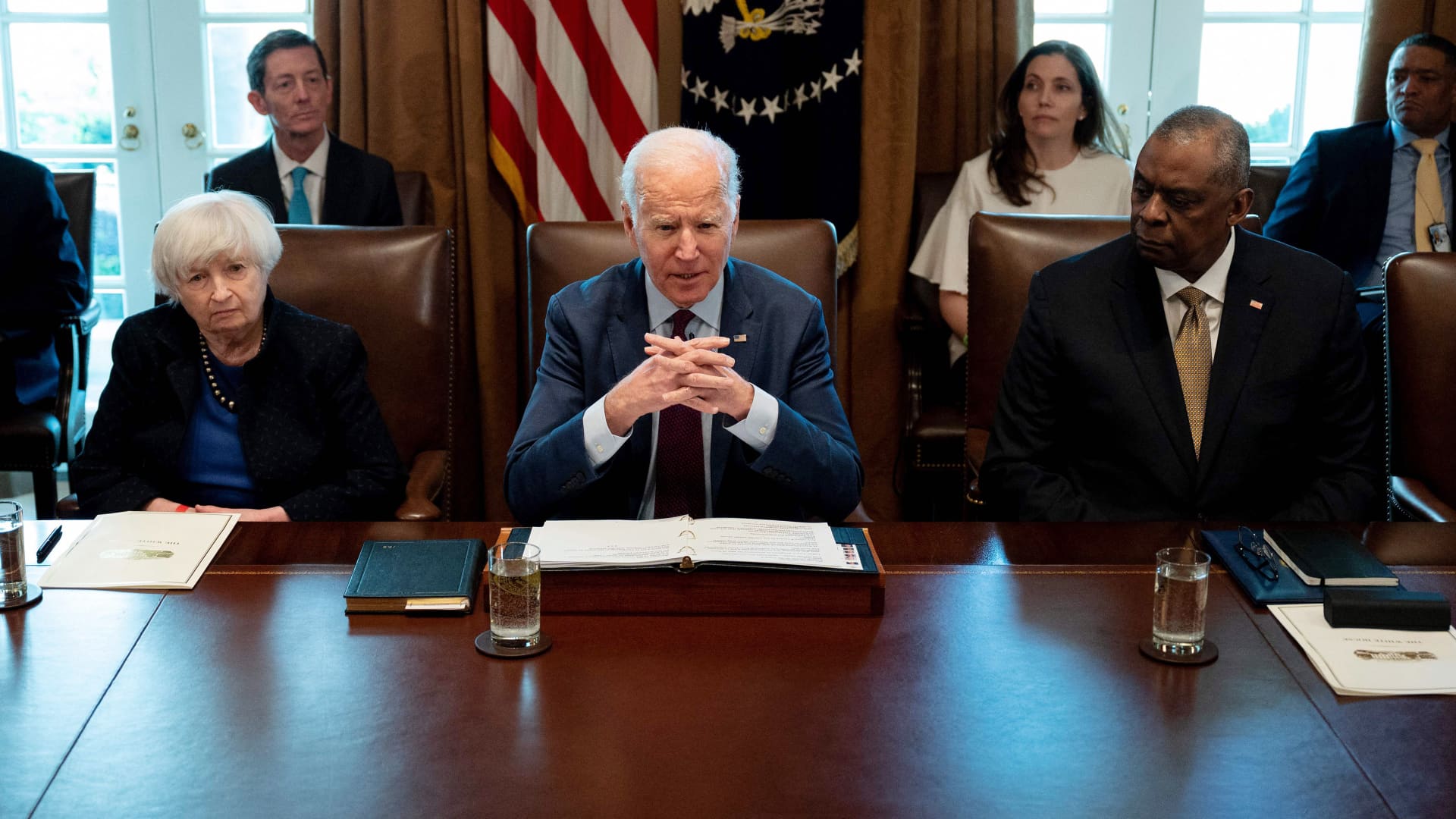
US President Joe Biden, with Treasury Secretary Janet Yellen (L) and Defense Secretary Lloyd Austin (R), speaks during a meeting with his cabinet at the White House in Washington, DC, on March 3, 2022.
Jim Watson | AFP | Getty Images
WASHINGTON — President Joe Biden’s 2023 federal budget, released Monday, proposes tax hikes on the ultra-wealthy and corporations while providing billions of dollars in new spending at the Defense Department and the Justice Department.
The proposal sent to Congress touts a reduction in the federal budget deficit of more than $1 trillion over the next 10 years. This is paid for, in part, by raising the corporate tax rate from 21% up to 28%, a rate favored by progressive Democrats but opposed by key moderates. Biden also proposes a new 20% minimum tax on the top 0.01% earners and households worth more than $100 million.
On a call with reporters Monday, White House officials credited Biden’s economic policies with creating economic growth that was strong enough to justify cutting back pandemic assistance programs.
As a result of fewer pandemic safety net costs and higher tax revenues, the White House projects that the 2022 budget deficit will be $1.3 trillion less than the 2021 deficit, which the Biden administration touted Monday as “the largest ever one-year decline in our country’s history.”
Overall, the 2023 fiscal year budget shifts focus away from the pandemic, which has subsided after the massive Omicron wave late last year. Notably, there are no emergency pandemic or supplemental funds being requested.
In place of Covid, the budget focuses on the need to tackle crime and public safety, and the global peril created by Russia’s invasion of Ukraine.
Key spending items:
- Approximately $31 billion in new defense spending, which will bring the total national defense spending up to $813 billion.
- As part of that defense spending, $6.9 billion is directed to NATO, European defense, Ukraine and countering Russian aggression, according to the White House.
- More than $32 billion in spending to fight crime at home, including more than $20.6 billion at the Justice Department and another $3.2 billion for state and local law enforcement grants and for hiring police officers.
- Roughly $10.6 billion for global health security, which includes Covid as well as future pandemics.
Key revenue raisers:
- Raise the corporate tax rate from its current rate of 21% to 28%.
- Raise the top individual tax bracket to 39.6%.
- Impose a 20% minimum tax on the top 0.01% earners and households worth more than $100 million, the so-called the “Billionaire Minimum Tax.”
- Repeal several tax breaks for oil and gas producers and processors.
- Tax carried interest as regular income, closing the so-called “carried interest loophole.”
- End tax deferrals on the gains from like-kind exchanges.
The budget also serves as a blueprint for Democrats in Congress, who currently hold slim majorities in the House and Senate but face strong headwinds going into November’s midterm elections.
For them, the budget contains a little bit of everything. Progressives in deep blue districts are likely to focus on Biden’s proposed tax hikes and on the budget’s additional climate change funding.
For moderate Democrats, the additional funding Biden’s budget requests for the Pentagon and for police will likely be popular with their constituencies.
The budget proposal was released amid a spate of new polls that showed Biden facing some of his lowest approval ratings ever.
A new NBC News poll released Sunday found that only 40% of Americans approve of the job Biden is doing as president, with 55% disapproving.
When asked who they hold responsible for the high inflation rate, a higher percentage of Americans said they blame Biden and his policies, 38%, than the percentage who blame the pandemic, 28%, or corporate price increases, 23%.
— CNBC’s Ylan Mui contributed to this story.

