


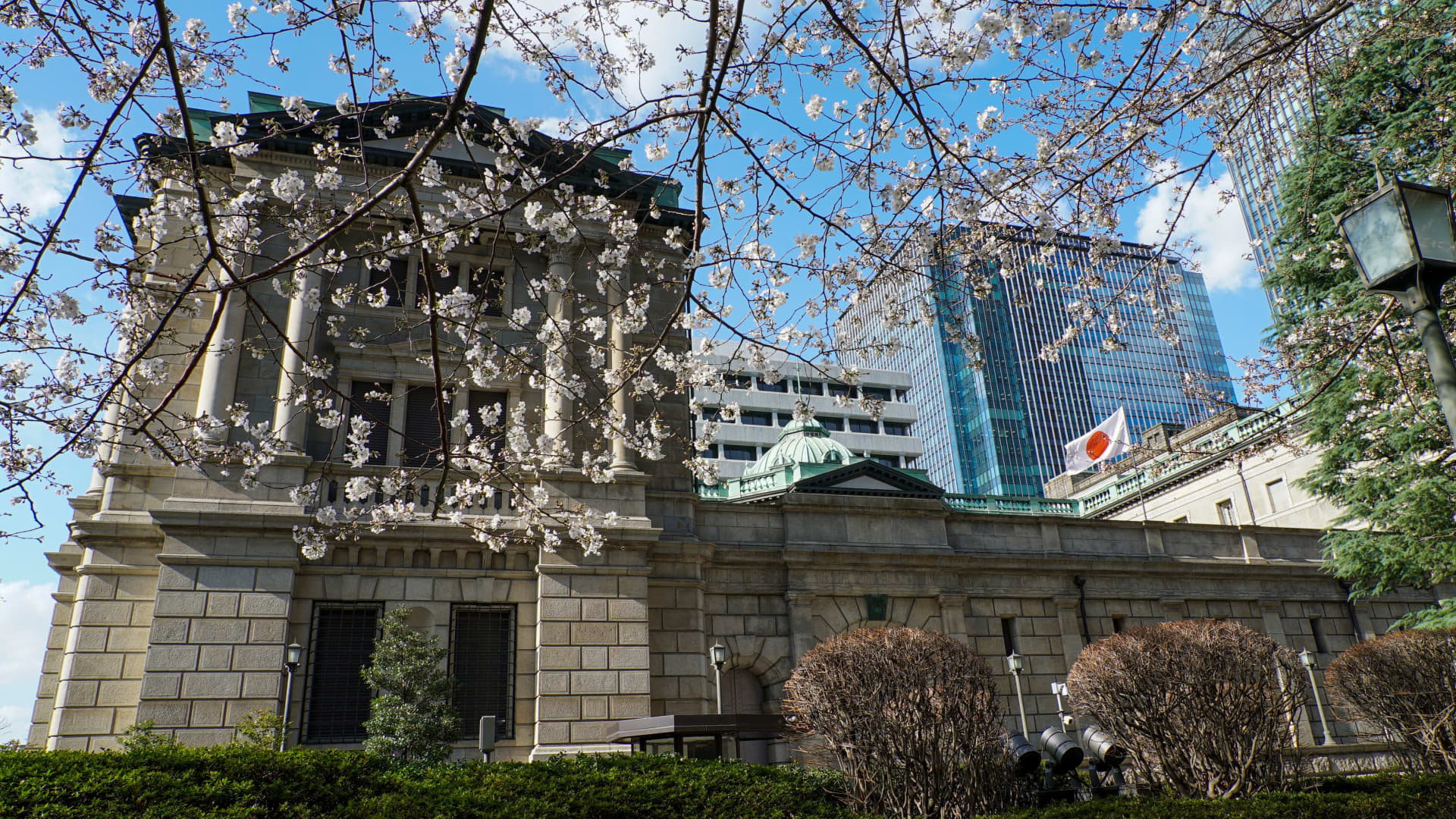
The Bank of Japan (BOJ) headquarters is seen beyond the cherry blossoms in Tokyo on March 20, 2023.
Kazuhiro Nogi | Afp | Getty Images
The Bank of Japan left its interest rates unchanged in newly appointed Governor Kazuo Ueda’s first policy meeting.
The decision was in line with economist expectations for no changes to the benchmark interest rate, which has been held at -0.1% since the central bank took rates below zero in 2016.
The central bank also kept the tolerance range for 10-year Japanese government bonds unchanged at 50 basis points above and below its target of 0%.
In December, the central bank shocked global bond markets by unexpectedly widening its tolerance range for 10-year Japanese government bonds from 25 basis points to 50 basis points above and below 0%.

The Japanese yen weakened roughly 0.8% to 134.75 against the U.S. dollar after the announcement. The yield on the 10-year JGB fell slightly to 0.425%.
Policy review ahead
While maintaining current policies, the Bank of Japan said it “decided to conduct a broad-perspective review” of its easing measures.
The central bank said the planned time frame for the review is around one to 1½ years.
“Achieving price stability has been a challenge for a long period of 25 years,” the central bank said, adding that its monetary easing policies “have interacted with and influenced wide areas of Japan’s economic activity, prices, and financial sector.”
In a separate outlook, the central bank forecast inflation for all items excluding fresh food and energy to be around 2.5% for fiscal 2023, and between 1.5% and 2% for 2024 and 2025.
Ueda has previously emphasized inflation needs to be “quite strong and close to 2%” — the central bank’s target — before making any adjustments to the yield curve control policy.
Abandon YCC?
Despite market expectations for the central bank to widen its yield curve control tolerance band further or to scrap the scheme entirely, the central bank stood by its current policies.
“The Bank will continue with QQE(Quantitative and Qualitative Monetary Easing) with Yield Curve Control, aiming to achieve the price stability target as long as it is necessary for maintaining that target in a stable manner,” it said in its outlook.
It added that the central bank will “not hesitate to take additional easing measures if necessary.”
Asset management firm Pendal’s head of income strategies Amy Xie Patrick predicts the central bank would abandon YCC rather than widen its tolerance range.
“I think the next move they make with regards to the YCC will be abandonment. But the path to there has to be about making the markets understand that it’s about their concern about markets function rather than their concern about inflation running away from them,” Xie Patrick told CNBC’s “Street Signs Asia.”
Inflation still above target
Inflation in Japan’s capital city ticked higher in April, according to government data released Friday ahead of the BOJ decision.
The consumer price index in Japan’s capital city rose 3.5% in April, exceeding forecasts in a Reuters poll for a 3.2% increase. That figure is also slightly higher than the 3.2% reading in March.
Excluding fresh food and energy, Tokyo’s consumer price index rose 2.3% in April — slightly above the central bank’s inflation target of around 2%. Inflation in Tokyo is a leading indicator of the nationwide trend. Japan’s nationwide core CPI was at 3.1% in March.
Meanwhile, Japan’s unemployment rate rose to 2.8% in March from 2.6% in February, government data showed. That’s higher than Reuters’ forecast for 2.5% and marks the highest reading since January 2022.
The nation’s jobs-to-applicant ratio was at 1.32, below Reuters’ estimate of 1.34.
More uncertainty ahead
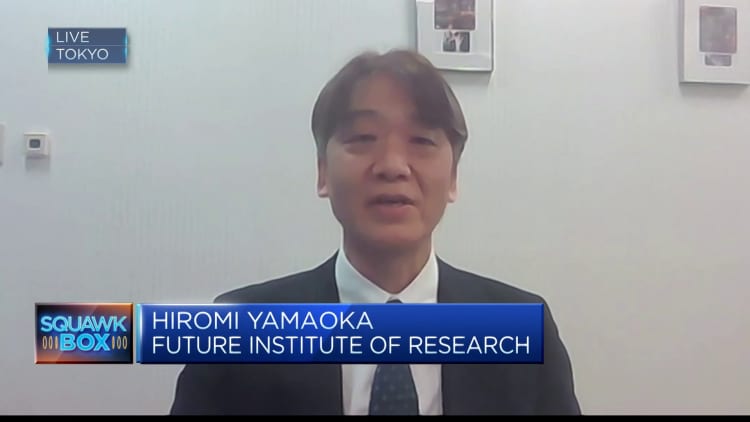
“There remains some uncertainty in the Japanese real economy, but at the same time, inflationary pressures is becoming more imminent,” Hiromi Yamaoka, a former official at the Bank of Japan and the current head of Future Institute of Research told CNBC’s “Squawk Box Asia” on Friday ahead of the announcement.
“It’s a difficult situation but BOJ has to pay attention to price stability as the primary purpose of a central bank,” Yamaoka said, but added the central bank needs to focus more on increased inflation pressures, rather than the real economy.
In order to juggle both, Yamaoka said “they cannot continue the current extraordinary intervention in the JGB market.”

