


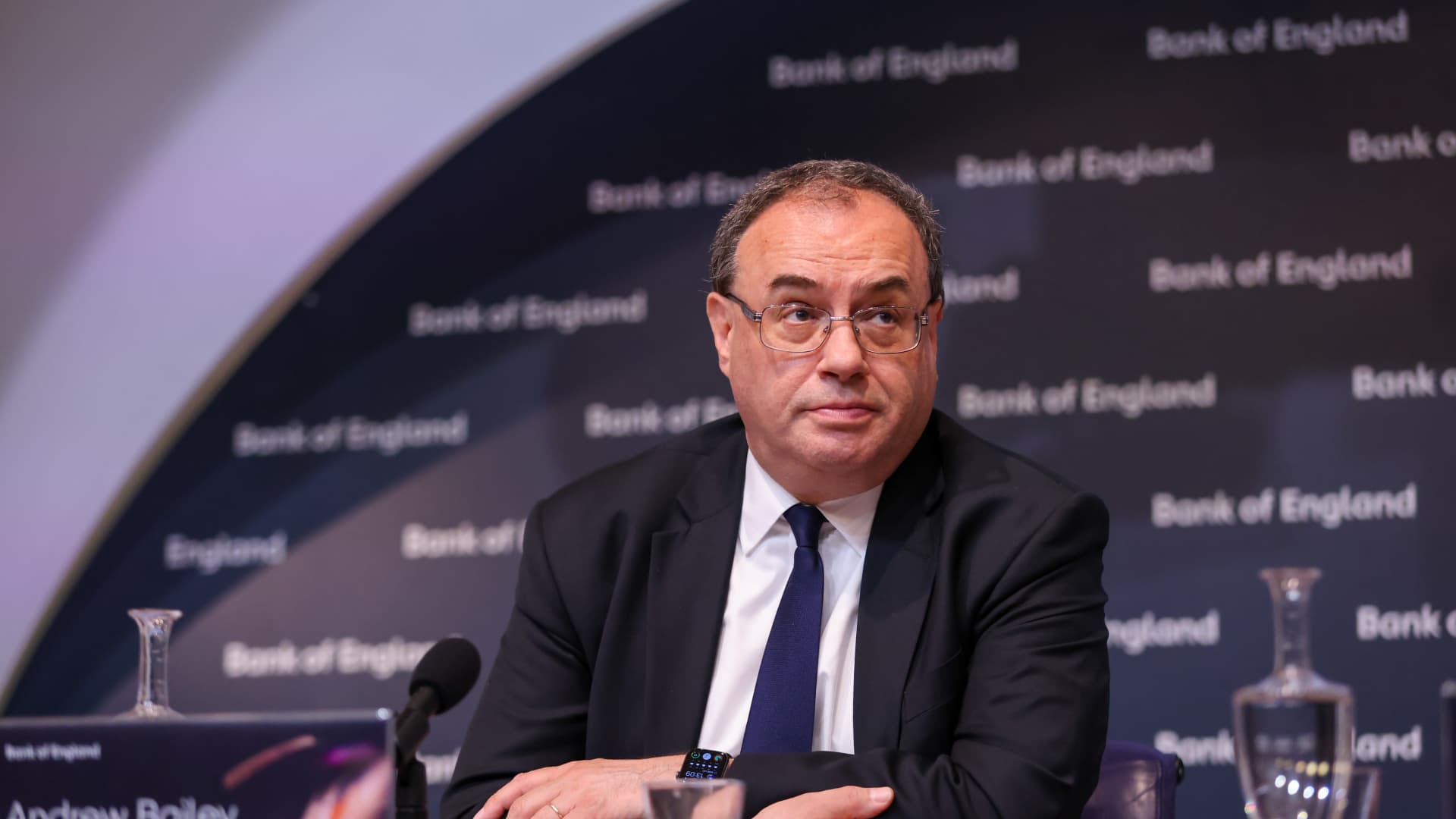
Bank of England Governor Andrew Bailey has said he is not at all happy with rising inflation, but that the central bank couldn’t have done anything differently to avoid it.
Bloomberg | Bloomberg | Getty Images
LONDON — The Bank of England on Thursday implemented a fifth consecutive hike to interest rates as it looks to rein in soaring inflation.
The Monetary Policy Committee voted 6-3 to increase the Bank Rate by 25 basis points to 1.25%, with the three dissenting members voting for a 50 basis point hike to 1.5%.
The MPC said in a statement Thursday that it will “take the actions necessary to return inflation to the 2% target sustainably in the medium term,” with the the scale, pace and timing of any further hikes depending on the economic outlook and inflationary pressures.
“The Committee will be particularly alert to indications of more persistent inflationary pressures, and will if necessary act forcefully in response,” the Bank said.
The pound dropped by 0.8% against the dollar shortly after the announcement to trade at around $1.2080.
Policymakers face the unenviable task of bringing consumer prices back under control against a backdrop of slowing growth and a rapidly depreciating currency, while the U.K. faces a major cost of living crisis.
At its May meeting, the Bank raised its base rate by 25 basis points to 1%, its highest level for 13 years, but warned that the British economy risks falling into recession.
Since then, fresh data has shown that U.K. inflation soared to a 40-year high of 9% annually in April as food and energy prices spiraled. The Bank now expects inflation to rise to “slightly above 11%” in October, reflecting higher projected household energy prices following an expected further increase to the U.K. energy price cap.
Inflation is surging worldwide due to spiking costs of food and energy, which have been exacerbated by the war in Ukraine and supply fears in agricultural commodities. Supply chain disruptions and demand shifts as a result of the pandemic have also driven up tradable goods prices.
However, in its statement Thursday, the MPC acknowledged that not all of the excess inflationary pressure can be chalked up to global events, noting that domestic factors such as a tight labor market and the pricing strategies of firms have also played a role.
“Consumer services price inflation, which is more influenced by domestic costs than goods price inflation, has strengthened in recent months. In addition, core consumer goods price inflation is higher in the United Kingdom than in the euro area and in the United States,” the Bank said.
The economy unexpectedly shrank by 0.3% in April after a 0.1% contraction in March, the first back-to-back declines since April and March 2020, and the OECD has forecast that the U.K. will be the weakest G-7 economy next year as higher interest rates, tax rises, reduced trade and spiraling food and energy prices hammer households.