


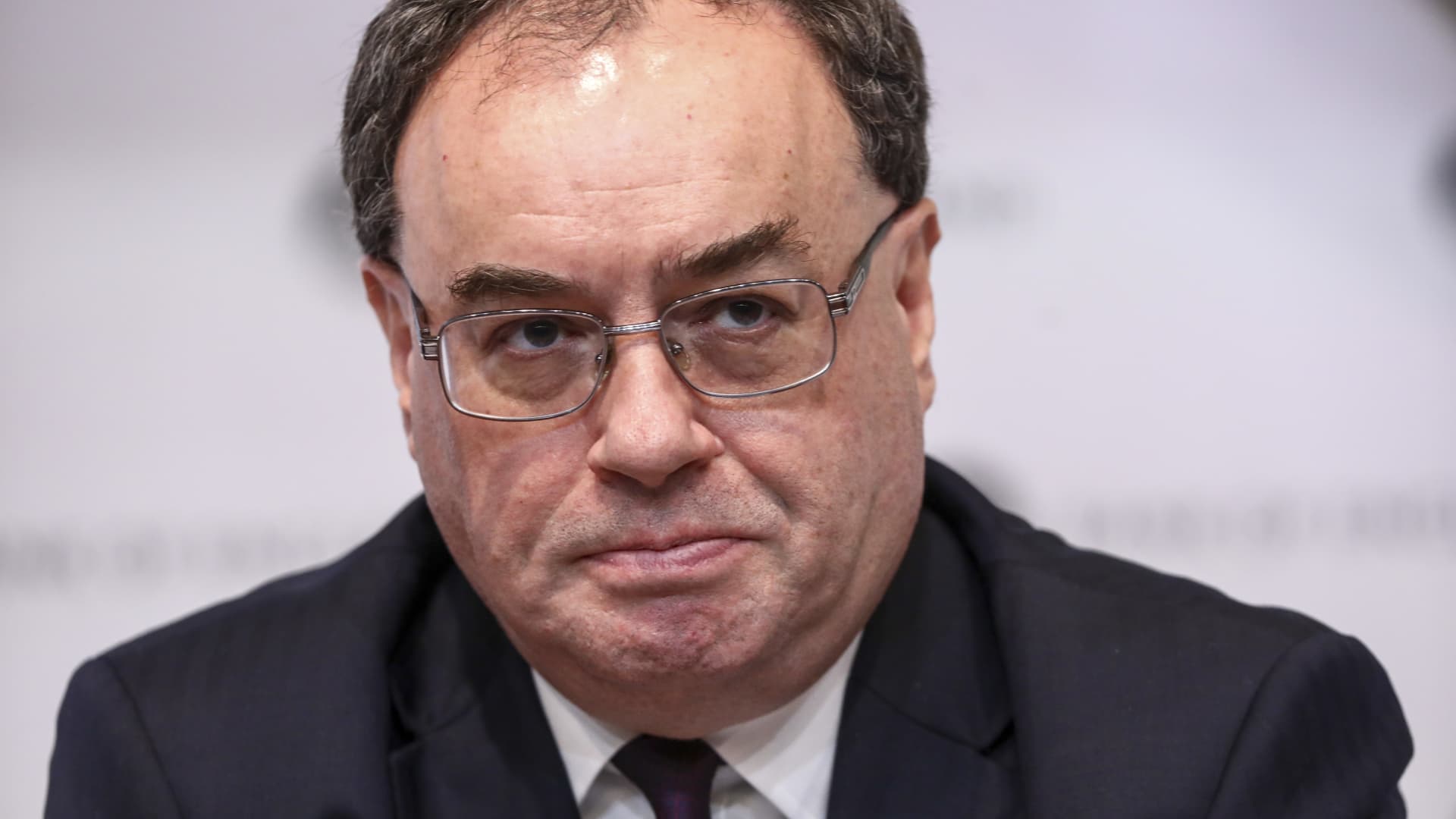
Bank of England Governor Andrew Bailey.
Simon Dawson | Bloomberg via Getty Images
LONDON — Governor Andrew Bailey has sought to defend the Bank of England’s cautious approach to monetary tightening, saying policymakers are considering the wider picture of an inflation shock that the U.K. economy is now experiencing.
The BOE may have completed its fourth rate rise in a row on Thursday, but three dissenters at the Bank and a prediction of inflation peaking at 10% have left many wondering whether it should be acting more aggressively — such as frontloading with larger rate hikes.
“I think that’s important to put that into the context of the shock that we’re seeing,” Bailey told CNBC’s Geoff Cutmore Thursday following the bank’s 25-basis point move.
“We’re seeing this unprecedentedly large shock to real income in this country coming from abroad, it’s a terms of trade shock … And that is having a negative effect on real income, we think that’s going to feed through to activity during the course of this year in a big way.”
Like many central banks around the world, the BOE is tasked with steering the economy through an inflation surge that has been exacerbated by Russia’s unprovoked onslaught in Ukraine.
The Bank’s Monetary Policy Committee approved the hike by a majority of 6-3, taking the base interest rate up to 1%. The Bank said the members in the minority preferred to increase interest rates by 0.5 percentage points to 1.25%. The Bank’s main benchmark interest rate helps set the cost of all sorts of mortgages and loans in the U.K.
Sterling hit a low of 1.2393 against the dollar early Thursday afternoon London time, its lowest level since Jul. 1, 2020.
In its updated forecasts, the Bank highlighted the looming recession risk for the world’s fifth-largest economy. The BOE said it now expects gross domestic product to contract in the final three months of the year, partly reflecting the projected large hike in household energy bills in October.
Bailey added that the Bank was already seeing signs of diminishing consumer confidence, starting to form a large gap when compared with business confidence in the U.K.
“So I think the answer to the question of ‘what does monetary policy do?’ actually has to start with what is going to be the impact of this shock,” Bailey continued.
“We think the impact of this shock in terms of pushing down activity, pushing down inflation is going to be much bigger. And therefore how we, sort of, calibrate the monetary policy needs to take that into account,” he said.
—CNBC’s Sam Meredith contributed to this article.

