


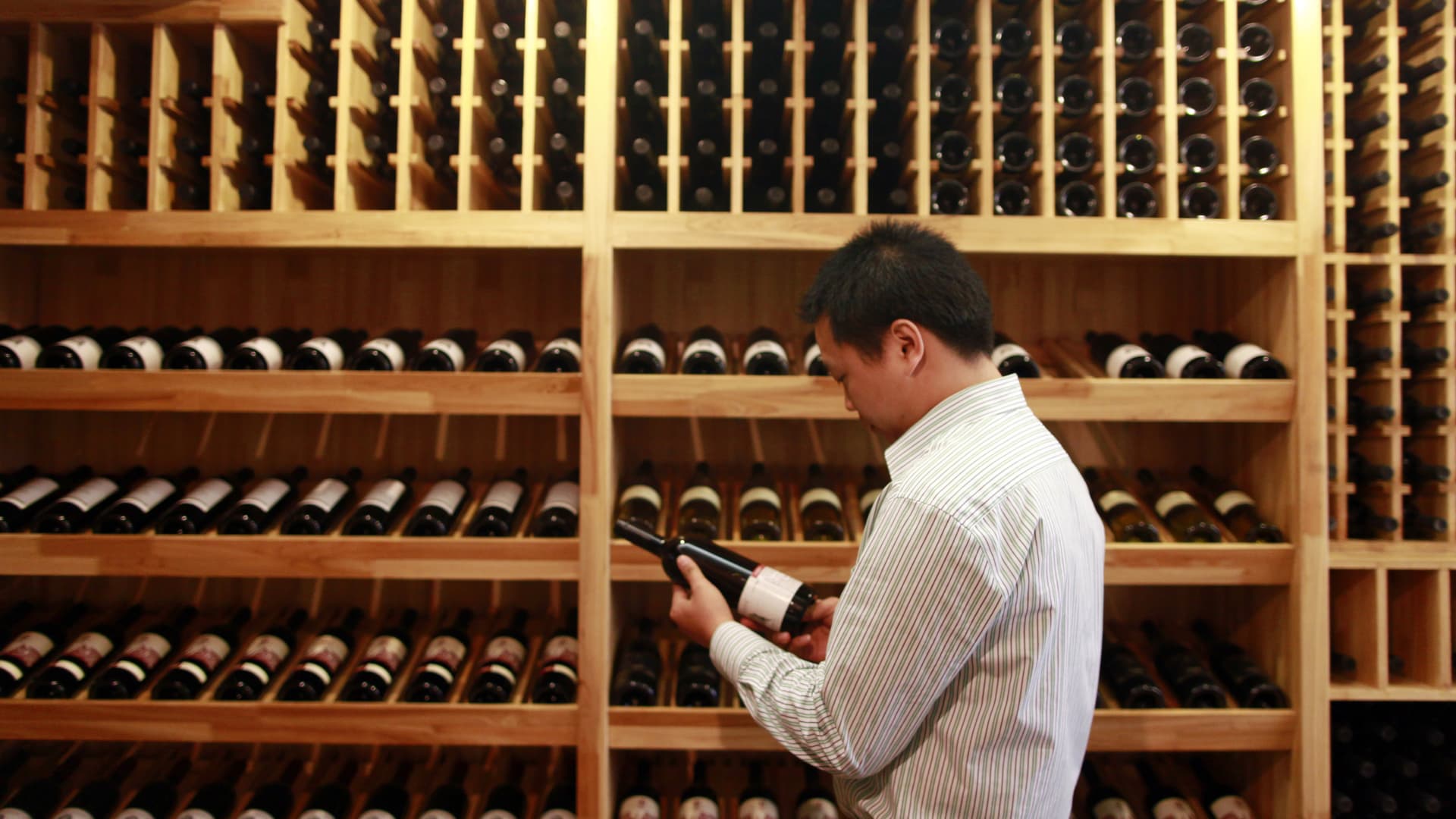
Lin Tiangui, a representative of Winston Wine, looks at a bottles of wine produced from Winston Wine’s own Australian winery at one of its stores in Shanghai, China on October 18, 2011.
Qilai Shen | Bloomberg | In Pictures | Corbis Historical | Getty Images
Australia’s leading wine industry body Wine Australia will be closing its only physical office in China after sales to the greater China succumb to Beijing’s prohibitive duties.
“Wine Australia has made the difficult decision to close our physical office in Shanghai. This decision follows extensive consultation with the Australian grape and wine sector and is based on the current environment and market opportunity,” a Wine Australia spokeswoman said.
“Wine Australia will continue to maintain our brand presence in China via our wine trade and consumer facing social media channels, and will continue to work closely with in-market trade representatives on brand building and marketing campaigns.”
The once 1.2 billion Australian dollar-a-year trade ($830 million) has whittled down to just over AU$200 million at the end of March, an alleged casualty of the tension between the two countries.
Wine Australia said it will continue to operate in China as it does in other markets, through “relationships with key in-market agency and marketing partners, trade show organizers and education networks,” a format that tends to be used for smaller trading markets.
The industry body is responsible for supporting Australia’s wine industry through research and development as well as establishing new export markets.
The once-envied Chinese trade for Australian exporters however suffered a blow in 2020 when Beijing launched an investigation into allegations of dumping cheap Australian wine in China.
Beijing subsequently imposed anti-dumping duties of between 116.2% and 218.4%, rendering Australian wines uncompetitive in the Chinese market. The matter is being arbitrated at the World Trade Organization.
Anti-dumping and anti-subsidy duties are protectionist tariffs that governments impose on imports that they deem to be below fair market value, usually at prices lower than the exporting countries’ domestic markets.
The punitive tariffs were among a series of Chinese trade restrictions on Australian exports including barley, coal and lobsters.
Many of these restrictions were informally enacted after the two countries fell out when Canberra called for an independent inquiry into the origins of the coronavirus, without diplomatically consulting Beijing.
Australia’s national association of wine producers, Australian Grape and Wine, said the closure of the Shanghai office did not signal “an end to an era.” It noted that despite the challenges, exporters would like to return to the Chinese market and Chinese demand for Australian wines remained buoyant.
“We understand and support Wine Australia’s decision, which is based on operational requirements,” AGW General Manager Lee McLean said.
“We also note that there is still strong demand for Australian wine in China and we hope Chinese consumers will have the opportunity to enjoy Australian wines again at some point in the future.”
Australian exporters struggled with wine sales in China after the duties were imposed, data from Wine Australia for the 12 months ending in March showed. They have since diverted sales to other markets like the U.S. and U.K., but still faced pandemic-related challenges such as supply chain and global freight disruptions.
The U.K. has since dethroned China as the top destination for Australia’s wine exports, although that market is less than half the size of the Chinese market at its height.
Australia exports 60% of its wine production and China previously accounted for about 40% of those exports.
But there have been some signs of thawing between the two major trading partners in recent weeks after the election of a new Labor government in Australia.
Earlier this month, Australia’s new defense minister, Richard Marles, and China’s defense minister, Wei Fenghe, met on the sidelines of the Shangri-La Dialogue in Singapore, also known as the “Asia Security Summit.”
Before this, there had been no ministerial visits or conversations between the two countries for several years.
Political observers also said Marles’ speech at the summit indicated there had been a change in Canberra’s tone towards Beijing. Using less hawkish rhetoric, Marles recognized the reality of China’s rise but framed it in terms of responsibilities that come with it, Nick Bisley, professor of international relations at La Trobe University wrote in an opinion piece last week.
Chinese Premier Li Keqiang also sent a congratulatory message to new Australian Prime Minister Anthony Albanese after his win in the Australian federal elections in late May and in turn received “an appreciation letter.”

