


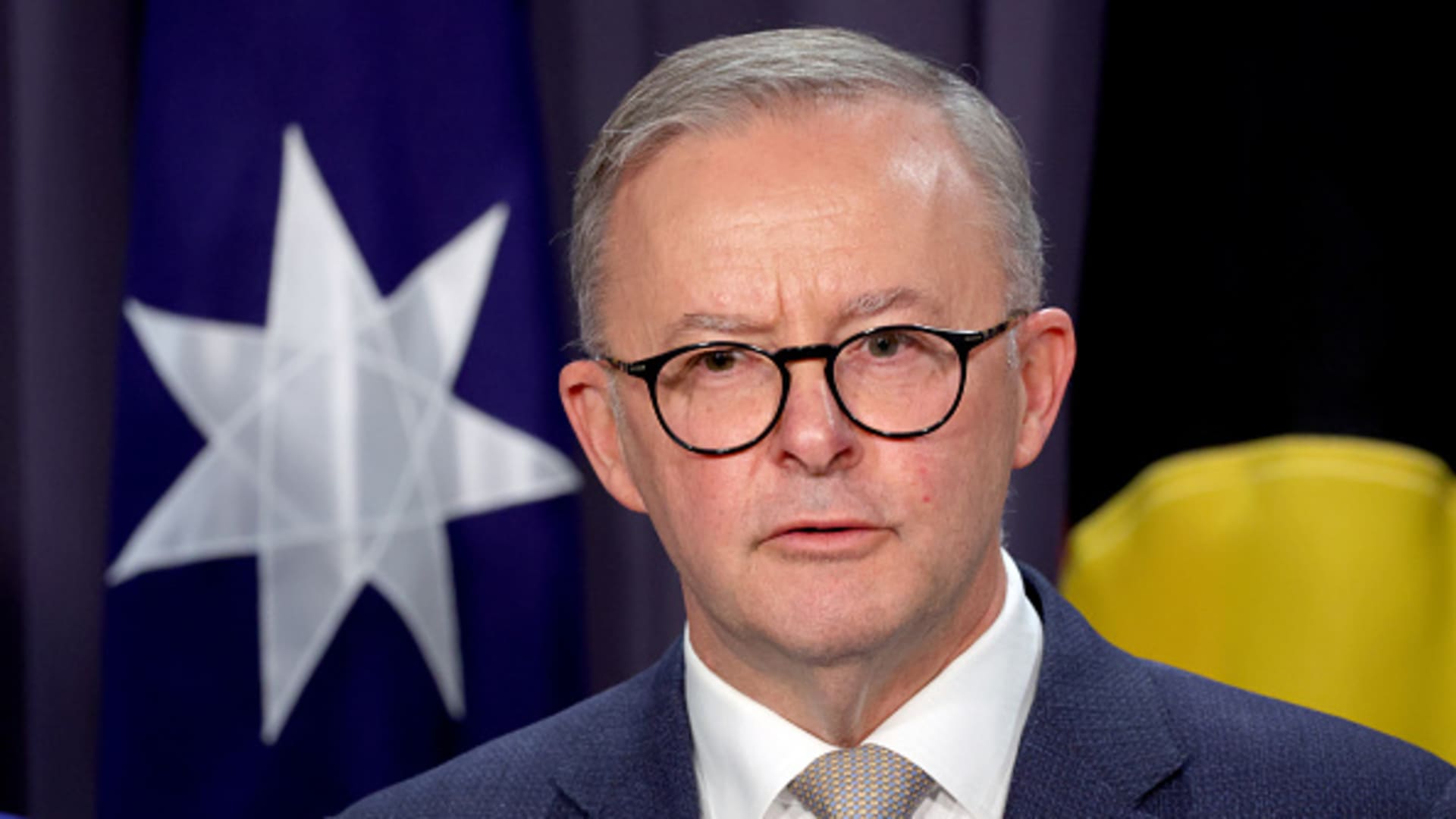
Australian Prime Minister Anthony Albanese speaks during a press conference at Parliament House on May 23, 2022 in Australia.
David Gray | Getty Images News | Getty Images
Australian businesses and their investors globally will be keeping a close watch on the newly elected government’s climate change policies.
Analysts say the Labor government under Prime Minister Anthony Albanese may come under pressure to strike a new deal to stretch its emissions reduction targets.
Even though the Labor party won the federal election on the weekend, it has yet to claim 76 seats to form a majority government and counting continues. On Tuesday afternoon, Labor was still two seats short.
If Labor cannot form a majority government, it may have to negotiate with a rush of climate change-focused independent and minority candidates who have snatched up more seats than expected.
For now, Labor has promised to reduce emissions targets by 43% by 2030, based on 2005 figures.
“The one that will move, that markets want to watch, is around the environment, carbon tax and all that,” Richard Martin, managing director of IMA Asia, told “Street Signs Asia” on Monday.
Who climate policies will impact
Martin said businesses like coal miners and electricity generators would most likely be impacted by the government’s climate policies. Companies would need to stay alert to any policy changes by the Labor government, which unlike its predecessor which was soft on climate change, could step up on climate action.
But whether Labor needs to negotiate or not, Martin’s concern is whether currently proposed mechanisms to reach 2030 targets would even work.
“That’s just five years away and the mechanisms outlined by Labor are at the status of ‘a nice plan,'” he told CNBC.
All large emitters from power through industry to mining will have to accelerate plans for emissions reduction, and that has a cost to operations.
Richard Martin
Managing director, IMA Asia
“Central to the plan will be imposing tighter caps on big emitters while bringing to life a market for trading carbon credits that doesn’t exist.”
Martin pointed to the flailing effectiveness of Australia Carbon Credit Units awarded to eligible projects that result in a reduction of Greenhouse Gas (GHG) emissions.
The value of the units fell after the previous government under Scott Morrison said it would step back as the largest buyer of emissions in March.
Anthony Albanese, leader of the Labor Party, stands on stage with his partner Jodie Haydon, his son Nathan Albanese, and Penny Wong, Australia’s shadow foreign minister, during the party’s election night event in Australia, on May 21, 2022. Businesses in Australia and their investors globally will remain wary of how the new Australian Labor government rolls out its climate change policies amid concerns it will come under pressure to strike a new deal to stretch its emissions reduction targets, analysts say.
Brent Lewin | Bloomberg | Getty Images
“If Labor is genuine in committing to its 2030 carbon emissions cap, then Australia faces a dramatic acceleration over the next year in carbon regulation and trading framework development,” Martin said.
“All large emitters — from power through industry to mining — will have to accelerate plans for emissions reduction, and that has a cost to operations.”
There may be benefits from things such as new investment energy generation but “who gains from such spending isn’t the same as who must spend to lower emissions and that’s what investors need to focus on,” Martin said.
Labor, Greens and climate promises
As vote counting continued and Australia’s new leader Albanese took time out to attend the Quad security meeting in Tokyo, newly sworn in Treasurer Jim Chalmers reiterated to local media on Monday that the new government had no intentions of cutting new deals on emissions targets.
However, minority party, the Greens, may be on track for a record election outcome. With the possibility of six seats in parliament, they’ve said they would use their increased power to push the government on more climate change.
Either way, the Australian public has signaled through its election of a record number of climate change-focused candidates that it is keen on more climate action although it is unlikely the new government will budge on existing promises, Danielle Wood, CEO of think tank Grattan Institute told CNBC on Monday.
Political analyst and professor at the Australian National University’s Australian Studies Institute Mark Kenny agreed.
“Conventional wisdom held that voters would put climate concerns to one side if they felt green-policies might erode their buying power through higher electricity prices,” Kenny said.
Voters are worried about soaring costs but care also about climate and sustainability.
Mark Kenny
Australian Studies Institute, Australian National University
“Election 2022 disproved this thesis. Voters are worried about soaring costs but care also about climate and sustainability.”
And while the Labor government will likely hold its ground against independent candidates for now to keep its election promises, it may still shift down the track, Kenny adds.
“In time, Labor may find ways to exceed the target anyway – much as the Morrison government set its target at 26-28% by 2030 and then [boasted] constantly that it was on track to ‘meet and beat’ that benchmark,” he said.
Stability is key
Additionally, long-term stability in climate change will be crucial, Australian businesses say.
“When we make investments, we’re going to be operating these assets for 20 and 30 years. We know governments will come and go and will change and their priorities will change,” Australia’s largest LNG producer Woodside chief executive Meg O’Neill told CNBC on the eve of the election.
“What’s important for us is that fiscal and policy stability that gives us confidence that when we make an investment, that we’ll be able to get the return that we want.”
The stability of policy would be key, especially when surveys showed sluggishness among businesses in Australia to make a move on climate change policies.
The Deloitte 2022 CxO Sustainability Report released earlier this year showed that while concerns from businesses over climate change had risen, there was no urgency to act.
Executives are “not yet convinced on the link between climate action and the core drivers of value creation – long-term revenue, margin, and asset values,” Will Symons, Deloitte’s Asia-Pacific climate and sustainability leader said.